Selecting Trees: Surviving in Hell(Strips)!

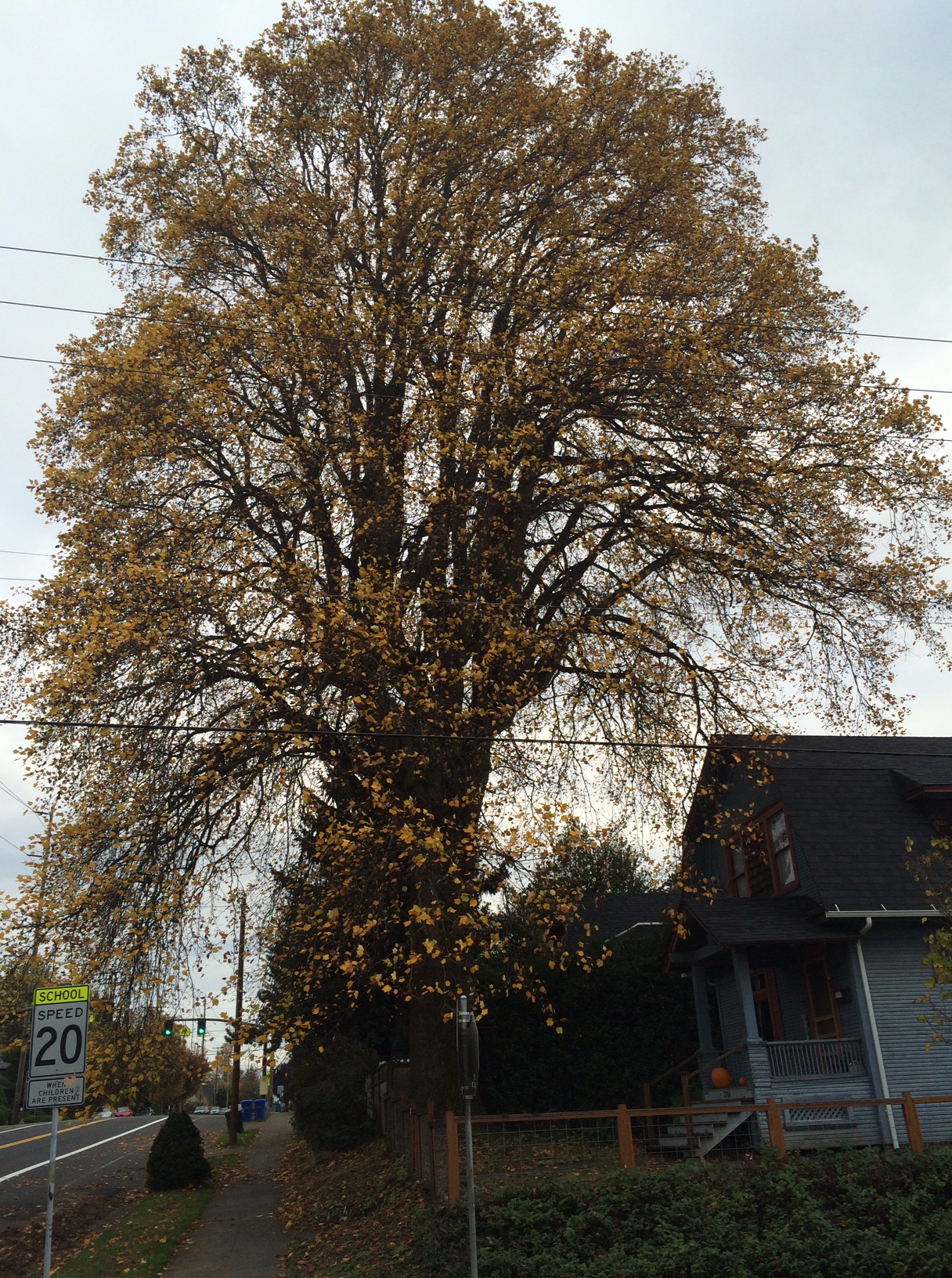
This Liriodendron tulipifera, a heritage tree in my neighborhood, has a canopy over 90' across. It is a beautiful and dominating tree dropping tons of drain clogging leaves and negating any need for actual street trees in the vicinity.

This Liriodendron tulipifera, a heritage tree in my neighborhood, has a canopy 90′ across. It is a beautiful and dominating tree dropping tons of drain clogging leaves and negating any need for actual street trees in the vicinity.  Little can grow in the dry shade beneath it.

I’m a horticulturist, a person trained and practiced in the ‘art and science of growing plants’…a classification to which trees belong. I’m not a ‘tree expert’ though I like to think I’ve learned a few things having spent most of my last 35+ years out working in the landscape, planting, caring for, diagnosing and designing, the bulk of which was maintenance, trouble shooting and tweaking landscapes so that they work ‘better’. Trees were always part of it…so I have opinions.

            [One of the lessons most of us learn on our journey to adulthood is to avoid the topics of religion and politics in casual conversation. These can be very divisive. In Portland the topic of trees can also elicit strong feelings amongst their advocates. The City of Portland has worked toward the protection of its trees. Here we have, in many cases, codified the planting, pruning and removal of trees in an attempt to stop the most egregious offenses and to expand the urban tree canopy. The City, through its Forestry Division, also works to help educate a public that too often has little to no connection to the green growing world. It is a huge task especially when so many other public institutions, like public schools, play almost no role. I spent the biggest part of my professional work life in Portland Parks and Recreation and I know that most Park’s staff have a passion for the work as well, even after years of working in a very political atmosphere with inadequate support. It would wear on anybody. So when I criticize aspects of the City’s tree program I want to be very clear that I am not criticizing the people or their intent.]

Portland loves its trees, except for the malcontents who view each leaf that falls on their property as an affront not to be tolerated, oh, and those developers looking to build and cash in on ever square foot of space that they can appropriate. Yes, these people are out there, just as are there opposite. Continue reading
Choosing Trees for Larger Public Landscapes (and your yard!)

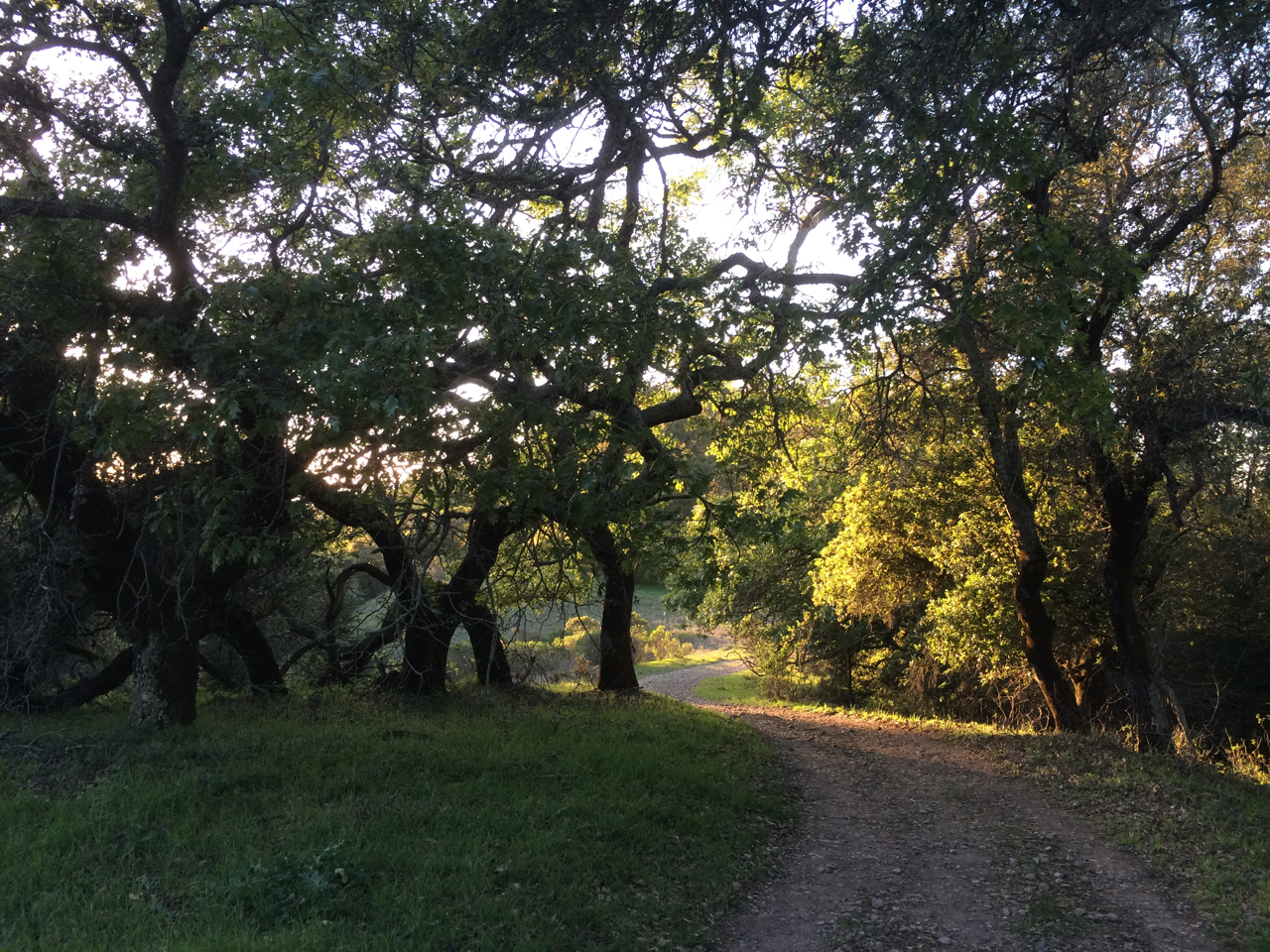
Still one of my favorite Oak photos. This one take in the late afternoon beneath a canopy of Interior Live Oak (I think) at Shiloh Ranch Park, last March.

Still one of my favorite Oak photos. This one take in the late afternoon beneath a canopy of Interior Live Oak (I think) at Shiloh Ranch RegionalPark, near Windsor, CA, last March.

A friend recently asked me if I had some favorite trees that I would recommend for planting on school landscapes, that would be like asking if I had favorite park trees, no I don’t…and I don’t have a list of proven performers either. A planting site being located at a school, only tells me something about the uses/abuses one can likely expect on a site, and nothing more. When we choose plants we need to be paying attention to a lot more than that. Many people are intimidated when it comes to choosing trees, there are so many and potentially, they live so long, growing from year to year…all of this tends to magnify the ‘weight’ of our decision.  People often look for short cuts because there are so many things to keep in mind when choosing. There are two major questions that need consideration first, the site conditions and design, what will the tree have to put up with and what do you expect? Continue reading

Tri-Met’s Orange Line Landscapes: Bybee Stop to Oak Grove

Part 2 of the Orange Line series

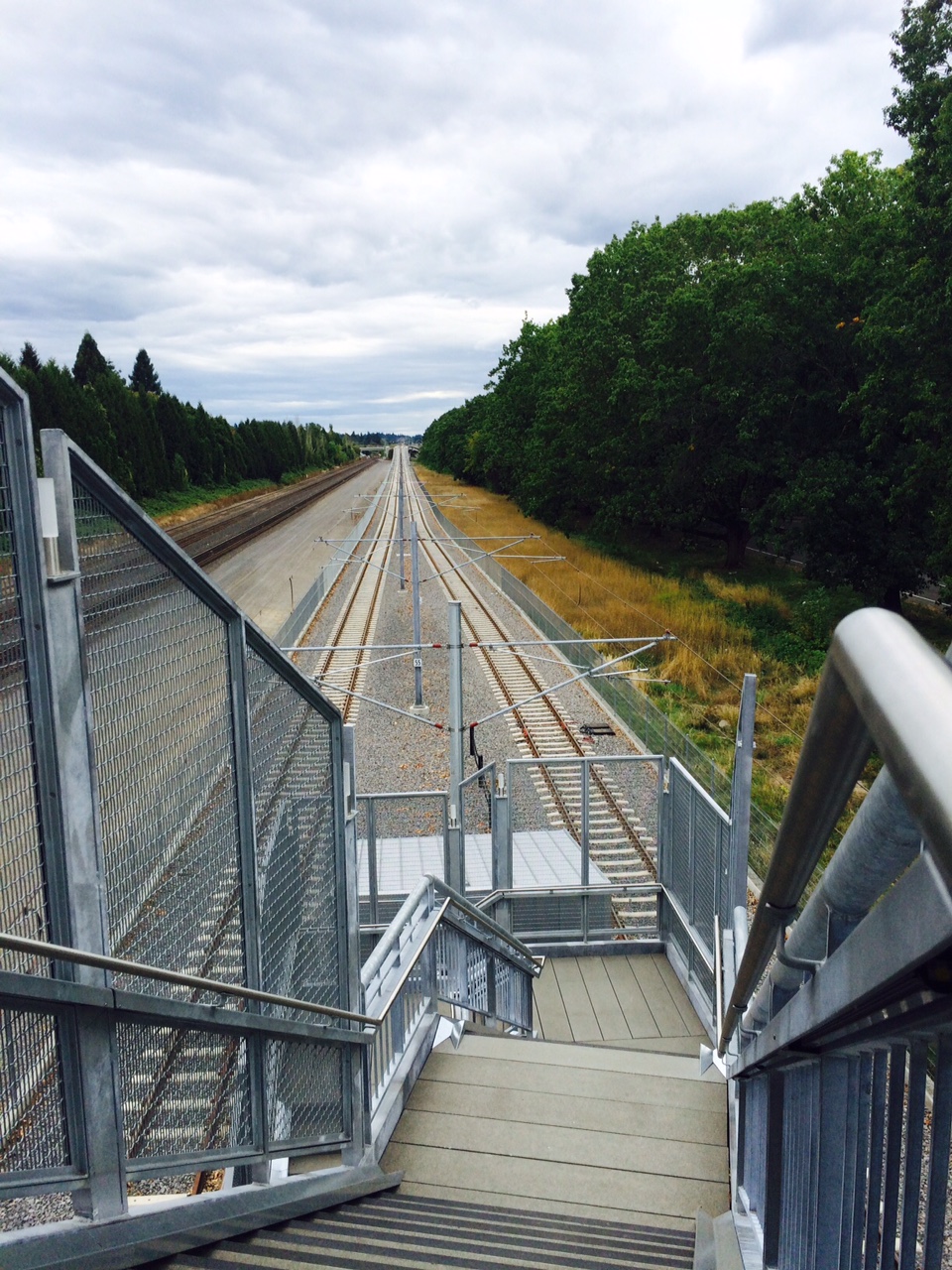
Looking south from the top of the stairs at the Bybee Stop. This is pretty much the same view as looking north with respect to the landscape.

Looking south from the top of the stairs at the Bybee Stop. This is pretty much the same view as looking north with respect to the landscape.  BNSF’s tracks lie to the left, the east.  The railroads have their own ‘landscape’ maintenance standards set primarily for safety reasons.  Within so many feet of their tracks they have a zero tolerance for plant growth and use sterilants.  There is also a zone within which the will ‘brush back’ trees and shrubs to keep site lines open.  Metro will have its own standard.  The two side by side show their combined effect.  Also, typically railroads do not fence off their tracks making clear sight lines a more pressing safety concern.  Trimet has fenced off the tracks from casual pedestrian ‘conflicts’.  Fencelines are problematic for maintenance unless ‘dead zones’ are expanded to include both sides.

Heading south of the Harold St. overpass the Orange Line leaves the most urbanized portion of its route, or at least its most densely populated stretch.  Traveling south to the Bybee, the Tacoma/Sellwood and then the Milwaukie stops, the line run alongside the BNSF tracks and there is very little ‘landscaping’ of the corridor.  The railroads contract out maintenance of their thousands of miles of tracks. (For a brief look into their approach check this link.) Continue reading

Tri-Met’s Orange Line Landscapes: Clinton & SE 12th to Harold St.

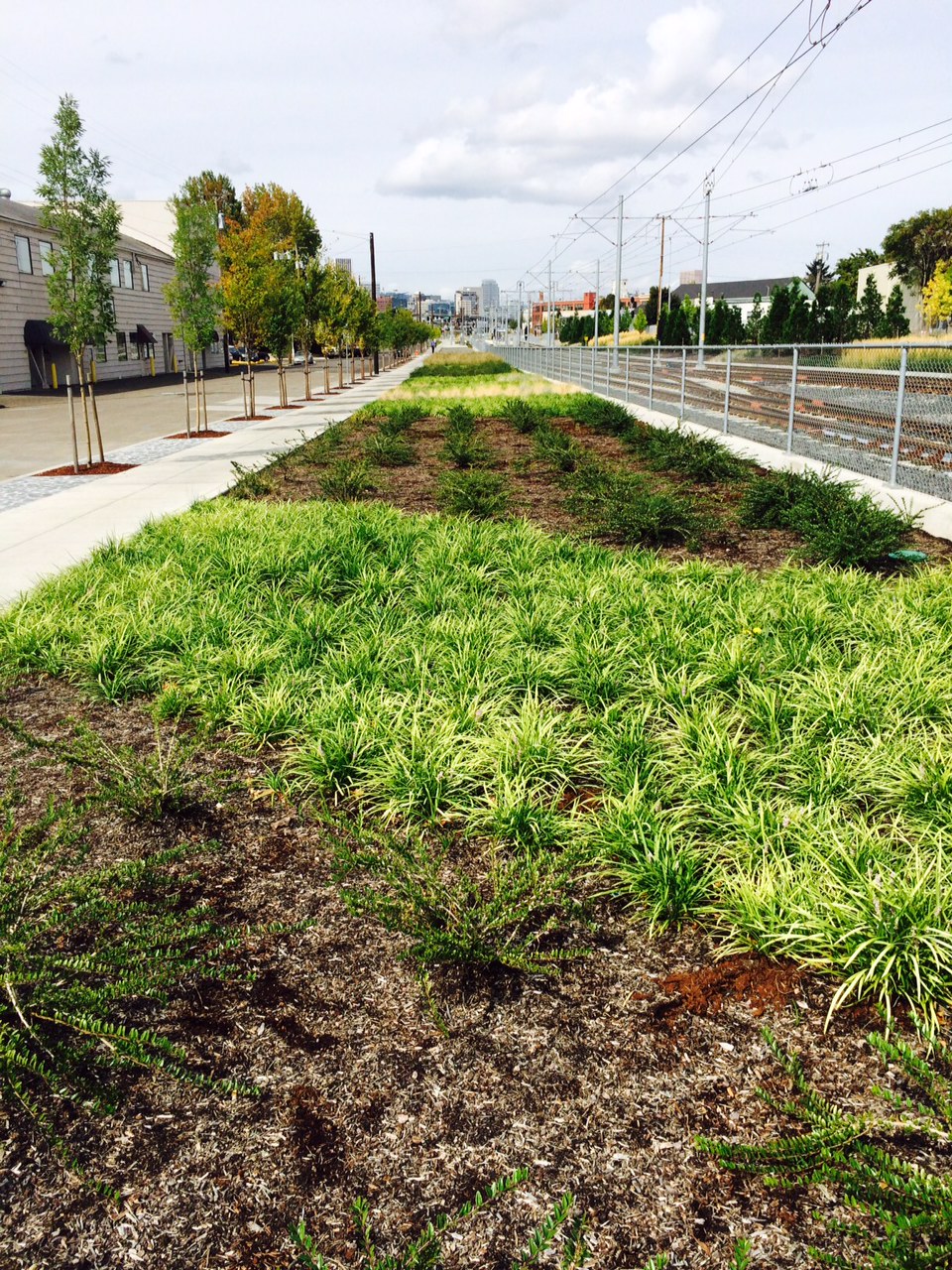
This shows the banded pattern common today in long mass plantings each swath a single species.

This shows the banded pattern common today in long mass plantings each swath a single species going for a kind of landscape scale ‘graphic’ pattern that is less concerned with ‘fit’.  This is near the Clinton/ SE 12th stop.

Size matters.  In horticulture it changes everything.  Things that are inconsequential, or maybe even enjoyable in the backyard garden, can quickly become daunting or onerous when the scale is ramped up.  Working at a commercial or institutional scale has to change your entire approach to the landscape.  In a small garden it is easier to accommodate mistakes, the conflicted combinations and those issues of horticultural ‘fit’ that we missed when we design or install.  Scale, however, rubs our faces in it everyday, makes us pay with aching backs as unintended consequences play out across the thousands of sq.ft. and acres.  It becomes a matter of physical survival and undermines your professionalism.  You become perforce part laborer, part diagnostician, designer, plantsman and critic….Out of necessity you sharpen your critical thinking skills and the last thing you ever wanted, your sales skills, as you work to sell your ideas to management who are absurdly ignorant of the problems you face everyday in the field.  And, then, eventually, you retire, but you don’t turn it off…you can’t.

Which brings me to the MAX Orange Line and its landscapes.  When I did horticultural design review for large capital Parks projects, it often felt like a dueling match.  I would pour over the design, whatever the stage it was in, match that with my particular knowledge of site conditions and my maintenance experience within Parks.  I would state my concerns on paper and in meetings with the Project Managers and Architects.  I was stubborn and consistently found myself up against a process that undervalued horticulture and my input.  Good horticultural practice was regularly placed in a losing position opposite not just that of the Landscape Architects but of a very political process that tried to give the public what it wanted as long as it fit within the Architect’s vision.  Horticulture always came out a poor third, even though good horticulture always saves money in the mid and long runs.  It was exasperating.  The public, by and large is ignorant of horticultural practice and no effort is made to educate them at any level. Continue reading

Political Paralysis, Direct Democracy and Personal Action: If the People Lead the Leaders will Follow

This is off topic, so If you’re looking for a horticultural twist here, there isn’t one.  Those of you who don’t know me should understand that my first degree was in Sociology, that I had intended a career in urban planning.  Things happened.  The fit was wrong.  But, the function of our social institutions, like our political system, has always fascinated and exasperated me.  I am not a man of faith as a rule and I expect those above me to demonstrate their competence and hearts in their work.  Words are too often used as a smoke screen.  I think we are way beyond the point where words can substitute for action.  So, here we go.

What’s on my mind? Lots lately. The growing crisis in affordable housing here. The yawning chasm between the super wealthy and the rest of us and their spending of money to buy legislation and Congress, climate change which apparently has been banned from some states…the solution should be so simple….
The letter below is what I’ve been thinking of most recently, a letter to Americans of all political affiliations and stripes. The future is upon us friends. We have not been invited to the party!!!

Letter to America

I am a bit obsessive in the way that I look at the world. I can’t let it go though I’m regularly told that I would be happier if I did. Global warming, the looming Cascadian Subduction Zone Quake, the yawning chasm between the super wealthy and the rest of us, the violence and war that has become common place, a growing human population that is putting every resource under increasing pressure from arable land, to fresh water, building materials and petroleum to wildlife habitat and the wild places that can replenish our spirits and restore us; Congress and governments at every level that seem incapable of ‘correcting’ anything, mired in juvenile squabbles, the mind numbing loss of species worldwide and in our own country that we seem resigned to, oh well, what can be done? There is a blasé sense of resignation that takes the place of a meaningful public dialogue…that and finger pointing. And our leaders seem okay with it. Continue reading

Revisiting Holgate Overpass: A Mistake Repeated

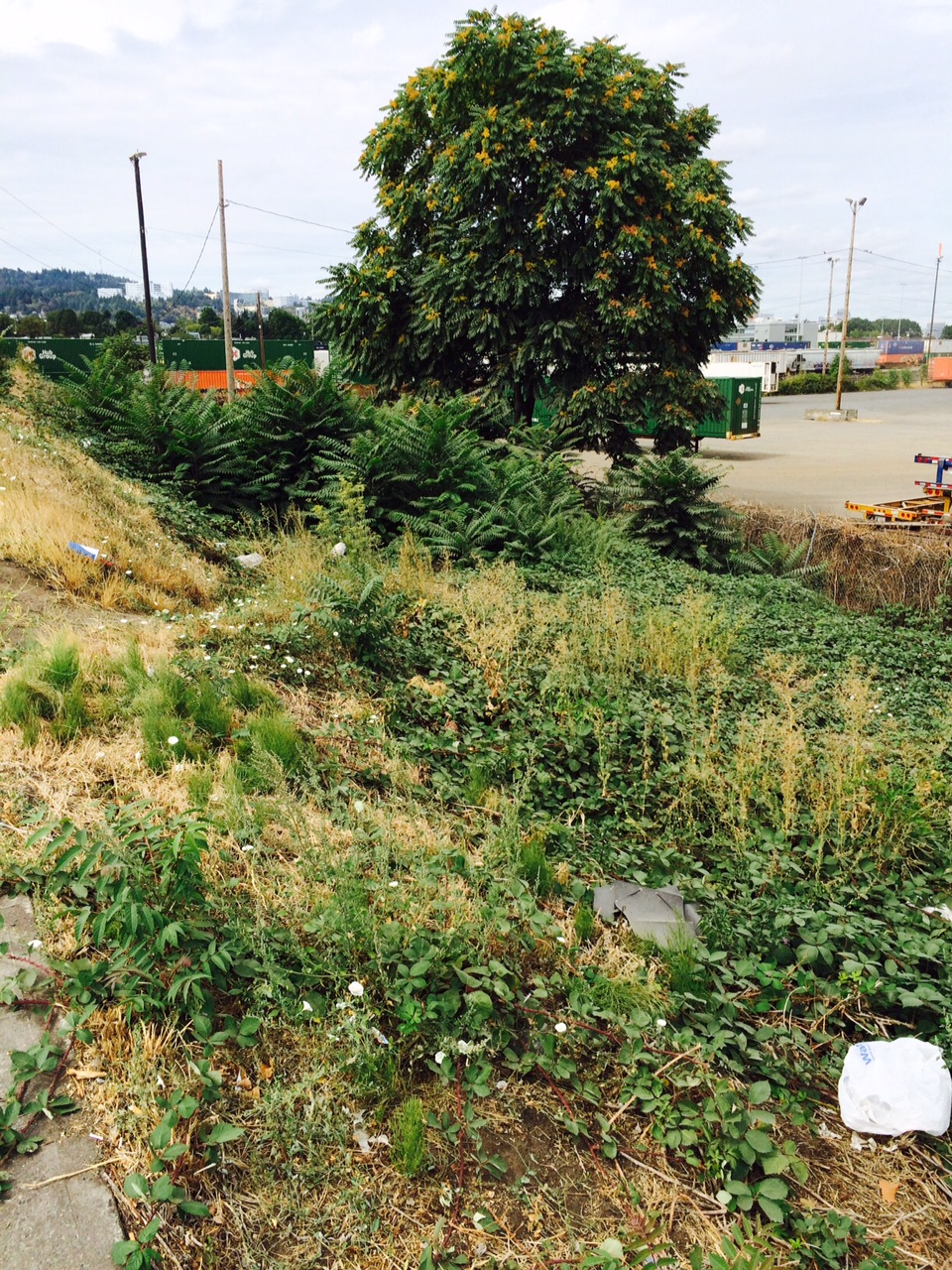
Holgate Overpass - the northeast approach. This was taken Aug. 28 of the landscape cut down in April showing regrowth in a hot drought year.

Holgate Overpass – the northeast approach. This was taken Aug. 28 of the landscape cut down in April showing regrowth in a hot drought year.

Holgate Overpass Update:

It finally rained this last weekend!  Somewhere around .3″.  Woohoo!  It will be the most rain that we’ve received since March.  It’s been dry!  In April the City cut down the ‘weedscape’ on the northeast approach of the Holgate Overpass.  It’s rained very little since and we’ve had record warm temperatures all summer.  No one has come back to spray, plant or do anything.  No one’s even picked up the trash.  If you compare the four ‘weedscapes’ on the two approaches they are very similar.  The NE, by volume has had the most regrowth.  This is for two different reasons: first, this site was cut earlier in the season when there was more moisture still in the soil to enable regrowth, and secondly, because the site is dominated by Blackberry and Tree of Heaven, both perennials, well established and of larger stature than the plants dominating the other approach landscapes. Continue reading

The Plaza Blocks – Practicing Horticulture at Lownsdale and Chapman Squares

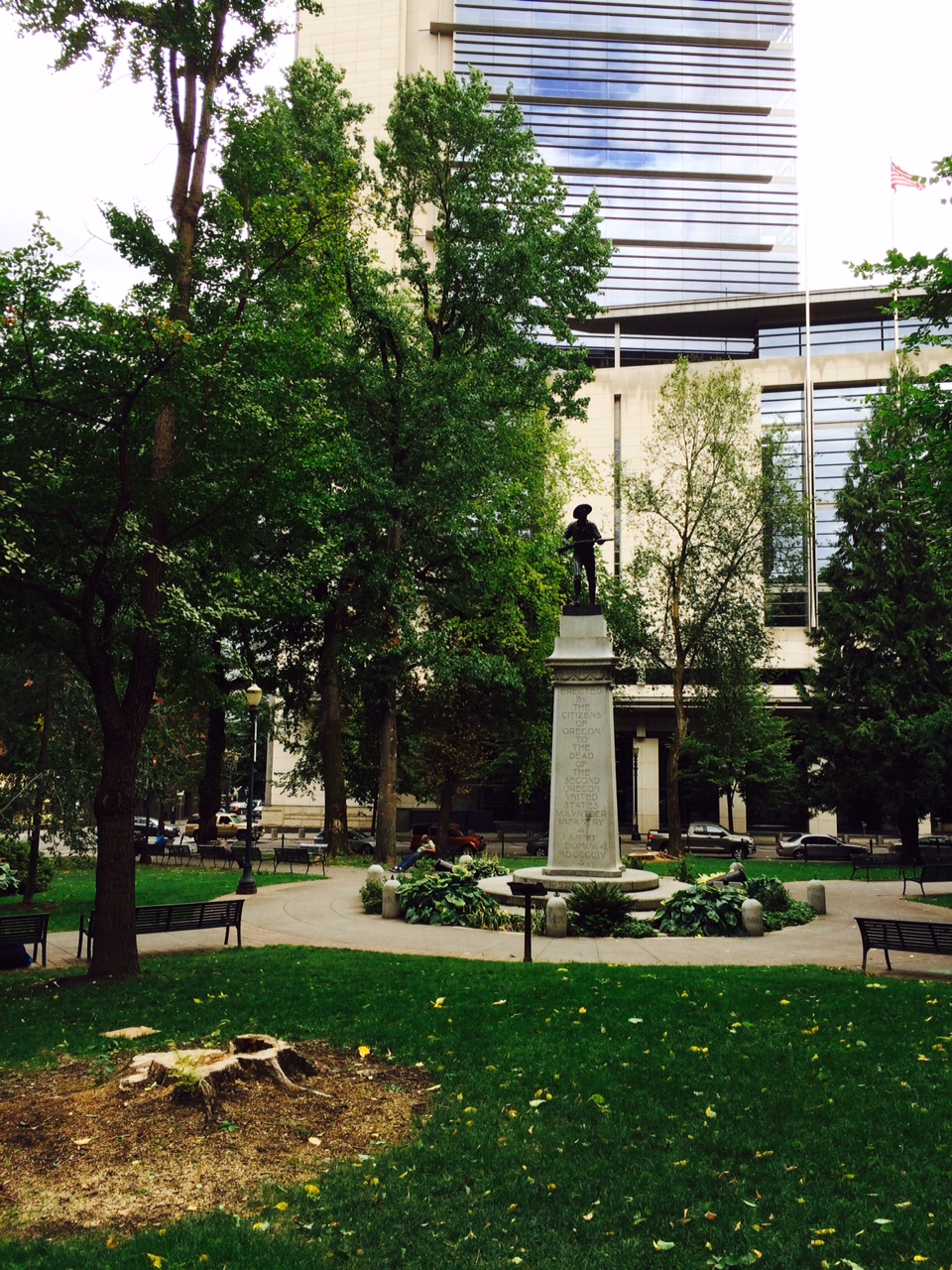
The Spanish American War Memorial the the Federal Courthouse behind. A recent Elm stump in the left foreground and another behind and right of the Memorial. Ringing the memorial is Pachysandra, Hosta and Clethra alnifolia. These take a lot of abuse from playing kids and posing tourists crossing back and forth.

The Spanish American War Memorial with the Federal Courthouse behind. A recent Elm stump in the left foreground and another behind and right of the Memorial, the further had a cavity for several years housing raccoons, but the tree began to split. Ringing the memorial is Pachysandra, Hosta and Clethra alnifolia ;Hummingbird’. These take a lot of abuse from playing kids and posing tourists crossing back and forth.

Chapman and Lownsdale Squares sit aside each other on SW Main with the ‘Elk Fountain’ (the anatomically incorrect Elk, or at least disproportionate)holding the neutral ground in between, the street splitting traffic that flows around it like a boulder in a stream. These are among the City’s oldest Parks. Laid out formally they are nearly mirror images of one another, sidewalks hugging the streets without parking strips to shield them, a crossing pattern of concrete marking them boldly with an ‘X’, lined with metal benches, a center axis and each with a restroom building on opposite sides…the north, on Lownsdale serving as the men’s restroom with the more machismo memorials to the Spanish American War and the south, on Chapman, the women’s with its sculptural tribute to pioneer families Bible in hand. This is a carry over from the early days when each Park served as a respite for the opposite sex where one could publically relax without being ‘bothered’. As were most western territorial towns, Portland’s population was dominated by men and women were often brought here as wives or as part of commercial ventures. Somewhere here was the site of the gallows, erected as need be, up until 1870 or so when the state banned public executions. More recently it has served as a respite for government workers, lawyers, officers and staff of our courts and jail, or visitors to either, taking their breaks, having lunch or getting a few minutes of air as they cross on their way to an appointment. Walking tours and school groups wander through pausing at the monuments. Others congregate here too, sometimes for rallys or protests within earshot of government offices. There are almost always a few members of Portland’s homeless community about taking a few moments or more in the shade of the large Elms and Gingkos. It was also the site of Portland’s own ‘Occupy’ movement in the Fall of ’11. Continue reading

Horticulture: Gardening in Portland Parks

The land occupied by Kenilworth Park and most of the Kenilworth neighborhood was part of the land claim owned by Clinton Kelly, a Methodist minister from Kentucky who settled in the area in 1848. In 1909 the Portland Park Board purchased 9 acres from Kelly with funds from a 1908 bond measure created specifically to acquire land for parks in Portland. In 1910, Park Superintendent Emanuel Mische created a design for the park that was inspired by the park's natural topography and vegetation. The design included a bandstand, tennis courts, sports field, wading pool and play area, sand courts, walkways, and vista points. Today, the basic layout of the park remains intact and is indicative of the strength and appeal of Mische's original design.

One of my favorite neighborhood parks is just a few blocks from my house.  The land occupied by Kenilworth Park and most of the Kenilworth neighborhood was part of the land claim owned by Clinton Kelly, a Methodist minister from Kentucky who settled in the area in 1848. In 1909 the Portland Park Board purchased 9 acres from Kelly with funds from a 1908 bond measure created specifically to acquire land for parks in Portland.
In 1910, Park Superintendent Emanuel Mische, a contemporary of the Olmsteads who conceived the overall plans for Portland’s Park system, created a design for the park that was inspired by the park’s natural topography and vegetation. The design included a bandstand, tennis courts, sports field, wading pool and play area, sand courts, walkways, and vista points. Today, the basic layout of the park remains intact and is indicative of the strength and appeal of Mische’s original design.

Gardening in Public – Full Frontal Gardening

Preface to the series. I worked 27 years for Portland Parks and Recreation as a Gardener later upgraded to Horticulturist, a change in title only. I loved my work and job. I can count as friends many of the people who still work there. I have the utmost respect for the many there who remain positively engaged in their work. It is a wonderful place to work and grow. I also found the organization a continuous source of aggravation. I don’t think this should be interpreted to be damning of the organization or its people. It simply speaks to the nature of the ‘beast’. Like any organization it takes considerable effort and focus to address one’s shortcomings. It is all too easy for any of us to become complacent, because it is difficult and there is little reward when what you seek others interpret as threatening to themselves. It is what it is. I would do nothing different except perhaps had more confidence earlier on to pursue what I thought was both creative and healthy for myself and Portland Parks. I don’t mind being taken to task. It hones my own practice and I try to rise above the personal and wish the same for others. Growth is difficult it does not mean that we should not pursue it. Continue reading

Weeds, Patterns and Pokeweed

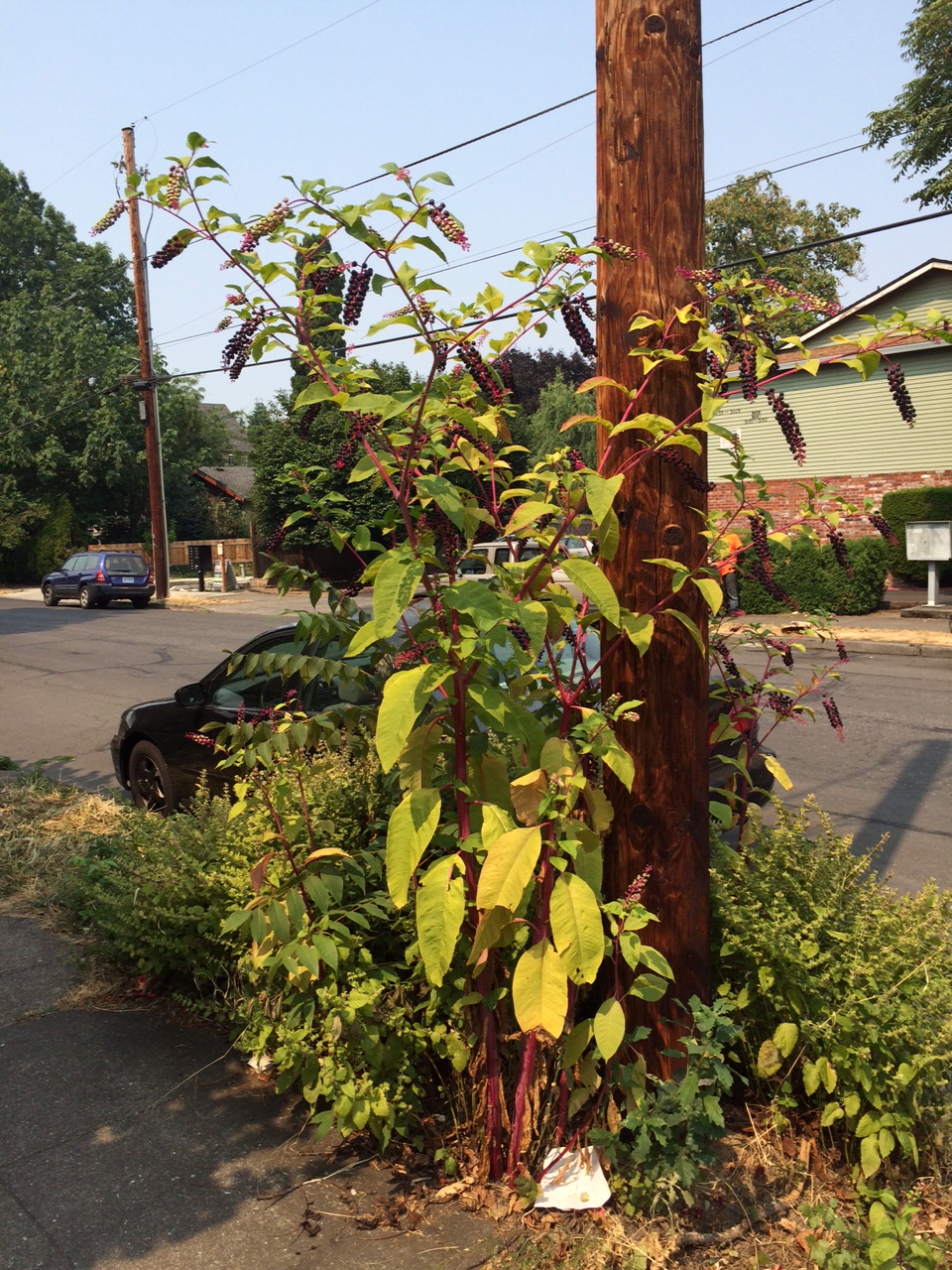
Pokeweed, Phytolucca americana in my neighborhood growing in a parking strip well over my 6'2

Pokeweed, Phytolucca americana in my neighborhood growing in a parking strip well over my 6’2″ height.

It’s true, the longer that you garden, the more you realize that you have to learn! And, that sum total of bits and factoids to learn in the garden universe, is itself changing over time! Gardening can be a ‘wild ride’ through a dynamic and evolving world. We can never have it all figured out!

Gardening in Parks has you building these relatively long term relationships with multiple sites. For sometimes slow learners like I can be, this broader scope can give you different insight into change in the garden. Different soils, different histories of use, different plantings trundling down the path of time in often times very different directions. On one site plants perform well with little conscious intervention on our part, while on others, they struggle or even die. As a home gardener you see this when you visit the gardens of others, but it’s a different relationship and you don’t really know what has gone into the development of someone else’s garden. Continue reading

Gardening in Public: The Duniway Park Experiment

Portland Parks: horticultural profiles series

I’m almost a little embarrassed to post this article….  Most of my earlier project were much smaller, more like bandaids.  This is the first Park I went through more systematically assessing, horticulturally, and trying to correct landscape ‘problems’ with entirely different plantings. We generally weren’t expected to do more than little fixes and bandaids.  Larger issues were considered beyond our scope and should be addressed by our Planning Division, with master plans and all of that.  The Bureau was, however, neither staffed nor funded to do master plans which is a laborious and time consuming process.  They were few and far between.  So, as I said, this was my first go at it, though I don’t claim to have created a master plan in the process.  My time was even more limited. Continue reading