
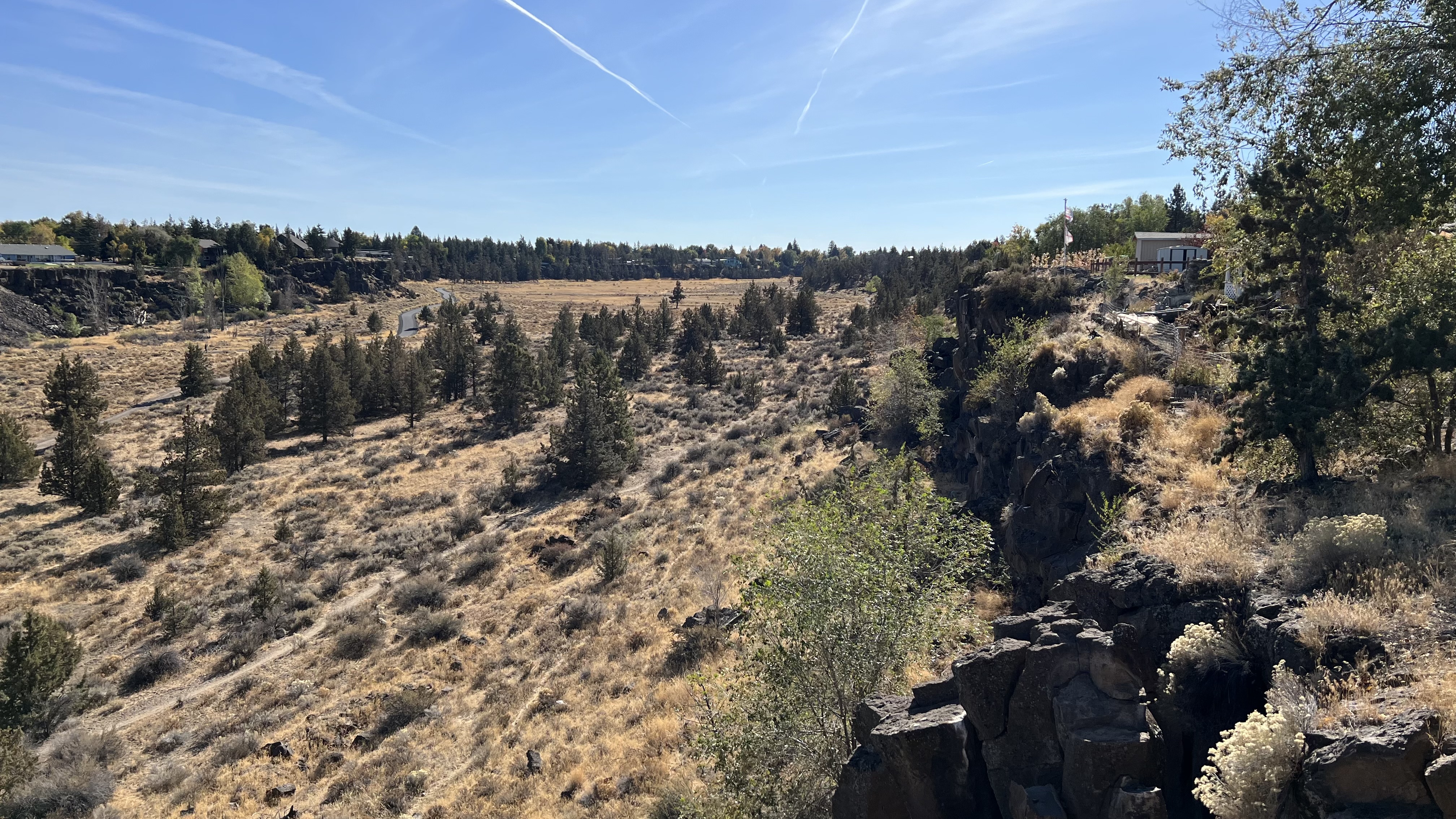
Redmond’s Dry Canyon looking south from the west rim on the Maple Street Bridge. The area in the immediate foreground burned this last summer.
If you garden, or maintain a landscape, you come to understand that not all weeds are the same. Each will have its own ‘strengths’, or perhaps you might call it ‘virulence’. Any particular weed, just like any other plant, will respond ‘positively’ to supportive growing conditions, conditions which often closely align with those which exist in its place of origin. Plant explorers and nursery growers are always looking for ‘new’ plants for landscape use. in a way, they have to walk a fine line. They must find plants, that with reasonable effort on the part of the gardener, can thrive across a range of conditions, unless they are looking for specialty plants, for narrow, niche, markets. The introduction of new plants must be somewhat measured, our enthusiasm tempered, because plants which are too adaptable, too vigorous, may possess the ability to escape our cultured gardens and find a place in the surrounding, uncultivated, landscape.
For Central Oregon, when we look beyond our regional natives, we must keep this in mind. Exotics from similar growing and climatic regions around the world offer both promise and threat. We want our plants to be successful, but not too. Sometimes through the process of trade, the movement of livestock and agricultural products, particularly aggressive species hitch a ride. A few weed seeds can be easy to miss. If they are aggressive enough and go unnoticed, a distinct possibility, it is likely that they wont be detected until a sizable local population asserts itself…and if no one is watching, that can be a fateful error. One group of plants, with many wonderful possibilities, also include species which can be exceedingly problematic here in Central Oregon, these are from regions sometimes referred to as Steppe. Continue reading
 We live today in a very divided and polarized world. You can take almost any characteristic used to define a group of people today and it is now being used to separate and divide. We do this sometimes out of pride, others, out of fear and desperation. We thus define our individuality, or our ‘people’, in a process of reduction, eliminating variation and possibility. This is who I am. This is my world, the world that matters. When we do this our world shrinks. That outside of it, becomes a threat and ‘threats’ proliferate. The causes of our problems are commonly reduced to ‘them’. Most of the divisions are, however inconsequential. Having been pried open we find ourselves separated by seemingly giant rifts, animosities greatly exaggerating the actual differences. Too many ‘leaders’, in bids to gain power themselves and cement their own advantage, beat the drums of division, gaining followers, customers and believers to their cause…which is often something very different than what they may publicly say. A world built on such differences is a precarious one, as groups strive for security by focusing on the differences rather than on the infinitely more common shared links which join us. This country was, in many ways, built on such differences.
  GardenRiots