
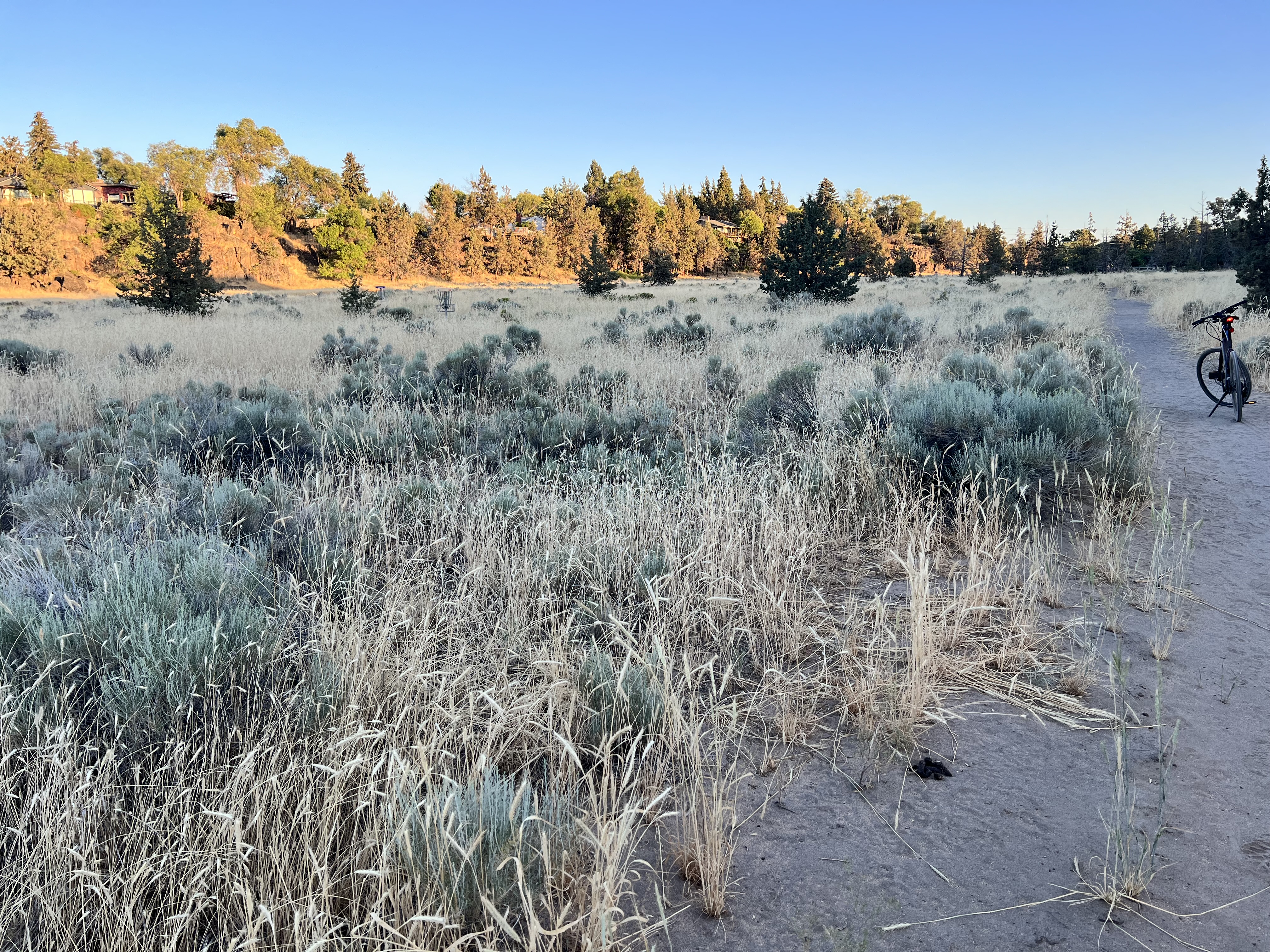
The bottom land in Redmond’s Dry Canyon was used for decades as low quality pasture, the native community pretty much obliterated. Those areas with surface rock are more likely to retain more of the original plant community, although Cheatgrass has invaded much of those areas as well. The is looking southerly over one of the larger ‘pasture’ areas near the disc golf course. There is very little Cheatgrass through this section south of West Rim Park. It includes a few native seral species which typically occupy disturbed sites as a site transitions, including Gray Rabbitbrush you see here. Found in this area too is Secale cereale, Annual Rye, a non-native, which appears to have been planted along more formal paths to limit Cheatgrass spread(?). Junipers are moving in. Sagebrush hasn’t yet.
It is commonly said that a weed is a plant out of place…and of course ‘we’ are the one’s who decide this. Some will try to argue that there are no weeds, that all plants belong and if we only left weeds alone landscapes would reach a balance on their own. If one’s time frame is long enough this may be the case, though this will take considerably longer than one of our lifetimes, and then there is our inability to actually leave landscapes on their own, or to at least consciously moderate our disturbance of them. Weeds are plants. They are not a separate classification of plants. They are plants removed from their places of origin and released into another where they have competitive advantages. Most people still simply tend to refer to plants they don’t like or want as weeds. These positions are at odds with one another. This leads to confusion and a lack of clarity, undermining any urgency to take action.
Weeds have become ‘personal’, their status a matter of ‘opinion’….A weed is a weed only if “I” agree that it is, or perhaps some ‘expert’, such as when agricultural scientist identify them as an economic threat to farms and label them as ‘noxious’. Without agreement and urgency there is a tendency to do nothing about them. Plants in general are attributed little intrinsic value. For many people they are just there. Native plants we vaguely understand as belonging to a place, but most people would be hard pressed to identify and name many at all. Quite different species are often lumped together, their relationships unnoticed. Natives are reduced to being ‘background’, their status reduced to decoration, attractive or not, a ‘space’ filler, perhaps a hinderance to what we would chose to do with a place.
Native plants and the communities they grow in, their relationships and roles, have become lost in this, of little interest. The idea of plants and their communities belonging to a place is a foreign concept. Most people generally give all of this little consideration. A place is simply an opportunity, one we can transform into anything we might want. Plants are incidental and weeds are too often reduced to a ‘who cares’ status. Undeveloped places are ‘raw’, with little inherent value beyond the space they offer us, unless it possesses resources convertible into something we do value. Value is something we attribute to an object. Weeds are simple annoyances that spoil our plans. If we have no plan…well then, who really cares? They attract little attention beyond that. It comes down to usefulness, utility. Everything is evaluated based upon how it serves us. Directly. Right now. But this is fundamentally wrong in the world of plants. They do possess an inherent value as living organisms serving particular roles associated with their place and community, whether we recognize them or not.
So let’s begin again, weeds instead are a product of disturbance, of the disruption of plant communities, their relationships broken, freed from their place of origin, released upon the world at large. They are human creations, not intended, but a consequence of our indifference to place. Weediness can also be thought of as a quality which goes to a plant’s role in a local community, its landscape. A weed then, is a plant that does not belong, nor does it fulfill an established role within a plant community. It may displace members of an established community which developed over time, often over almost countless generations, into a functioning, sustainable system…and by ‘sustainability’ I’m referring to such a system’s capacity to continue on without human intervention and/or the addition of resources from outside of the local area. We don’t ‘decide’ which are the weeds, rather we learn to recognize those plants that don’t ‘belong’ in a place.
Weeds rarely occur singularly. They arrive in what can be described as an assault, many at once and, once having arrived, spread from the infected center. Weeds themselves are symptoms of disruption and can be a disruptive force in themselves. Whether a landscape is intact or ‘broken’, weeds are those plants which possess the capacity to carve out a place for themselves. They can tip the balance, rearrange the relationships between members, in such a way that the functional whole, the ‘community’, is lost. They introduce, or add, an element of ‘chaos’. They don’t ‘belong’ in the sense that their presence was not ‘negotiated’ over time, through a process of accommodation. Plants ‘adjust’ to one another at a rate which can be characterized as a measured introduction, a testing of ‘fit’. Fitness is not about being the biggest, strongest or most aggressive, its about the ‘fit’, how well a plant or species fulfills a role within a functioning community. Community members are role players within a dynamic system, they do not dominate or crowd out other members. In a sense plants negotiate their relationships with one another. In established communities these relationships work in support of the community. Change an element and the community responds. Change too many, disturb the site, and the entire community may be put at risk, members lost and relationships forever changed. Under such circumstances, weeds act as spoilers and may be unchecked by remaining community members. Some would describe this by invoking the concept of contingency. Provoked far enough changes push the community in an entirely different direction. What follows is contingent upon what preceded it and the further ahead you look it quickly becomes impossible to predict what will happen next. Contingency.
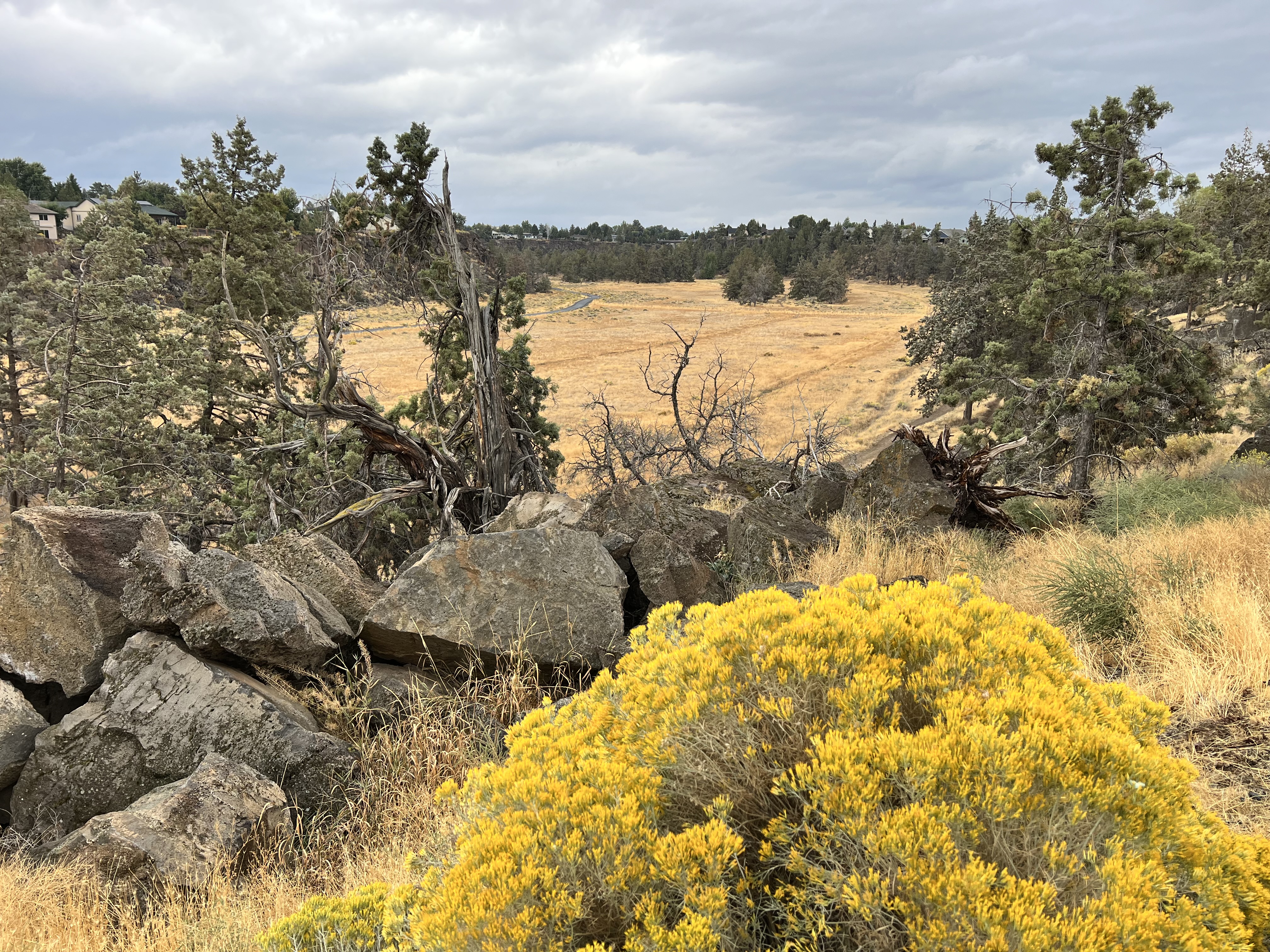
Looking out over the Canyon from the west rim over a Gray Rabbitbrush. When you see such uniform growth in the bottom you know it is a disturbed landscape, simplistic, dominated by a few weedy species. The Junipers are growing where the rock is, on the rim, its slopes and the bottom where lava solidified high enough that the blown in soil doesn’t full cover it, or if it does, only thinly.
Simply introducing an alien plant does not make it a weed. Nor does merely disturbing a site. Without the availability of weed seed or material, disturbance will trigger the process of recolonization by seral species, those native pioneer species which are available which tend to move the community back to a more mature, balanced community. Weeds are foreign to this process and possess the vigor and adaptability to carve out a place in a site. Disturbances present a continuous challenge to the integrity of a landscape, an opportunity for weeds. Without disturbance, health is maintained and there are no weeds. Because we possess radical technologies, and live lives which are disconnected from place, we act as both an avenue for weeds to move beyond their established communities, while ‘preparing’ a place for invasion by physically disrupting landscapes and their communities. Often we create a state of perpetual disturbance….disturbance being that which is done to a place with an incomplete understanding and lack of respect for the inherent value and integrity of a place. It is an imposition of a very human preference, disconnected from a particular place. Disturbance happens outside of that which tends to keep a system or community in balance. Weeds are symptoms and agents of change which lie in wait for needed disturbance.
There is a ‘rightness’ that arises from the thousands, even millions of years, of natural selection that began long before our ‘dominance’ of the landscape, even before we became actors on the Earth scene. Landscapes functioned quite well before us. These intact landscapes, with their plant communities, do not ‘need’ us, but we are dependent upon them…are of them. When we act outside of this relationship we ‘disturb’ them. The components of a landscape, those living and mineral, its climate, geography, the solar energy that powers it, the water and nutrients which continuously cycle throughout it, all of these combine to support and ‘become’ a place. Ideally ‘we’ share an active, supportive, role in this process. All exist in relationship to one another as an entirety. A whole. These relationships exist and cycle within a limited range which both permit and empower them. Together they operate as a complex system of checks and balances, as local communities, always changing, but recognizable, if one were to examine them over long time periods which can exceed even the longest of members lifespans, by many times.
All animals, including us, consume to sustain themselves, to power our metabolisms, to grow our cells and tissues, which allow us to reproduce, with a degree of security, so that we might continue from one generation to the next, and thus sustain the relationships which allow ours and other species to continue within our local communities of life. We are collectively the places in which we live. Our species, however, are consummate tool makers and we have become a powerful force in reshaping our places. As our technologies have developed and our numbers increased, we have greatly increased our impact. We have stepped out of our historic and biological role and are transforming the landscape into an urbanized one, ‘stamping’ out patterns we have come to expect, to grow our food, provide ourselves with shelter and the resources to support our ‘lifestyle’ and supply our massive manufacturing sector which makes what we have come to demand, habits and things which are often far beyond what any of us need to lead healthy, fulfilling lives.
Our demands have become shaped by marketers and an ever expanding range of material possibilities, items and services. We want much that puts our relationship with each other and the natural world under great stress. We live within a contrived human economy which expects unending growth, a productive capacity which expects ever more from what is a limited resource, land, in its unique, limited varieties of place. Our economy and approach to the natural world is predicated on a fictive future built of its insistent beliefs. All things in the universe are limited. It is our insistence that the limited here and now is infinite which drives us and the resultant conflict. This is at the root of what I’m calling ‘disturbance’. Through society and its tools we’ve implemented a collective, competitive and consumptive, vision.
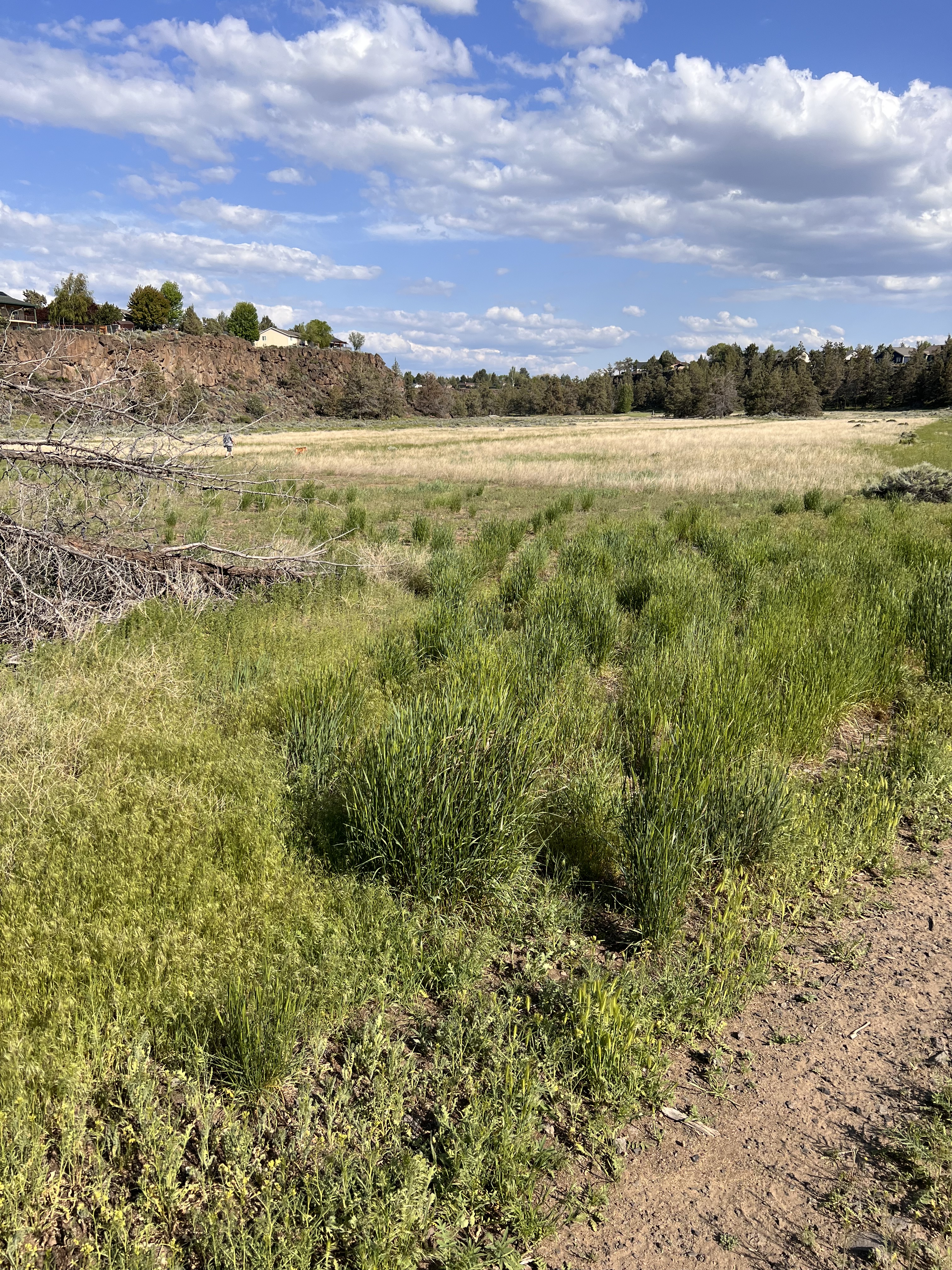
Here in the canyon bottom the soils were deep enough to support pasture grasses, the grade is very even through here. This area has burned in the relatively recent past. I’m told that a fire line was bulldozed here. Burned clean of pasture remnants and whatever seral species had established a foot hold, the light ‘buff’ colored area is essentially 100% weeds including several weedy mustards. Not even Rabbitbrush has begun to move back in. The green grass is Crested Wheatgrass which was seeded in after the fire. It’s non-native and is typically used to reclaim rangelands for grazing. It does help suppress Cheatgrass, but this isn’t range land….No other natives appear to have been planted. This pattern repeats in other areas as well.
Tools are amplifiers of our actions neither good nor bad in themselves. They multiply our capacity to effect our world, to build and change it in ways far beyond the capacity of any other member species. Instead of working to fulfill our needs within the bounds and limits of place, we have often been using tools to reshape place to meet our needs/wants with little or no regard for the other species and components of those historic communities. Tools have allowed us to effectively open a rift and take what we desire. This capacity has allowed us to break our relationship with place. Many of the limits are effectively gone. We transform place and gather to us all of the resources we demand. We ‘disturb’ the natural limits and flows of place. We are able to sustain this by taking more and more from places ever further away spreading our disturbance.
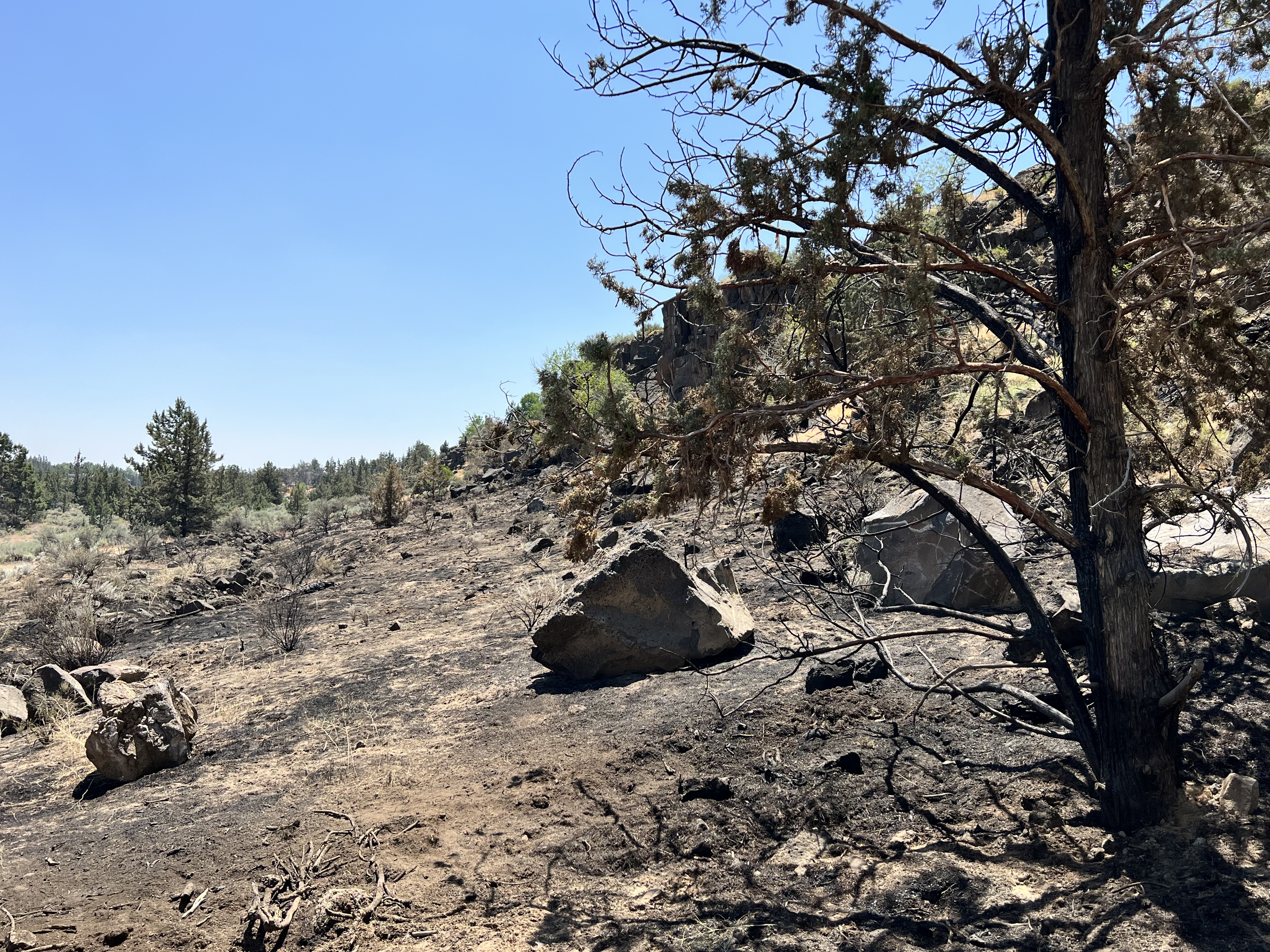
This area, maybe 5 acres, burned in July. It will be interesting to see what comes back and what the City may plant??? Fire kills Sagebrush and Juniper, while it seems to favor Cheatgrass. Rabbitbrush can survive a burn.
Our actions will always accrue ‘costs’. Resources are beingconsumed, landscapes compromised and forever altered. Reduced. Limited. Our consumption and existence comes with the sacrifice of other organisms, other species, entire communities as well as other people we see as outside our own human communities and kin. While our lives are dependent upon consumption to sustain our metabolism, our lives and reproduction, we are doing much more than just meeting our needs. Some economists refer to this as consuming ‘capital’, consuming that which once spent is gone forever, on which we depend. Ours utilizes an exaggerated interpretation of ‘profit’. We regularly ‘take’ from the ‘natural economy’ that which compromises its capacity to produce. Our abilities do not change the equation, we still live in place…but we have been doing so while ignoring its limits, its capacities. ‘Profit’, when it comes from deferring or pushing our costs on to others, is not really profit at all…it is ‘taking’. It leaves less for others and less for those who follow us.
We live within complex living systems, whether we acknowledge that or not. Our consumption must be limited. It must allow the living community to continue uncompromised. Nature allows the taking of profit, but only that amount beyond which the system requires to continue on. That which is true ‘surplus’. A healthy system, a healthy community, produces more than one which is compromised. Taking too much leads to decline. Reciprocity and gratitude are required. Take only what you need. Live within the limits of community. When we ignore this we push the relationships which sustain us beyond the system’s, and the community’s, capacities to sustain themselves. We deplete a resource in favor of short term ‘gains’. These losses are incremental and accumulative. Because of this it is ‘easy’ to see our own individual actions as inconsequential and we can excuse our behavior/disturbance, dismissing the losses/costs suffered by those ‘others’ around us. Disturbance is then that which moves the system beyond its ‘balance’ point into a state of declining health.
Weeds are a response to this imbalance. Disturbance is closely tied to scale and time. The actions of one may not unduly stress a system, but multiply that by the accumulative impact of all ‘actors’, and it becomes a significant ‘assault’. Any natural system will reach a breaking point and won’t be able to recover. Which actions? How many?
It would be difficult to make a proscriptive list. It is a question of which ‘threat’ and its scale to a particular place over time. Why time? If such events are ‘rare’ enough a system may be able to respond in a way which keeps it within recoverable margins. Every system, every landscape has the capacity to respond to change. These are not fixed and static. Time may not heal all wounds, but it may allow for recovery. As long as the change, threat, is limited, the system will respond and remain within its margins, in a state of dynamic balance. Fixity. Rigidity are a feature of humanly contrived systems, not nature. In fact it is often our imposition of such rigid patterns and expectations on the natural world which makes it so difficult for us to see our role in the problem.
When we consider our impacts, when we recognize a place’s value and understand our ‘debt’ to it, we are then more likely to behave ‘rightly’, to live within the limits of place. Because we value a place we anticipate the impact of our actions and reconsider them when consequences begin to indicate a problem. We don’t need ‘policing’ because we are doing it ourselves. We watch, listen and monitor. We keep the value and health of our place and community foremost in our minds. We become practitioners of the ‘cautionary principle’ which requires us to reject actions which are destructive, ‘First do no harm.” Right action is grounded in place. It is not abstract. When we buffer ourselves from the consequences of our actions, we distance ourselves from health and place and put everything at risk. Disturbance is that which we do ‘outside’ of the requirements of place. Society and civilization may require a degree of disturbance to continue on, but its impacts should be continuously evaluated. Long term costs vs. short term benefits.
We cannot long afford to act ‘wrongly’. By serving one’s self or one’s limited group, while sacrificing and putting others at risk. When we do this decline is assured and all will eventually suffer. Our actions, our disturbance, must be considered. Tradition, established schedules, common practice, personal liberties not in accordance with life and its necessary relationships, must themselves be questioned. They are not organic, that is, they are not a feature of the living world, but something we have adopted. They are social constructs, that preclude a deeper understanding of the natural world. ‘This is what we do, what we’ve always done,’ is not a valid argument for denying right action.
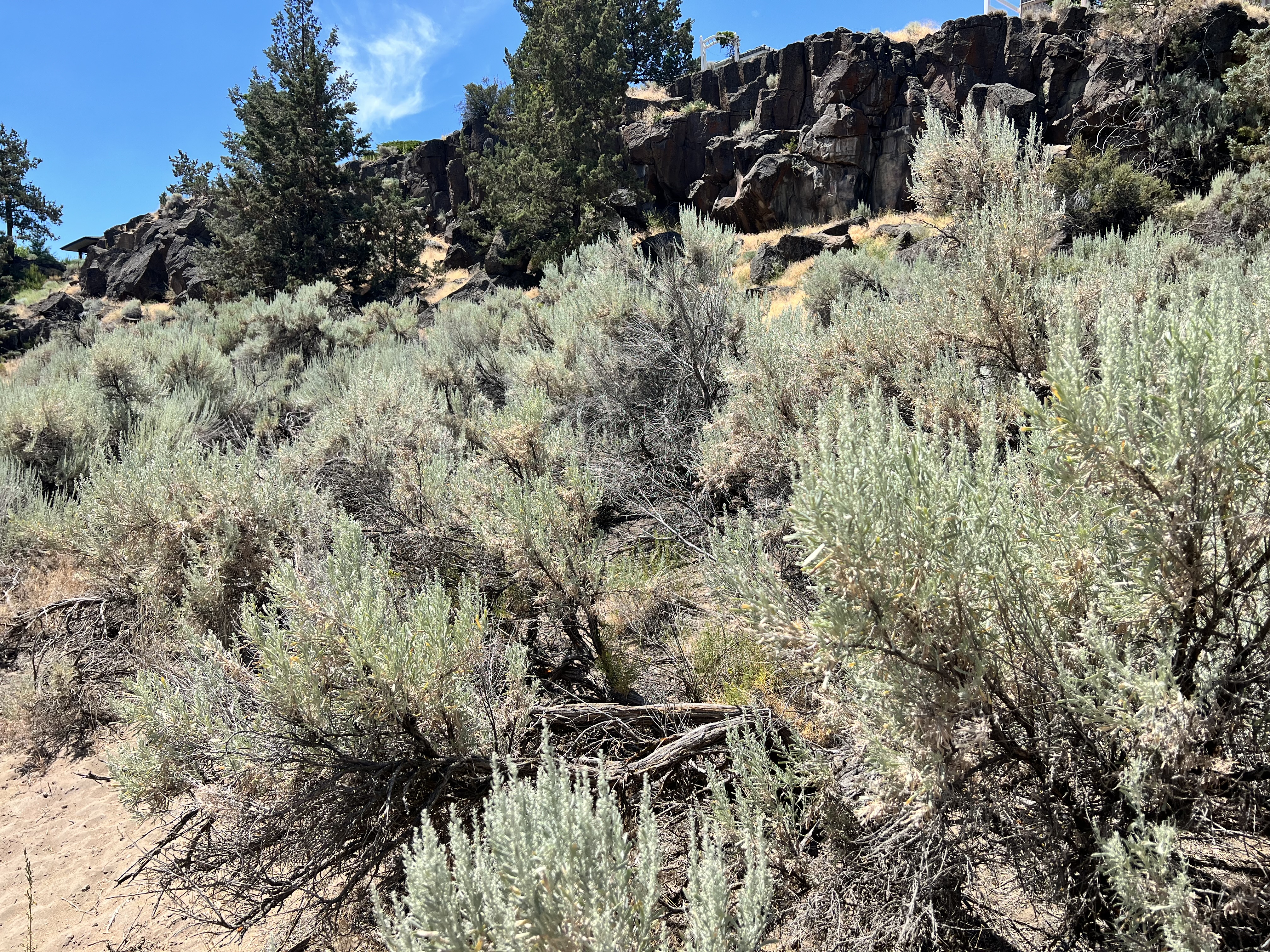
This is a rocky slope leading up toward the canyon wall. A few areas like this have been able to hang on to their Sagebrush. It probably wasn’t ever converted to pasture and has been able to avoid frequent fires which would eradicate it.
Before we acted this way, there were no weeds. We were relatively minor actors, we acted consistently with the conditions and needs of place, our ability to reshape our landscape was limited by our numbers, the requirements of our immediate lives and the tools at our disposal. We lived more locally out of necessity. Sure there was trade, but we remained more directly dependent on our place. Our concerns were more of our immediate survival. All of this tempered our actions. Was life ‘ideal’? Probably not, nor is it today. We possess the knowledge and technology today to change and live more in compliance, harmony, with place and the systems and communities which make them up. Today, landscapes, places, because they have been compromised, are much less stable. Relationships are weakened and the potential pool of weeds available to invade are many and widely established. We have ‘brought’ them with us in overlapping and continuing waves of immigration, trade and our wide ranging casual and perpetual movements. They spread as we continue recreating the conditions which favor them. Our designs, maintenance and uses of a place, support the continuing invasion. We regularly disturb our landscapes which are themselves simple contrivances.
We worsen conditions by dissolving the barriers which once confined and limited the movements of living organisms. Weeds have followed us ‘here’. We have become a highly mobile, placeless, species and the products we consume come from all around the world. Distance is dissolved. We have created a never ending wave of disturbance. Sadly, disturbance has become the norm wherever we live in any numbers and the economy, which supports our lives, provides a massive network of routes for the continuous flow of species around the world. This is not an inevitability. We have a choice. We could change our practices and the conditions that support weeds which surround us in our modified world today. We need not ‘fix’ everything, but we do need to stop doing those things which continue the disturbance. Weeds are ‘successful’ plants, the ones that have found a place within our wave of disturbance. We can make them less ‘successful’ by changing our role, our expectations and they way we have built our world. In short, initiate a healing process.
Plant communities are under attack around the world and species are being lost and with them the resilience and diversity of a healthy world, one place at a time, in a cascade of loss. Where one or two species previously may have moved and entered a particular landscape in a thousand years, the last several decades has brought with it the near dissolution of barriers to movement as we intentionally, and inadvertently, move thousands of species around the globe on a daily basis. Not every transplanted species will be a problem, many will in fact die in their new homes, but it is a numbers game, the most adaptable, the most vigorous, will find a way, given the opportunity.
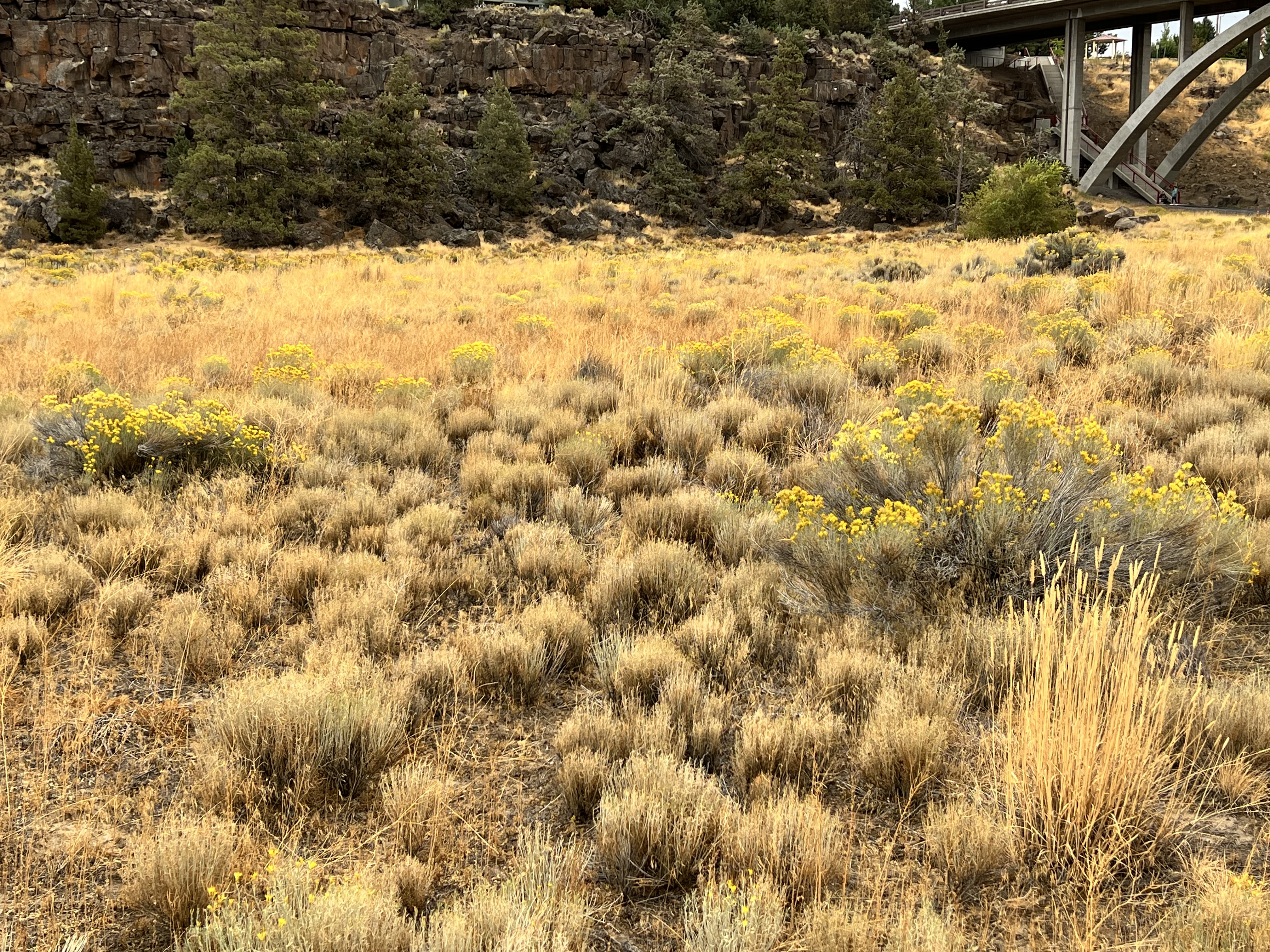
This section of bottomland, former pasture, probably burned not that long ago, has quite a colony of Rabbitbrush coming along, all it would appear of even age, suggesting a fire. This is just north of the Maple Bridge which is where the previous photo of the July burn occurred.
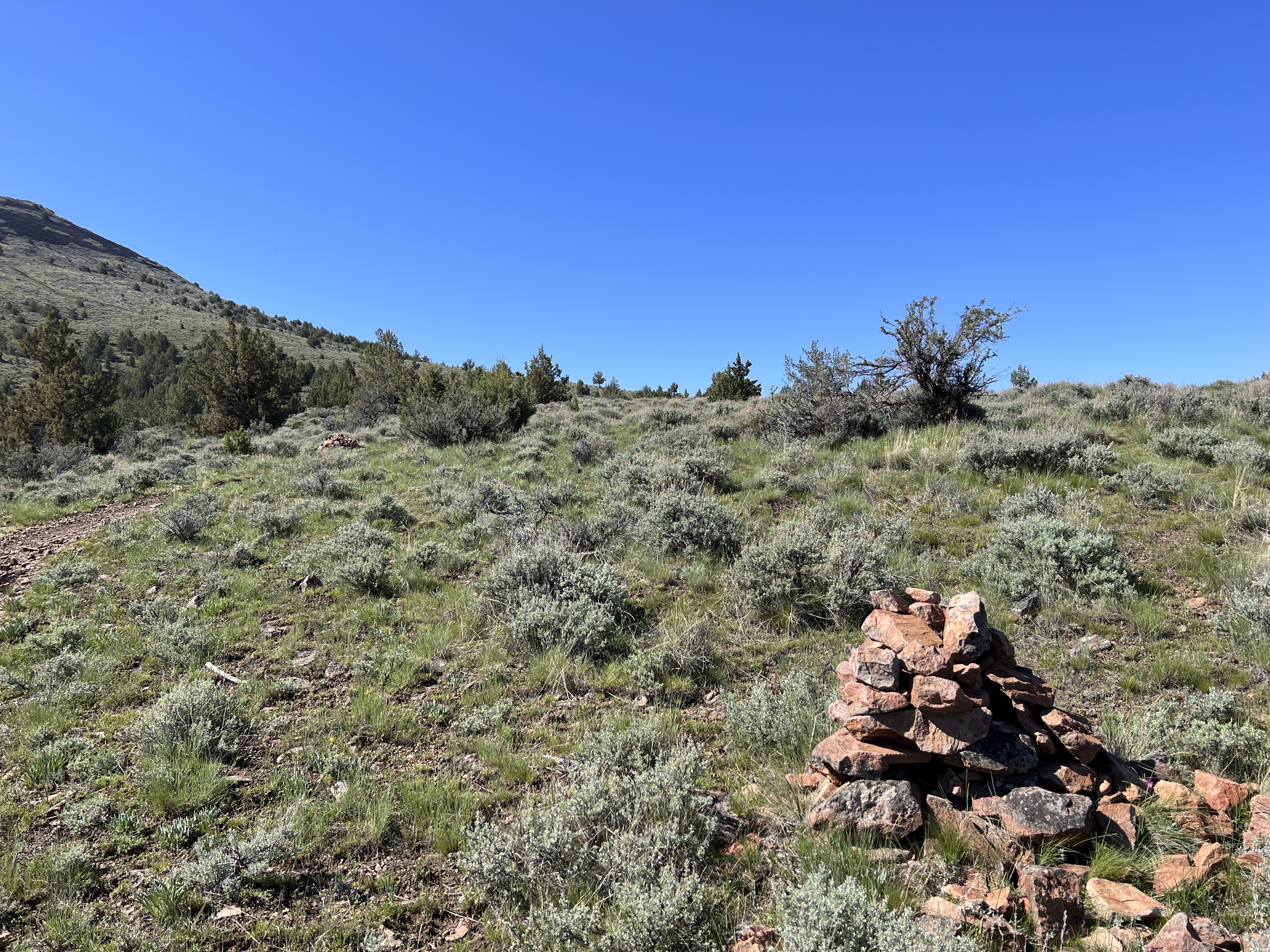
Taken on Gray Butte to Redmond’s north and east, the slopes here are as close to pristine as you will find near by. The ground layer is patchy containing many different flowering annuals and perennials. Cheatgrass is not established in many areas here. Other than the old abandoned McCoin Orchard low, on the north side of the butte, agriculture’s boot print is pretty light.
Weeds are not a separate category of plant. They have been selected from the several hundred thousand species. We create the conditions for weeds to develop. We can change this. We can take action to limit our disturbance and work to ‘heal’ that which we can. There really is no alternative. We need not have all of the answers. Complex systems possess a kind of integrity, a capacity to sustain themselves, such that as one begins to make positive, corrective, changes, the system itself can work in such a way that our action is not needed for every change. Health tends to support health. Reduce the threat to levels where a system can operate within its margins, and it can heal itself.
____________________________________________________________
Some weeds are problematic only in our yards and gardens where we continuously work to provide the modified conditions that our preferred plants demand to perform well. These weeds, if they do ‘escape’ generally can only infest like modified/improved/disturbed landscapes. Such weeds haven’t the capacity, the vigor and adaptability, to move into those places without such ‘supports’. Another class of weeds, having evolved in much the same conditions that fit our regional norm, however, may freely invade unirrigated sites, whether they are landscapes of those increasingly rare healthy, intact, native communities, or those which we’ve disturbed for other purposes, such as you find everywhere urban development, agriculture and traffic and utility corridors. Some of these can be extremely aggressive spreaders creating problems they were incapable of in the regions of their origination. There they existed in different relationships which worked to keep them in balance. Here, no such relationships exist.
The existence of a weed does not require our active participation, our recognition. Weeds exist outside of a healthy, intact, local, intact plant community. They come from ‘outside’ and, having the vigor and adaptability to flourish, find a place that meets their needs. Under historically stable conditions these kinds of introductions were extremely rare and, when they did occur, were in very low numbers. Introduction does not mean ‘success’ for the weed. Its seed or vegetative propagule must still ‘land’ in a suitable place under supportive conditions. The number of introductees then is important. This is where our participation in this process is so central. We follow patterns. Patterns of disruption. We move into a place, clear it and then develop it in repeating patterns, recreating very similar conditions and patterns across the landscape, from region to region, while at the same time introducing both desirable, intended new plants and those unintended tag-a-longs which have proven successful in our journey and occupation of one place after another. Successful weeds become fully established as plants creating new seed which can accumulate in the soil seed bank where they are able to germinate, grow and mature when conditions are supportive. Seeds can lay dormant for widely varying periods. Some of our ‘worst’ weeds have seeds that can lay dormant in the soil for decades. Re-disturb the soil, grade it, cultivate it, begin to irrigate it and the seed now at the proper depth in the soil, will germinate. The process is essentially the same whether it is selecting the best adapted weeds for a site or working to maintain a healthy, dynamic, balanced plant community.
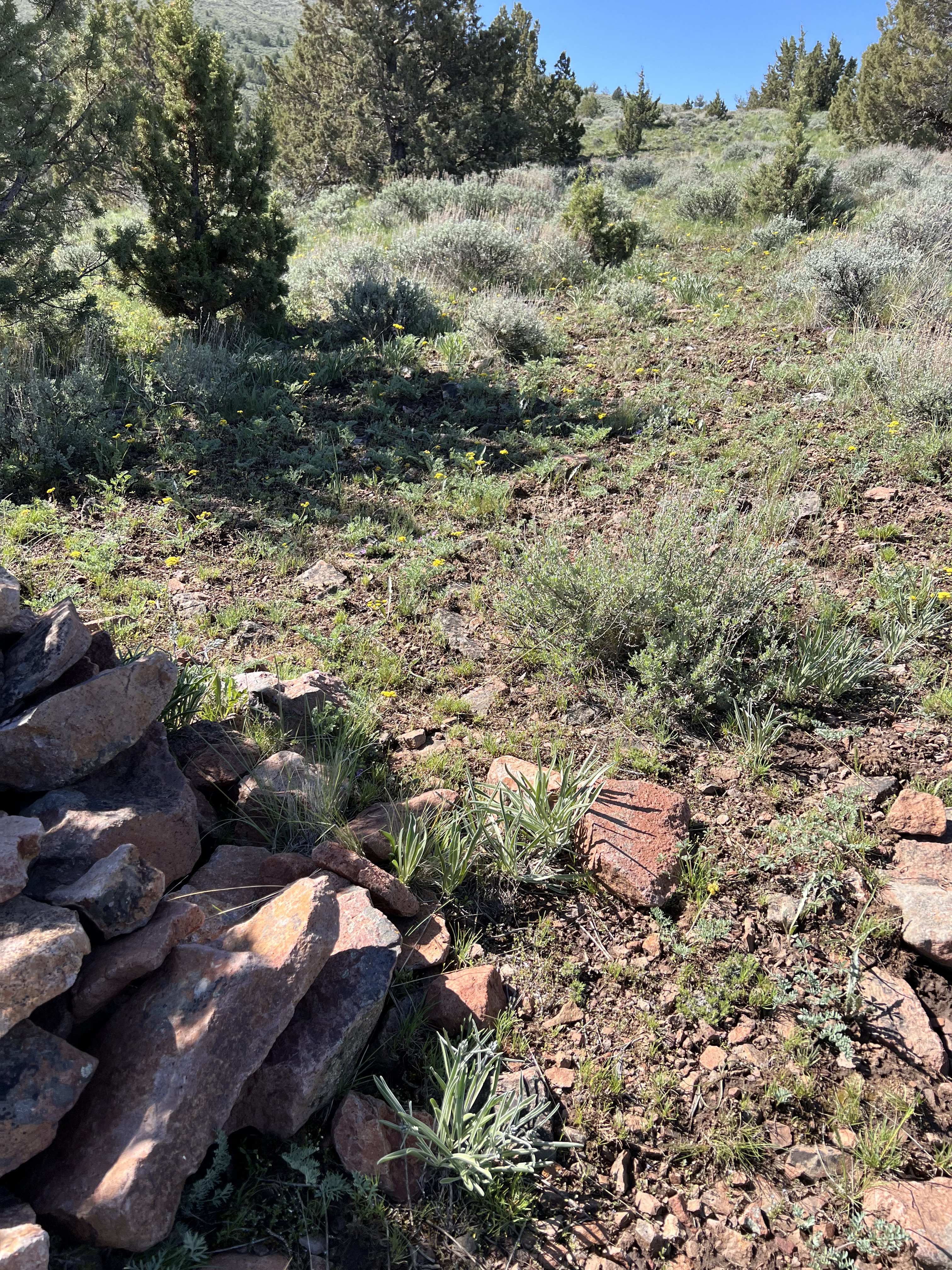
Another Gray Butte shot. Places like this and the nearby BLM land around Cline Buttes to the west, serve as a benchmark when considering management policies for places like the heavily disturbed Dry Canyon. While the conditions are somewhat different, you can train your ‘eye’ on places like this so that you can have a better idea of what’s missing on disturbed sites. You can begin to seen the ‘rhythm’ and spacing of the plants in a healthy community. Plants in desert communities don’t crowd themselves, there aren’t enough nutrients or available water to allow crowding, so when you see it or thicker, uniform, single species or simple crowded stands of herbaceous plants, you know something is amiss.
Natural conditions are cyclic following relatively consistent patterns, throughout the year and from year to year. Each place will have a relatively unique set. When we work to actively effect those conditions such as when we garden, farm or maintain the generally monotonous pattern of landscape common to our modern, urbanized, human lives, we provide a relatively consistent pattern of conditions for the weeds we have ‘selected’ over the course of generations. As we move around, disturb the landscape and recreate the patterns we are familiar with, our common weeds follow us, repeating their success story. They will continue to do so as long as we continue imposing these patterns and common practices on our landscapes. In the process what was here before, and existed for many thousands of years, is lost. Those plants and animals which depend on those landscapes, over time and the increasing loss of species and the relationships they lived in, begin to fail and disappear in an unpredictable and accelerating way, each species possessing a variable capacity to tolerate such losses. Weeds don’t just ‘happen’. Native plant communities don’t just fail. We have set our landscapes up for weed invasion and the loss of native plant communities and the life they have historically supported. When we disturb the landscape, we reduce the possibilities for life.
Ultimately, we are responsible for our landscapes, even those we may have not directly disturbed. We have introduced these changes, effectively setting them loose and still are reluctant to take responsibility. How long we can keep this up is hard to say. Plant communities are a part of the larger whole. They all support one another…until they can’t.

