Category Archives: Site Analysis

Fabiana imbricata: the Andean Un-Tomato, a Non-Heath That Looks a lot Like its Cousin Cestrum

800px-Fabiana_imbricata_HRM2

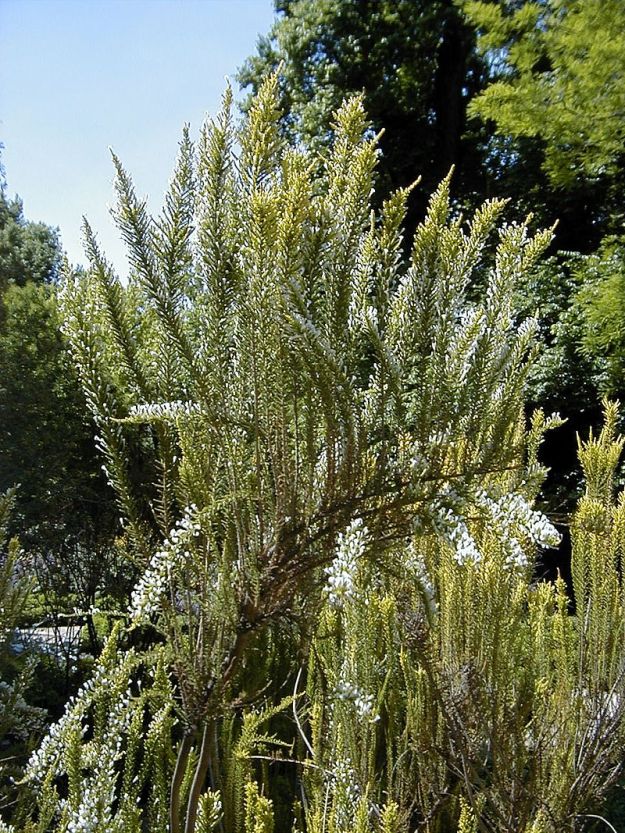
Fabiana imbricata has an appearance much like the upright and shrubby Erica arborea…maybe mixed with an upright form of Rosemary…providing a remarkable texture in the garden.

In gardening and botany one of the first things we learn is that not everything looks as we might expect that it should!  Fabiana imbricata, is a member of the Tomato Family, the Solanaceae, yet, if you don’t look too close, it looks like it might belong to the Ericaceae.  At one time I was planning to take advantage of this similarity as I was attempting evoke a South African feel in part of my garden substituting this for one of the many tender South African heaths as the correct Erica species are either too tender, of borderline hardiness for my conditions or are simply difficult to come by.  It was sharing an area in the garden with Restio capensis, Eucomis spp., Melianthus spp. and others to give an impression of South Africa, not a strict species for species duplication of a community.  I didn’t quite pull it off….I’ve done much the same thing when substituting tropical looking temperate plants for the real thing when evoking a tropical feel.  It’s a matter of manipulation…a sleight of the garden hand.

Its Chilean Home and Garden Merit

Fabiana imbricata is not from South Africa, though it shares Gondwanan roots, and is endemic in Chile, occurring very frequently throughout much of its Andean range.  It is in fact identified as a ‘keystone’ species strongly effecting the composition of its local plant communities.  It can be found growing from well into the dry region of Coquimbo in the north, just south of the huge Atacama Desert, south into the wet Aysen region with its many islands and inlets south of the Lake District or Zona Sur.  The vast area stretches along much of Chile’s length which can be driven, on often tortuous mountain roads, for over 1,700 mi., stretching from the arid city La Serena to the small, rainforest town of Tortel, in the south, a distance almost 500 miles further than the drive from Vancouver, BC to Los Angeles, CA….There are not that many plant species in the world that span a similar latitudinal range with its accompanying climate differences.  As you look for this plant moving from north to south through Chile, the soils and its particular niches change along with the temperature and rainfall.  You are more likely to find this growing exposed in rocky scree in wetter regions to the south, while it tends to be more commonly found on sites more protected from the sun’s intensity and into better soils as you move into the arid and hotter north, more protected from the sun’s tropical intensity.  No surprise there, but overall this is an adaptable plant succeeding in cool rainforest to arid, desert like, conditions.  As would be expected across the more arid portion of its range fire is an important factor in maintaining the plant communities balance, riding it of other competing woody plants  and even aiding it in germination, when followed by ample winter/spring rainfall, though this is obviously not essential for its continuing survival in rainforest areas where fire is much less frequent.   This is a very adaptable species and as we live near the Pacific Coast in the northern hemisphere, which mirrors much of the range of conditions, we should be able to have success with it, if we pay attention to its cold limits.  Those away from the Pacific Coast, especially those with ‘continental’ climates or strong influences from them, will have to pay closer attention. Continue reading

The Fascicularia and Ochagavia Question: Two Worthy and Relatively Hardy Bromeliads


The inflorescence of Fascicularia bicolor with its blue flowers. The center of the foliage on a blooming rosette, turns red when the flowers appear and then, like many Bromeliad, that rosette dies replaced be previously formed offsets. My blooming plant had multiple rosettes at the time, three of which bloomed. Taken in my garden, Sept. of ’17.

If you’re not into blood and guts, consider this genus, as on my scale of one to ten as described above with ten warning of near complete evisceration if one is fool hardy or reckless, this one’s a solid 4, dangerous enough but not stupidly so.  Fascicularia pitcairniifolia.  You would think that in a genus composed of one or two species things would be pretty well settled taxonomically, guess again. Originally described as F. bicolor it was reclassified as F. pitcairnifolia and later changed back to F. bicolor.  Subspecies were proposed.  Changes retracted.  There are significant differences in the sampled populations, but were they sufficient to constitute separate species??? Adding confusion at a different level are those who say the species name indicates that it is from Pitcairn Island.  It is not.  The specific epithet simply recognizes a similarity to the foliage in genus, Pitcairnia, another Bromeliad member.  This Fascicularia is from the lower Chilean Andes, allegedly north of the other Fascicuaria species, F. bicolor which is suppose to be slightly hardier and occurs at least occasionally as an epiphyte!  Some botanists have argued that F. pitcairnifolia possesses thicker, slightly wider leaves. and some minor differences in the timing of flowering and is reputedly slightly less hardy.  The ranges of both overlap  Good luck sorting this out. Continue reading

Growing and Understanding Globe Mallows in the Urbanized Maritime NW: Sphaeralcea spp. and Cultivars

Every plant evolved in and lives in context.  They are dependent upon it for continuing support, not just for their survival, but for their well being as they grow, mature and attempt to reproduce.  It is not just competition out there.  Though we may order them from a catalog, grow them from carefully collected seed, receive them as gifts from a friend or purchase them from the shelves or rows at a garden center, they are individual plants, removed from their context…their futures’ will be short if we don’t make some attempt to recreate it.

Sphaeralcea ‘Childerly’, from the Dancing Oaks catalog, though it’s not currently listed.

Sphaeralcea are often called Globe Mallows and are another member of the large Mallow Family, the Malvaceae, some 244 genera with 4,225 known species.  I’ve written recently of Anisodontea another genus of the family.  Most of the 40-60 species of Sphaeralcea are North American natives of dry areas, growing from the Great Plains west and south into Mexico, with a few occurring in South America while a few others reaching into southern Canada.  They include annuals, perennials and shrubby species, I’m looking here at perennials, all of which have very long bloom times, often spanning the entire summer into fall.

Sphaeralcea (ambigua) ‘Childerley’

Sphaeralcea ambigua, one of the largest growing species of the genus, at up to 3′-5′, often found considerably smaller, is native to the US Southwest, SW Utah, Nevada to Arizona and southern California down to Sonora and northern Baja, Mexico.  They are found east of California’s Sierra Nevada and the several other smaller ranges of southern California, which shield them from moisture coming from the Pacific.  It is the most xeriphytic of the genus, meaning, the most tolerant of drought.  The USDA breaks the species into four separate subspecies, S.a. ssp. ambigua, the most commonly occurring form across the four states with the typical orangey flowers, S.a. ssp. monticola, the one occurring at higher elevations, beyond the Sonoran Desert and covering its Nevada range, S.a. ssp. rosacea which is limited to the San Diego area east to Maricopa county in Arizona, of the warmer Sonoran Desert, with a flower that is rosy-pink and S.a. ssp. rugosa which is limited to the Mojave Desert area with the more expected orange-red flowers.  Both S.a. ssp. ambigua and S.a. ssp. monticola grow on north of the Mogollon Rim, an east-west running escarpment,  the abrupt rise in elevation marking the southern edge of the Colorado Plateau.  The other two subspecies grow below this and largely south and west of it. Continue reading

Roldana cristobalensis (formerly Senecio cristobalensis…now, Roldana petasitis var. cristobalensis)


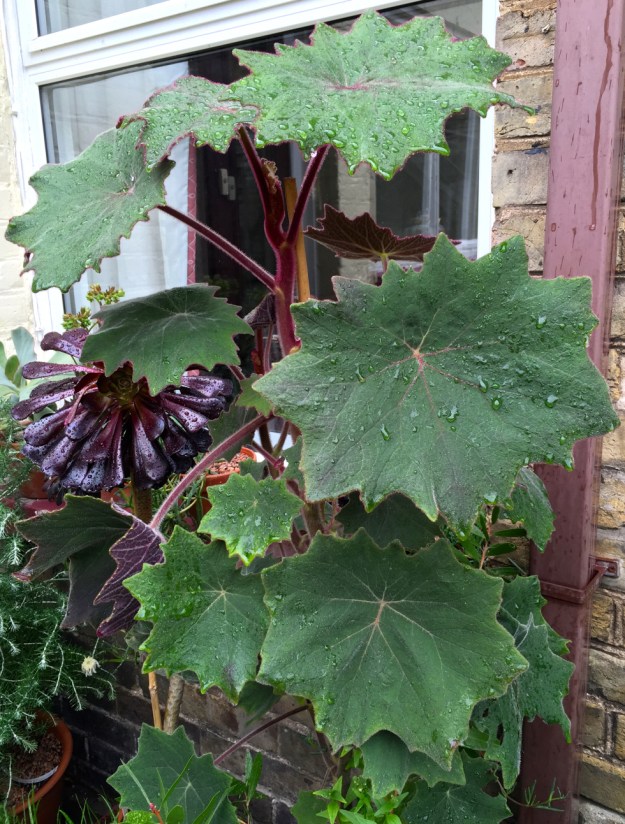
Roldana petasitis var. cristobalensis shown here looking amazing with Aeonium arboretum ‘Zwartzkop’.  Its substantial leaves are some 8″ across, thick and velvety, the undersides of which are red/purple, like the stems.  The color often comes through in the veins along the top surface.  A very striking foliage plant.  Picture this with its close relative, Pseudogynoxus chenipodiodes, the Mexican Flame Vine, formerly known as Senecio confusus!

Sometimes called Velvet Groundsel, this plant has been living and marketed under several different names.  The first name in the heading is the one Jimi Blake ascribed to it, a name I didn’t recognize for a plant I’ve grown off and on in the past…it got lost in his list paired with a particular Thalictrum and I simply missed it…until recently.  I knew it as Senecio cristobalensis and, had I recognized it, would have included it with an earlier post in which I focused on his favorite Asteraceae.  I did actually mention the plant there simply as another Senecio that I’ve grown of value.  Here I shall treat it more directly.  The genus, Roldana, was recircumscribed in 2008 to include some 54 different species.  Other authors include as few as 48 and as many as 64 in the genus, most of which used to belong to Senecio and are native to the extreme Southwestern US, Mexico and Central America.  Most of the Roldana species are somewhat ‘shrubby’ herbs with a few, like this one woody, even tree like.  Both genera are within the Asteraceae and share tribe status as well, Senecioneae.  For the curious, Roldana spp., even more finely, are included in the sub-tribe, Tussilagininae, which includes the very commonly grown genus of garden plants…Ligularia!  On closer examination the morphological similarities will begin to stand out to most of us.  Check out all of the photos on the Wikimedia Commons page for Roldana petasitis.  Roldana petasitis is the correct species name for this plant.  With all of the shuffling and consequent confusion still going on in the world of taxonomy, especially in such a mixed large genera like Senecio, we must all be allowed our mistakes of nomenclature.  It is a volatile changing world out there. Continue reading

A Closer Look at Jimi’s Beautiful Obsession, A Review of Chosen Plants From his Presentation, Part 1

It would seem that gardeners are a difficult lot!  For those of us intent on gardening with ornamental plants we are continuously drawn to the exotic and novel, sated less and less by the plants in yesterdays’ garden…at least until those have had suitable time to have fallen out of fashion and are rediscovered. For most of us it is the plants we’ve never grown, or even seen before, that draw us.  This is as true when we ourselves are novices as it is many years later.  Sure, we all have more than a few long term relationships with particular plants, but we seem forever subject to the seductive calls of the unknown (to us)!  For many of us this is at no time more true than when nurserymen, on the ‘cutting edge’, and plant explorers come to town, especially if they come bearing pretty pictures…Even mores so when paired with the opportunity to acquire them.  Instant gratification.  It is a conspiracy you know. Continue reading

Argyle Winery: A Look at a Landscape in Dundee as an Example for Those on the Trail to Xeric Design and Sustainability

IMG_9186

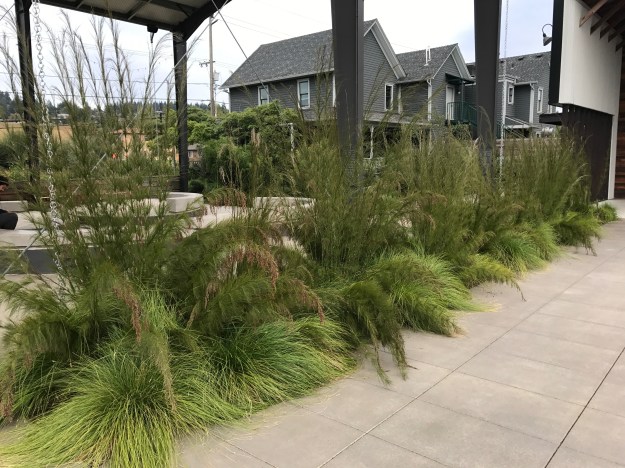
This strip planting dominated by a Carex and a taller, 7′ or better, spine of the feathery Rhodocoma capensis from South Africa, rated at zn 8b. Mine, in my home garden, survived two nights down to 15ºF this last January with very little damage.

I don’t usually do this, write about a particular landscape with which I have no history, so this is a bit of  a departure for me.  I’ve know Sean Hogan for quite a few years, consider him a friend and a highly influential mentor of sorts.  His encyclopedic knowledge of plants, his boundless enthusiasm, has been infectious and inspirational over much of my career as a horticulturist while I was working for Portland Parks and Recreation.  I’ve benefited from the existence of his nursery and his commitment to horticulture picking his brain for plant and design suggestions as I attempted to broaden my own repertoire. Continue reading

Manzanita, Rock Roses and Friends: The Strength to Stand

Choosing the right plant is not an easy process.  We pick a design theme, make sure our plant choices are a good match for our site conditions, are compatible with their ‘bedmates’ and won’t become overly burdensome, in terms of the maintenance we are able and willing to perform.  There are a lot of variables here.  Our expectations of how a plant performs in the landscape, as individuals and as a composition, are important as we assess their performance over time and decide how we will respond to them.  Many of us are attempting to create gardens that require less of us in terms of maintenance, that fit the conditions on the ground with minimal intervention on our part.  We may chose to create a xeric garden to minimize or even eliminate supplemental irrigation.  If we do, the plant choices we make, their spacing, the size of plants we purchase, even the timing of the planting and the soil prep we do, are all important in our success or failure.  While we attempt to keep our specific site conditions and our goals in mind, we need to be prepared for the extremes of conditions, like weather, that can occur occasionally, even if only once every several years.   Continue reading

The Strength to Stand: Surviving the Load of Ice and Snow in Portland

img_7484

The morning after the big snow along the front of my house. To the left, splayed out and weighted down, is my Butia capitata. This one, from Argentina and not used to snow, had me worried, but it sprung back. The Oleander to the right, next to the sign, was bent down to the ground from its 8’+. Further back is one of my Chinese Windmill Palms, Trachycarpus fortuneii, bent under a snow load it is used to from high in the mountains of southern China.

Many of us who garden in the Pacific Northwest, and especially those of us in Portland this year, will be visiting our garden centers and favorite nurseries this spring and summer with a little more anxiety and need as we look for plants to replace those that have succumbed to this winter’s cold, ice and snow loads, all of which were more severe than what we have come to expect here.  But before we pull on our boots and don our rain gear to head off for shopping there are several questions that we need to consider before we make our purchases.  Not all of us draw up plant lists, but most of us at least carry in our heads a wish list of plants we have seen in other gardens, in magazine spreads and while on vacations, but if we want to avoid some major mistakes and move our gardens toward the kind of landscapes that we really want, we are going to have to put on our reality goggles and critically assess our choices…that is, if we want to avoid unnecessary losses in the future. Continue reading

Failing Landscapes, Failing Practices: A Look at Tri-Met’s Landscapes and How We Could Do Them Better!

img_6991

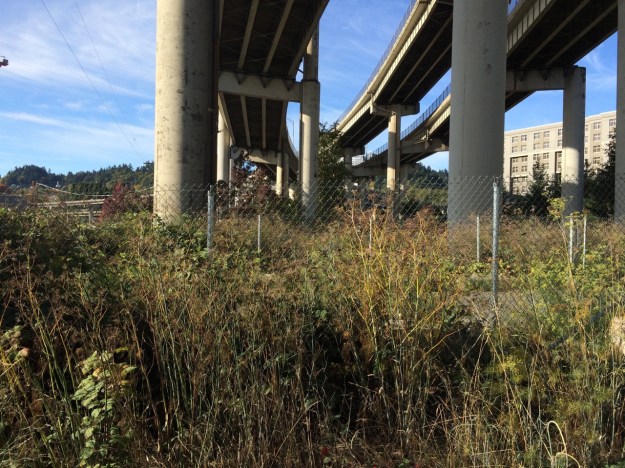
I include this photo, taken beneath the west approaches to the Marquam Bridge, an ODoT property not Tri-Met, as a reference for what is commonly found in transportation rights-of-way. This is not a problem solely with Tri-Met’s landscapes. It crosses the southern end of South Waterfront Park which was one of my responsibilities for 15 years and so I’m familiar with its level of care or lack thereof. The nearest portion, to just beyond the nearest piers, was entirely neglected for the entire period except for where I cut it down to reduce the amount of weed seed I had to deal with in the Park. There is literally nothing that was intentionally planted in the entire space. It is a landscape composed entirely of weeds and it is possible because landscapes for ODoT are of an extremely low priority. It is the neighboring properties that bear the brunt of their decision. It will be interesting to see if they come under increasing pressure over the years as the expensive and undeveloped properties to their south are developed. Currently the Knight Cancer Institute is developing a hundred yards or more away. The Marriot Residence Inn, immediately to its north, has had no effect on its level of care.

About a year ago I posted a series of three articles on Tri-Met’s landscapes along the new Orange Line.  They were a critical assessment of their design with many photos and explanations for my criticisms.  I had a brief correspondence with the project manager after the first two before he stopped responding.  I had asked about the maintenance schedule that they had with the contractor who would be doing the work.  I did not receive it.  Part of the reason was mine, as new ideas came up for me, my interest wavered and I moved on.  Still, I’ve never received anything.  Now, a year later, I decided to reassess the first portion of the landscape that  I wrote about, as it is a section I regularly walk and ride by bike to downtown or to just get out.  I would encourage readers to see my previously posted reviews. Continue reading

Losing Our Urban Landscapes: Sustainable Goals and Our Crisis in Leadership

The Brooklyn switching yard. These areas must be kept clear. The fence line to the right, next to the container yard, is typical, here filled with common weeds, aggressive invasives and Tree of Heaven.

The Brooklyn switching yard. This ‘landscape’, in a modern utilitarian sense, is ideal.  These areas must be kept clear. The fence line to the right, next to the container yard, is typical, here filled with common weeds, aggressive invasives and Tree of Heaven…and it doesn’t matter.  It works and that is the priority.  Whatever results elsewhere…is not.

The following is intended as a template for action or a beginning point for a discussion that is long overdue.

Landscapes are more complex than most people realize.  They can go seriously awry in a very short time.  Undisturbed native plant communities are relatively stable and are able to respond on their own, as they have for millions of years…if the disturbances they suffer are relatively small.  Unfortunately these plant communities have been decimated in urban and most rural agricultural areas severely compromising their abilities to respond in a positive and effective manner.  The addition of invasive species to the region puts even stable, undisturbed plant communities at risk.  Because we are not all ecologists, or even gardeners, what can we realistically do to stop or reverse this process of landscape degradation?  The decline of our landscapes is linked to a long history of practices that have ignored the value of both our native and contrived landscapes, a belief in a right to ‘dispose’ of the land in whatever way we so choose and our denial that this destruction matters.  We have done this through our land management practices, our designs and the uses of the land itself even those that may seem unrelated, many that have become automatic in our society and are directly related to how we live, work and play today in the modern world.  Our active threat is inherent in the way that we do business.  Our attempts at correction are, too often, limited to only slight modifications that do not put any undue ‘pressure’ on our local economy, business or the privileges that we have come to see as ours.  We are a society that has, in short, become disconnected from the realities of life at the local level and what is required to support it.  We see a limitless nature that is there for our use.  Whatever we may need, we believe that we may merely buy from elsewhere, an elsewhere that is limitless though undefined.

To turn this situation around, or to make significant improvements, requires that we examine what we are doing now, that may be working against the goals that support life and landscape,…and stop.  We have to stop doing the things that are working to continuously disrupt the ‘healthy’ functioning of the landscape.  If we don’t do that then all of our attempts at improvement, all of our tweaking of our system, will come to nothing.  We cannot ‘save the patient’ with good thoughts while they bleed out. Continue reading