Category Archives: Metabolism

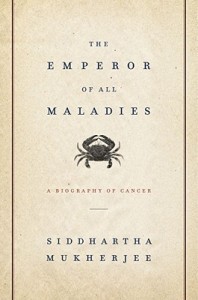
The Emperor of all Maladies: Mukherjee’s look into Our Relationship with Cancer

Siddartha Mukherjee’s first book, “The Emperor of All Maladies: A Biography of Cancer”, is the third of his I’ve read. My interest earlier, and still, remains in understanding the biology of the organism, so I read his books on genetics and the cell first, trying to improve my understanding of the complex actions and structures of life before attempting to understand a disease that ravages and destroys so many lives. His effort to write this book led to Mukherjee receiving the Pulitzer Prize. It is a gargantuan endeavor, artfully constructed. It contains several stories in an overlapping, although, natural style beginning with man’s earliest recorded conception of the disease(s). It becomes clearer and clearer as you read through it that cancer is more a ‘family’ of diseases, linked by their pattens and effects as they progress within the cell and from there, into the collective structures of our body, than it is a singular disease. But that gets way ahead.

Cancer is not a ‘new’. The ancient Greeks wrote of it and there are scattered records of it much earlier from other civilizations. Galen, wrote of it almost 2,000 years ago, attributing it to an imbalance in ‘black bile’, one of the four humors, which when out of balance, he claimed, lead to various diseases (This was the justification for the practice of ‘bleeding’ a patient that continued on into 18th and early 19th centuries, not that long ago). Such ‘humors’ were thought for centuries to be at the root of many diseases and infections across Europe until scientists, through the use of microscopes, began to understand that the cell was the basic building block of all life, and that there was a microbial world beneath and within the world readily observable to us. Galen’s views continued to hold sway until anatomists, through their careful dissections, realized that ‘black bile’ was a fabrication, an attempted explanation for something unseen at work within the body. Cancer then, along with our understanding of the body and disease, began its slow, lurching, advancement through the practice of science. What actually is cancer? Continue reading
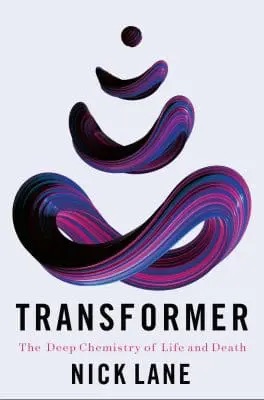
“Transformer: The Deep Chemistry of Life and Death”, a Review and Thoughts on this Life

I begin this post in my usual way of attempting to incorporate the science presented in Lane’s book into my own understanding of life. That’s what I do through the first portions of this piece. Then I stray….discussing how I understand the process of homeostasis and what I see as the extension of this, relationship as integral to complexity itself, developing from necessary sensitivity, the ‘awareness’, necessary for internal communication,  signaling, responsiveness and, ultimately, the coordination of internal functioning and cognition, sentience and ,ultimately, intelligence. It is a process of accretion, with increasing complexity. The links between related ‘things’ are then not just physical, they are energetically connected. I’ll leave this now for later.

I’ve just finished reading evolutionary biochemist, Nick Lane’s latest book, “Transformer: The Deep Chemistry of Life and Death”.  It is not light reading. There are diagrams of chemical reactions, often with descriptions that urge the reader to not get overly hung up on them, the terms and steps. They are not simple processes. One transformation following another, necessarily, in precise order, until removed for other processes, other needs, the remainder augmented by what is required to continue on. Uninterrupted. Billions of times per second. He writes about the quantum hopping occurring in reactions instantaneously. Shared electrons. The flow of protons in the continuous ‘flux’ of life. The processes changing ‘directions’, spinning off secondary products, closing and reopening paths as the cell and organism works to maintain homeostasis, interpreting the seeming chaos of activity into the sustenance of life. It is a ‘story’ of constant metabolic change, patterned and ‘free’, the work of homeostasis that takes place within every organism. There is a lot here I write of not in the book, but which I’ve picked up in my other reading. And, again, I’ll remind you that as an intuiter, I combine ideas, works from disparate sciences and follow my own paths. This is another part of my journey to understanding this world.

His other books have been more accessible, for this reader anyway, but to move ahead in one’s understanding of life’s complexity, one has to have an understanding of the concepts and big ideas involved. Life isn’t magic. Its study can be simultaneously intimidating and fascinating as well as a wondrous process when look closely. I’ll be rereading this one to pick up more bits later. Continue reading

On Biology, Ecology, Evolution: Health as a Product of an Engaged Life Aided by Science

Biology, the ‘life sciences’, botany, evolution, cell biology, ecology, health and disease, plant communities, our relationship as humans with each other, geology and the life around us, are all topics that interest me. My most recent reading choices have focused on embryology and an organism’s capacity to maintain homeostasis, what is meant by ‘health’. Earlier I focused on the big question of ‘What is life?’ I’m an integrator, an intuitor, an assembler of conceptual puzzles. For me understanding is the goal and that usually involves understanding the ‘pieces’ of the puzzle and fitting them together into coherent wholes. That’s what I do when I select books and read. While my fiction choices are relatively wide and varied, when it comes to this question, I am far more focused, purposeful. I am not overly concerned with being correct in terms of conventional thought or even regarding that which is accepted as being scientifically correct. I’m looking for what makes ‘sense’. I ‘test’ what I read.

Science is conservative and rightly so. It works to define a foundation from which we may build on. Many, if not all scientific advances, came at the expense and pain of researchers who reach beyond the established to address the problems that accepted theory has revealed as the process advances. Egos and careers can get crushed. Arguably, every significant advance in science began as a controversial idea. Over time, with repeated experimentation, advances in technologies that enable scientists to address questions not previously possible, new insights and ways to ask the ‘question’, the new gains support, or alternatively, is revealed to be ‘wrong’. In this process other questions arise, that move us toward a more complete ‘truth’, a truth that enlightening and revealing, can never be the ultimate answer. What preceded it was not necessarily ‘wrong’, but more likely incomplete, unable to fully explain the world as our understanding of it itself changes. Science becomes a process of understanding at an ever finer scale. What once served, still does, but in a coarser grained way. Occasionally, it demands a radical rethink of our basic understanding of reality. Continue reading

The Seat of Awareness: On Plants and What We can Learn from Them

“From the viewpoint of the evolutionary biologist it is reasonable to assume that the sensitive, embodied actions of plants and bacteria are part of the same continuum of perception and action that culminates in our most revered mental attributes. “Mind” may be the result of interacting cells. Mind and body, perceiving and living, are equally self-referring, self-reflexive processes already present in the earliest bacteria.”
Lynn Margulis and Dorian Sagan, “What is Life?”, 1995

From what do sentience, awareness, consciousness and intelligence come from? Are these capacities a product of an organism’s complexity? At what point does it first appear? is it a property inherent to even the simplest organic chemicals? of peptide chains and amino acids, of atoms themselves?What of the organizing principle that seems to guide embryogenesis, the growth and form of every living individual of every species? Is it in action in the most ‘simple’ interactions between organic chemicals and the energy flowing through them, that favors one form over another and animates those same forms once they meet some critical minimal level of complexity?  Is this evolution towards complexity and ‘awareness’ an inevitability? A product of its component parts and the energies within it? [This is an idea that is separate from the notion of an inevitable ‘progress’ of life, always moving ‘forward’. Progress is a human notion, an assessment and a valuation of the change around us, not a ‘goal’ of natural selection and the animating ‘flux’ of energies within the universe.] Rudimentary awareness must exists at some necessary and basic level in the simplest single celled organisms…even in plants.

I look to that which is shared between all organisms and question the idea of the animal brain, and its neural system, as the basis for these things and its purported absence in plants, fungi, bacteria, viruses and archaea, as lacking in them. The brain itself and associated nervous system is a unique and complex structure present only in ‘higher’ animals. This bias in favor of the brain and neural systems, especially that of the human brain, as the seat of awareness and consciousness, ignores the requirements of any organism. We are biased in our insistence that these capacities must be located in a singular physical organ and no other. A singular occurrence in the universe. A huge conceit on our part, that this capacity exists in us alone, in and organ and tissues we could could physically evaluate, one which we ‘carry’ internally within us as we move freely about. The body, any body, is a vessel which contains life and is shaped by it. Life is both of the body and transcendent, existing beyond it. Life exists within the continuously unfolding moment. Life is not a ‘thing’ so one can hardly expect awareness, consciousness and intelligence to fit neatly into a limited organ, however we define it. The roots of this reach back into the study of evolution, ecology, cell biology, neurobiology, the metabolism and thermodynamics of life and the expanding field of quantum biology.

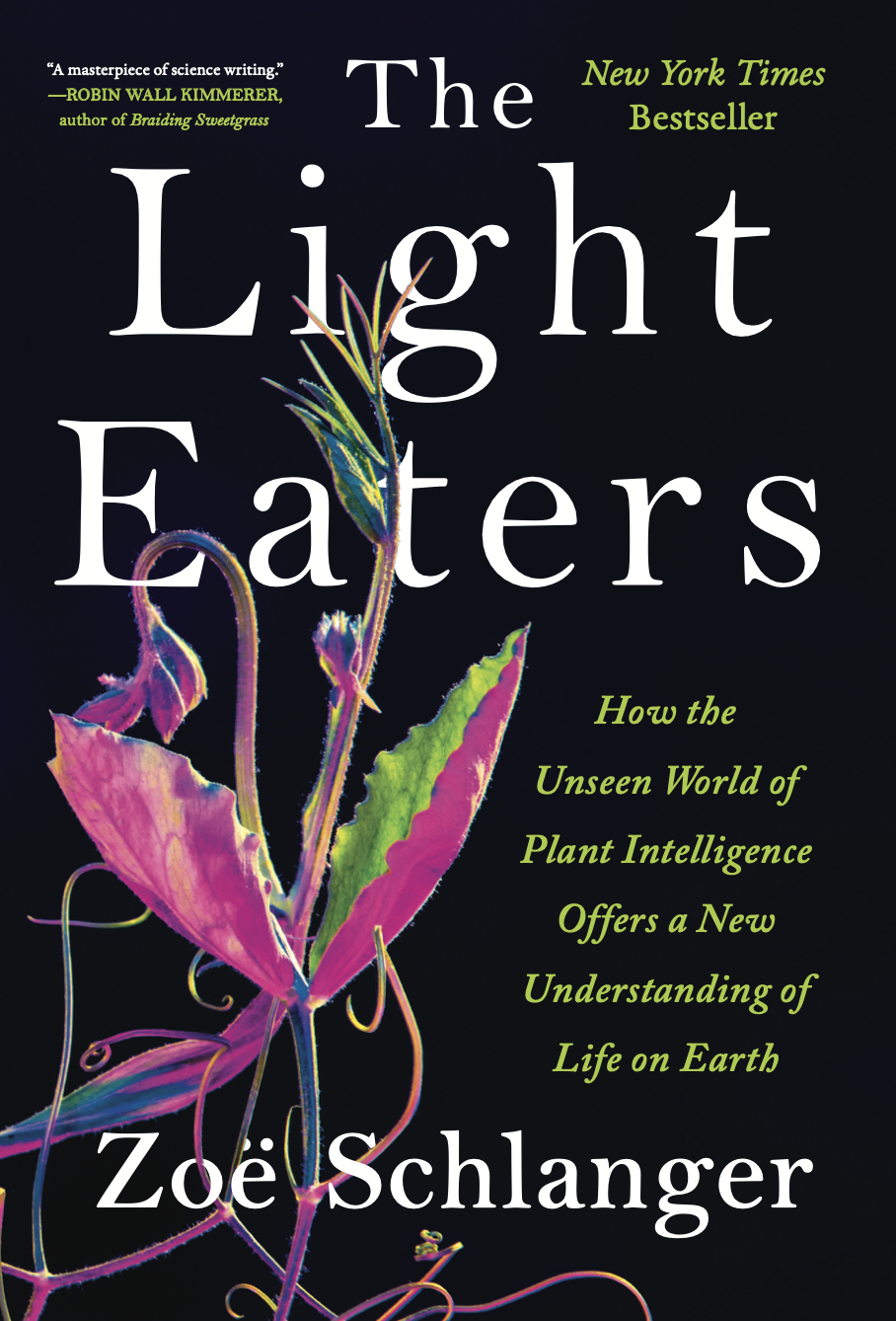
This latest thought piece has been inspired by three recent books I’ve read, Ed Yong’s, “An Immense World”, Paco Calvo’s, “Planta Sapiens” and Zoe Schlanger’s, “The Light Eaters”. I am not a scientist. I’m a student driven to make sense of this world. The connections and conclusions I make here are mine, although they may be suggested by the writings of others. Continue reading

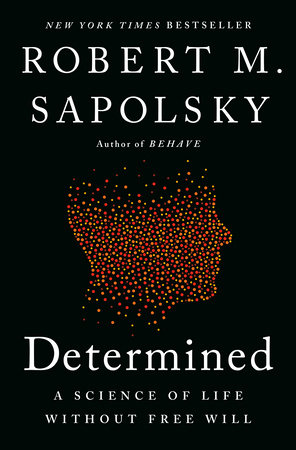
Determined: A Science of Life Without Free Will, a Review and Look Into its Consistency With the Sciences

Long ago I took a couple philosophy classes at U of O; one on existentialism, in which we read several novels and discussed their themes; and another, an upper division, class on ethics, because I was curious…I dropped the ethics class after sitting around the table in seminar discussing particular authors’ thoughts, like Kierkegaard and Butler. Majors seemed to take pleasure in making fun of what I got from them in discussions. Hated this. I still have trouble reading philosophy. It seemed like a game to them in which they argued a position to show off their cleverness, their superiority, the ideas themselves of relatively little importance…while hiding their biases. It must have been so self-assuring for them to ‘know’ these author’s precise thoughts and bash those who don’t get it…or saw something different (like the newbie, me). To quote someone isn’t to understand, it is only miming, presumably in hope of getting a reward. I read for understanding. It’s not a competition. So, this book, “Determined: A Science of Life Without Free Will”, taking a science approach to evaluate a philosophical concept, was difficult to begin. The author, neuro-biologist Robert Sapolsky, argues that those philosophers and theologians who claim that people have free will to do whatever they desire or set their minds to, are wrong. This appealed to me immediately. Continue reading

“Entangled Life: How Fungi Make our Worlds, Change our Minds & Shape our Futures”: A Review

Sheldrake, Melvin, “Entangled Life: How Fungi Make our Worlds, Change our Minds & Shape our Futures”, Random House, 2020.

I have spent most of my life outside amongst, growing, observing or studying plants and yet, every page here has caused me to take at least a moment to reconsider the life I’ve been so involved with. Everything here underscores what I’ve read and learned elsewhere, sometimes casting it in an entirely different ‘light’. While we learn to think of organisms as discrete individuals, fungi, a class of organism separate from the bacteria, plants, animals, even viruses which I’ve been examining, are impossible to consider on their own without looking into their vital relationships with the other forms of life.  While all organisms depend in many ways, great and small, upon other organisms for their support and sustenance, fungi are nearly impossible to imagine separately, their ‘bodies’ being literally intertwined in and around those of others.

Relatively early in the book, Sheldrake describes the difference between fungi and animals in this way, animals put food into their own bodies, fungi put their bodies in their food, digesting what they require by secreting acids and then drawing the broken down nutrients back into their mycelial bodies and transporting them to where needed. Continue reading

On Life: An Annotated Reading List of Titles Exploring the Physics, Biology, Evolution, Natural Selection and the Generative Power of Far Out of Equilibrium Dissipative Structures (Organisms)

Nurse, Paul, “What is Life?: Five Great Ideas in Biology”, WW Norton and Co., 2021. I’m placing this book out of order here, its American edition just released this year and I’ve only just read it, because I concur that this is an excellent introduction to its topic and should be accessible to a broad audience, one without an academic background in biology. It does what Carlo Rovelli’s “Seven Brief Lessons on Physics”, does for its readers, presents in a compact and cogent way the central ideas for understanding the science of life. Nurse, is a Nobel Prize winning geneticist and cell biologist, who has dedicated his research life to the study of the cell and what sets this class of matter apart and unique, looking into its structure, chemistry/metabolism, reproduction, evolution and the relationships and communication which must occur within and between cells. He looks into what genetics is and isn’t capable of, what it seems to control, the genes for 20,000 some different proteins included within our DNA, while leaving open to question the instructions and detailed directions, how the growth and development of an organism is actually determined. The reader will benefit from having some basic understanding of chemistry to fully grasp what he writes here, but this is an excellent starting point.  At 143 pages this book shouldn’t scare off the reader.  This is a window into life and should peek the readers interest as Nurse reveals what he still finds so fascinating about life and this world. Al-Khalili, Jim and Johnjoe McFadden, “Life on the Edge: The Coming of Age of Quantum Biology”, Broadway Books, 2016. In the world of science, quantum biology is a toddler.  Quantum mechanics itself only began a hundred plus years ago and quickly began redefining the way that physicists look at the world.  Today most branches of science are transforming themselves, aligning themselves with this new reality of physics.  This may be impacting none of the sciences more than it is biology and the life sciences.  What was once limited to the quantum world of elementary particles so much smaller than we can see even with technology’s assistance, today we are finding quantum actions behind even the most simple processes up to and including the energy and origins of life.  Mass and energy lie at the heart of everything and life is a very particular case of highly complex ordering of that mass and energy, intricately linked in coherent relationships, borne out of seemingly random, chaotic, actions at a subatomic level.  In these systems/organisms life has evolved effective patterns that ‘feed’ on themselves, self-regulating, self-maintaining, able to reproduce with great ‘fidelity’ to one’s parent organisms, energy dissipating structures, dynamic, balanced between stasis or death and a runaway consumption of one’s self,, a conflagration.  Patterns built on more basic patterns, conformed into very particular resonant structures which are additive and transformative, never perfect, evolving towards greater complexity and capacity, structures that ‘live’ in relationship to one another in a supportive manner, dynamic, time limited and ‘stable’ in a self-reinforcing sense…existing in different states, simultaneously.  Follow Al-Khalili and McFadden down part of a ‘proven’ path. Continue reading

Physics, Evolution, Natural Selection and the Generative Power of Far Out of Equilibrium Dissipative Structures (Organisms), part 1

On Darwin and His Theory

Evolution is a word that can divide the world.  Its opponents often claim that all that lives today, in terms of species diversity, did so yesterday…all the way back to the ‘first’ yesterday, which some people claim was precisely 4004 B.C., when ‘God’ created everything essentially in a moment.  Bishop Ussher, of Ireland, published his ‘findings’ in 1650 and his ‘documentation’ is that most frequently referenced by opponents of evolution.  He has it down to the day, Oct. 23 of that year.  This is a problem when a researcher goes in with an ‘answer’ and is only looking for corroborating evidence, evidence which they will eventually find.  Science, through the study of evolution, has developed various specialized technologies and techniques to reach back in time and analyze the evidence at hand.  It has done this building on the work of those studying paleontology, microbiology, geology, chemistry, atmospheric chemistry; palynology, the study of pollen; astronomy and cosmology, quantum physics, stochastic methods developed around the hypothesis of a molecular clock which posits a rate of genetic change; and cladistics which assesses genetic lineages, the relationships between species and larger classification groups…scientists have collectively been dating ‘life’ back over Earth’s 4 billion years.  The creationist argument depends entirely upon belief, denies science and views evidence such as fossils simply as ‘puzzles’ God left to confuse us.…Others accept that lower species may have ‘evolved’, but Man, created in His image, is special, exceptional and exempt, a creation of God, fixed and forever.  Modern science does not give a pass to such claims of specialness seeking instead more direct evidence, making connections, following patterns, doing science….

Continue reading

The Flowering of Monte: Going ‘Viral’ During a Pandemic


When will it actually flower?  Once people got passed the, ‘What is ‘that’ question?’, this is what they wanted to know.  When would it actually flower? by which they meant the individual petalous flowers open.   More than a few times I responded snarkily…it’s flowering right now!  Agave are among a wide ranging group of plants whose flowering includes a relatively large inflorescence, a supporting structure, which can rival the rest of the plant in terms of size.  An Agave montana flowering here is foreign to our experience.  The idea that such a large structure  could arise so quickly, is to most people’s minds, strange, if not surreal…but for experienced gardens, who observe and strive to understand, there are links and connections, shared purpose and processes with all flowers.  Gardeners and botanists, horticulturists and evolutionary scientists, they see the wonder in it all.  When does flowering begin?  When a plant commits to its purpose.  Flowering should not be taken for granted.  It does not occur to meet our aesthetic need.  It is also much more than a simple result of a plant’s life.  It is a fulfillment of one well and fully lived, projecting oneself into the future.  Flowering and the production of one’s seed is a commitment to a future that will go on beyond oneself…and it begins from where every plant begins. Continue reading

Viruses in Plants: Life, Disease and Evolution

Gardening for most of us is more than just a distraction, but these days, in light of the coronavirus, SARS-CoV-2, the disease it causes, COVID-19, the conflicted messaging we’re getting from our ‘leaders’ and the insecurity many or most of us are feeling around our own financial situations, we are likely more in need of one than we had been. This post will be a bit of that, while at the same time an attempt to shed a little light on the issue of viruses in the plant world. Yes, viruses plague plants as well, but they are also thought, by more than a few scientists, to have played other roles as well, such as in evolution, a process that continues to and beyond this day! In some ways they parallel those of bacteria. Both viruses and bacteria can cause disease. The disease that a virus can cause is generally very limited to a narrow range of species, even to one, with notable exceptions. Most, however, perform other tasks as they go about their ‘business’, within the bodies of bacteria and larger multi-celled organisms. In fact most viruses, like bacteria, play no direct roll in our health…and they are everywhere.

It is important to understand that science has its own biases and that our perspective as mortal human beings affects how we view things as well…viruses included. Science builds on experience. It requires that new science, and its theories, be consistent with what is ‘known’, but it must also be open enough to avail itself to new understandings when it better explains previously accepted theories. What do I mean? Viruses ‘cause’ disease, but might they also be something else? If our biases set us up to see them agents of disease, reservoirs for future disease or inconsequential, we will fail to see what they may also be…and there are some who would assign a much more important role to viruses and see them not just as disease agents, but as far more, as essential ‘elements’ and players to life today and the processes that made today’s form of it even possible! First, though, what do we ‘know’ of viruses. Continue reading