Category Archives: Assessment

‘Reed Canyon’ and Crystal Springs Creek: ‘Reclaiming’ a Natural Area

IMG_4523

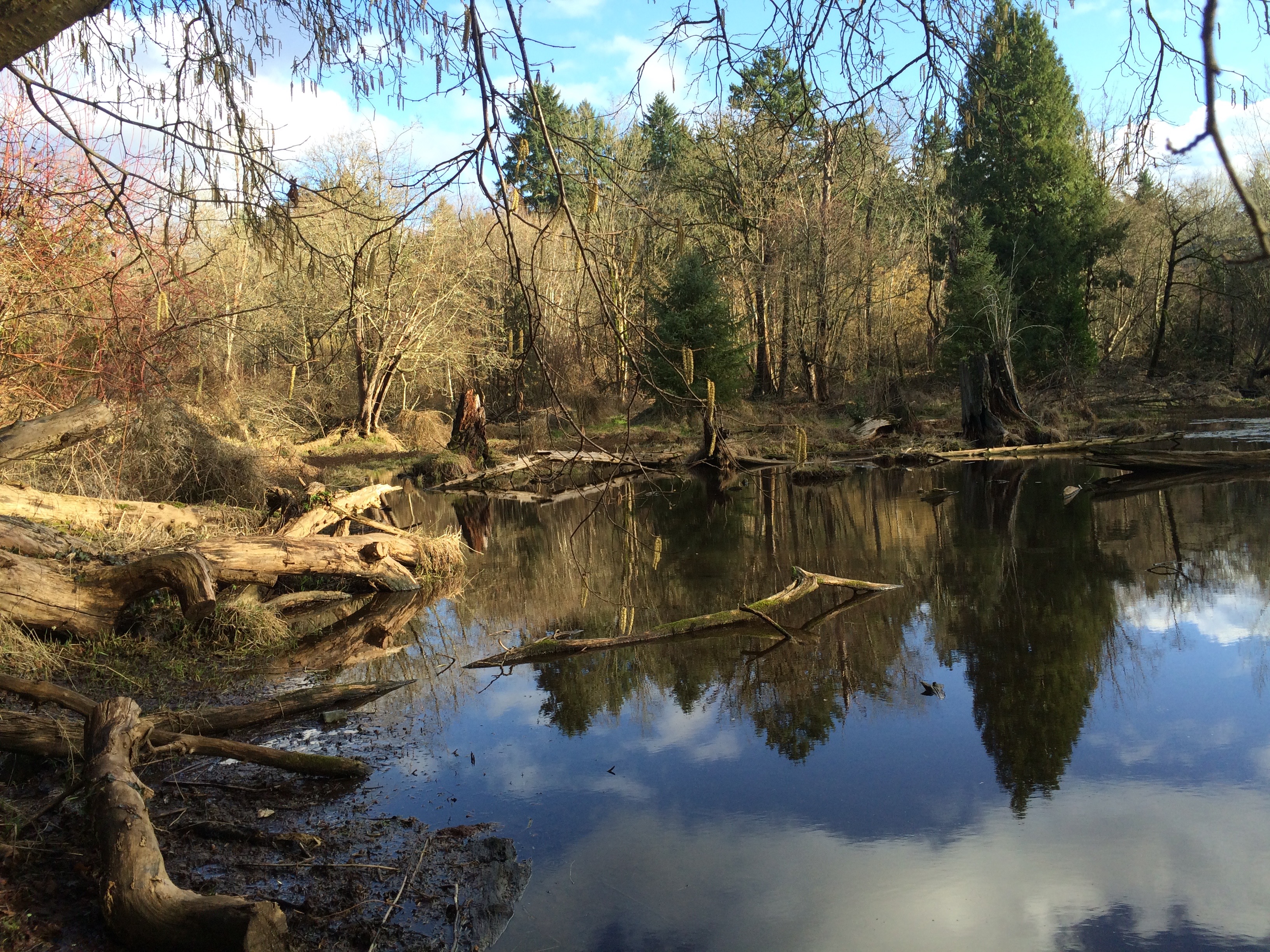
The east end of Reed Lake looking south.

The landscape is the land we live in.  It is the place and the territory that surrounds us: built, disturbed, neglected or purposeful.  A garden is a piece of that landscape that we have defined as special, that we have applied our own purpose to, a theme, above and beyond the natural forces at work across its face to grow plants of our choice.  Many urban places are feral, once domesticated, now gone to ‘weeds’.  A few pockets may be as nature made them, eroding at their edges, surrendering little bits of themselves to exotics tramped in on our boots, the hooves of our horses, the hair of our dogs, floated into place by streams or rivers or flown in by birds and on the wind.  Most landscapes exist somewhere on that continuum between undisturbed nature and the wastelands we have left in our wake of disturbance, vacant land waiting in that limbo, land on its way to purpose, value and development.  As Portland became urbanized over the last 150+ years the land has been literally transformed, become an expression of our culture, via a matrix of values and forces, that act as a particular and devastating template, a process that is still occurring and will continue to do so as long as value is measured in dollars, and demand, fashion and greed, keep cycling and reinventing this place we have made our home.  These in-between places are what French landscape architect, Gilles Clement, calls the Third Landscape.  Few areas are they that have escaped this process.  The Reed Canyon, that contains most of the headwaters of Crystal Springs Creek (another spring lies within the City Parks owned Crystal Springs Rhododendron Garden), the last of the free flowing such creeks on the east-side, may have been spared the heavy handed re-contouring of its terrain, but it has suffered much over the years anyway. Continue reading

Revisiting Holgate Overpass: A Mistake Repeated

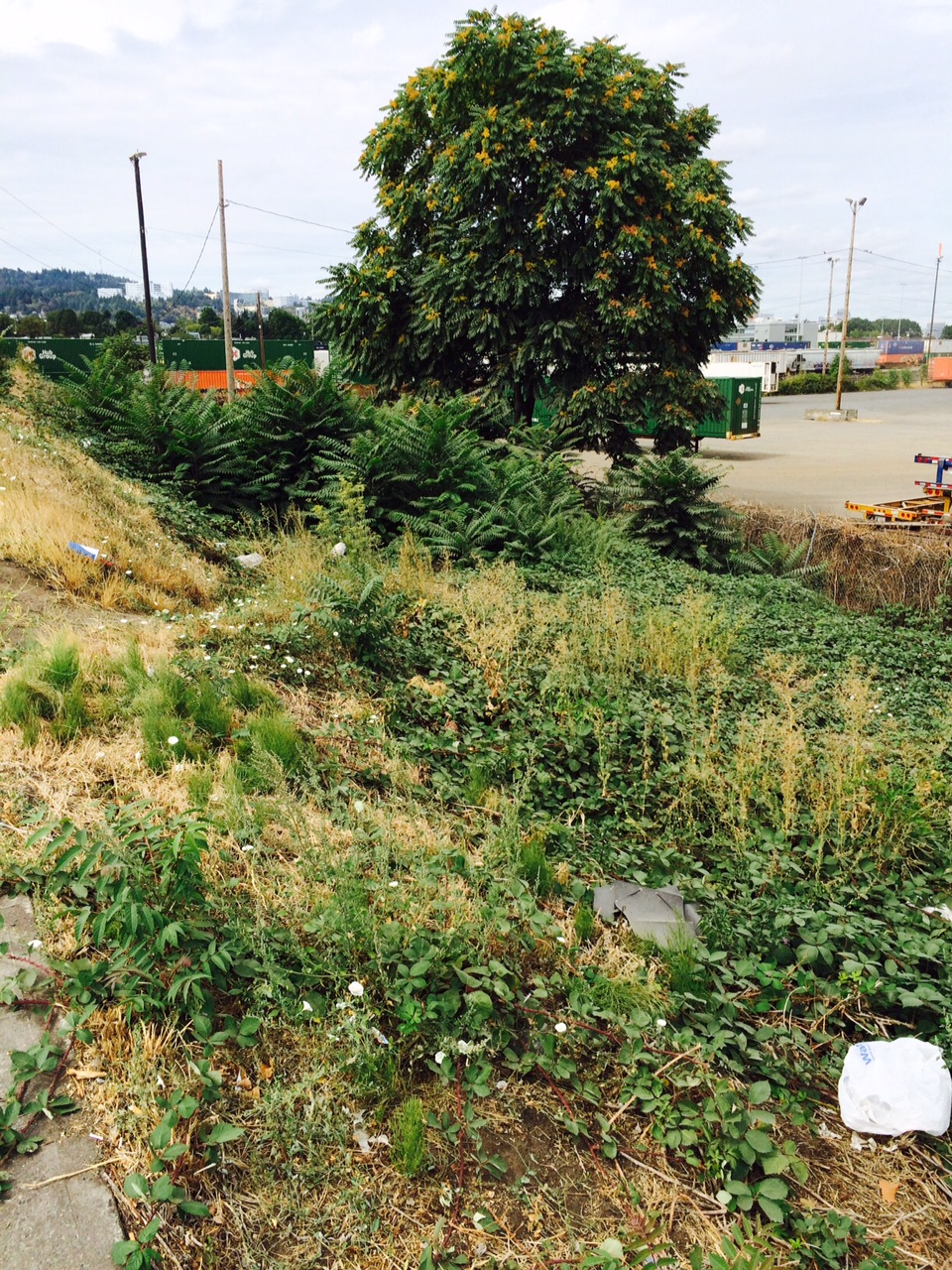
Holgate Overpass - the northeast approach. This was taken Aug. 28 of the landscape cut down in April showing regrowth in a hot drought year.

Holgate Overpass – the northeast approach. This was taken Aug. 28 of the landscape cut down in April showing regrowth in a hot drought year.

Holgate Overpass Update:

It finally rained this last weekend!  Somewhere around .3″.  Woohoo!  It will be the most rain that we’ve received since March.  It’s been dry!  In April the City cut down the ‘weedscape’ on the northeast approach of the Holgate Overpass.  It’s rained very little since and we’ve had record warm temperatures all summer.  No one has come back to spray, plant or do anything.  No one’s even picked up the trash.  If you compare the four ‘weedscapes’ on the two approaches they are very similar.  The NE, by volume has had the most regrowth.  This is for two different reasons: first, this site was cut earlier in the season when there was more moisture still in the soil to enable regrowth, and secondly, because the site is dominated by Blackberry and Tree of Heaven, both perennials, well established and of larger stature than the plants dominating the other approach landscapes. Continue reading

Gardening in Public: The Duniway Park Experiment

Portland Parks: horticultural profiles series

I’m almost a little embarrassed to post this article….  Most of my earlier project were much smaller, more like bandaids.  This is the first Park I went through more systematically assessing, horticulturally, and trying to correct landscape ‘problems’ with entirely different plantings. We generally weren’t expected to do more than little fixes and bandaids.  Larger issues were considered beyond our scope and should be addressed by our Planning Division, with master plans and all of that.  The Bureau was, however, neither staffed nor funded to do master plans which is a laborious and time consuming process.  They were few and far between.  So, as I said, this was my first go at it, though I don’t claim to have created a master plan in the process.  My time was even more limited. Continue reading

My Garden: Behind the Scenes

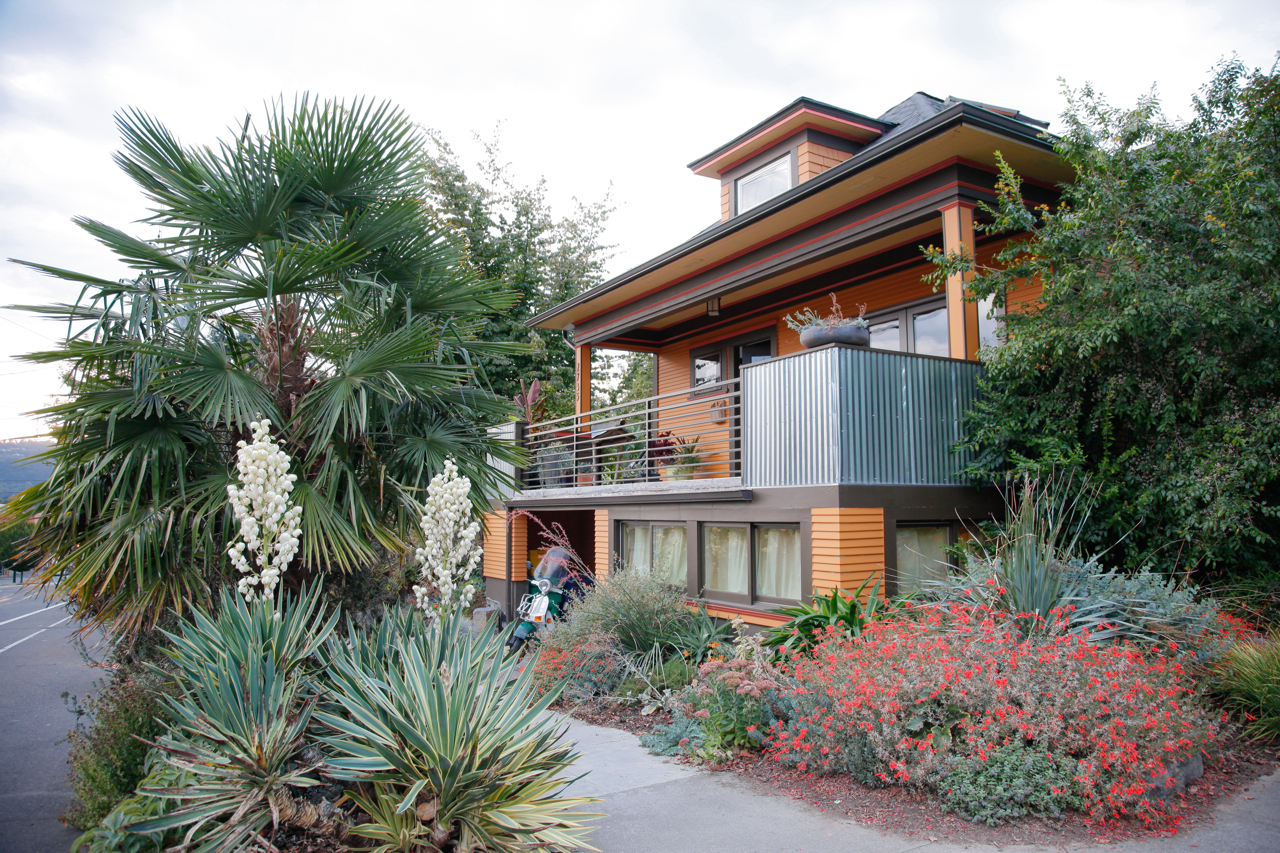
Photo thanks to Josh McCullough

Photo thanks to Josh McCullough

Overall, mine is a sunny warm garden.  Like any landscape or garden it is defined or described by its: place, design and plant choices. Where these three all come together, you have a garden. Each one presents itself as, what some might view, a daunting array of options or possibilities.

What exactly do I include under ‘place’?  Certainly climate, exposure, aspect, slope, soils and the ‘history’ of gardening and ‘disturbance’ on the site. It also includes the larger surrounding landscape, the context within which it is located and the physical ‘features’ built and natural with which it will be a part.  The story of a place is important.  Place, is the major limiting factor in a garden. Gardens are also defined by the choices we make. Each choice precludes others. In a very real sense gardening is a process of limitation. ‘If this then not that’.  What we need to be aware of is that these, design and plant choices, these limitations, can either work together or compound each other when not made with awareness.  When design and/or plant choices ignore place, the gardener must overcome all of the ‘conflicts’ this choice has put in to play, or face ‘failure’.
Continue reading

Adaptive Management and the Dynamic Maintenance of Sustainable Landscapes


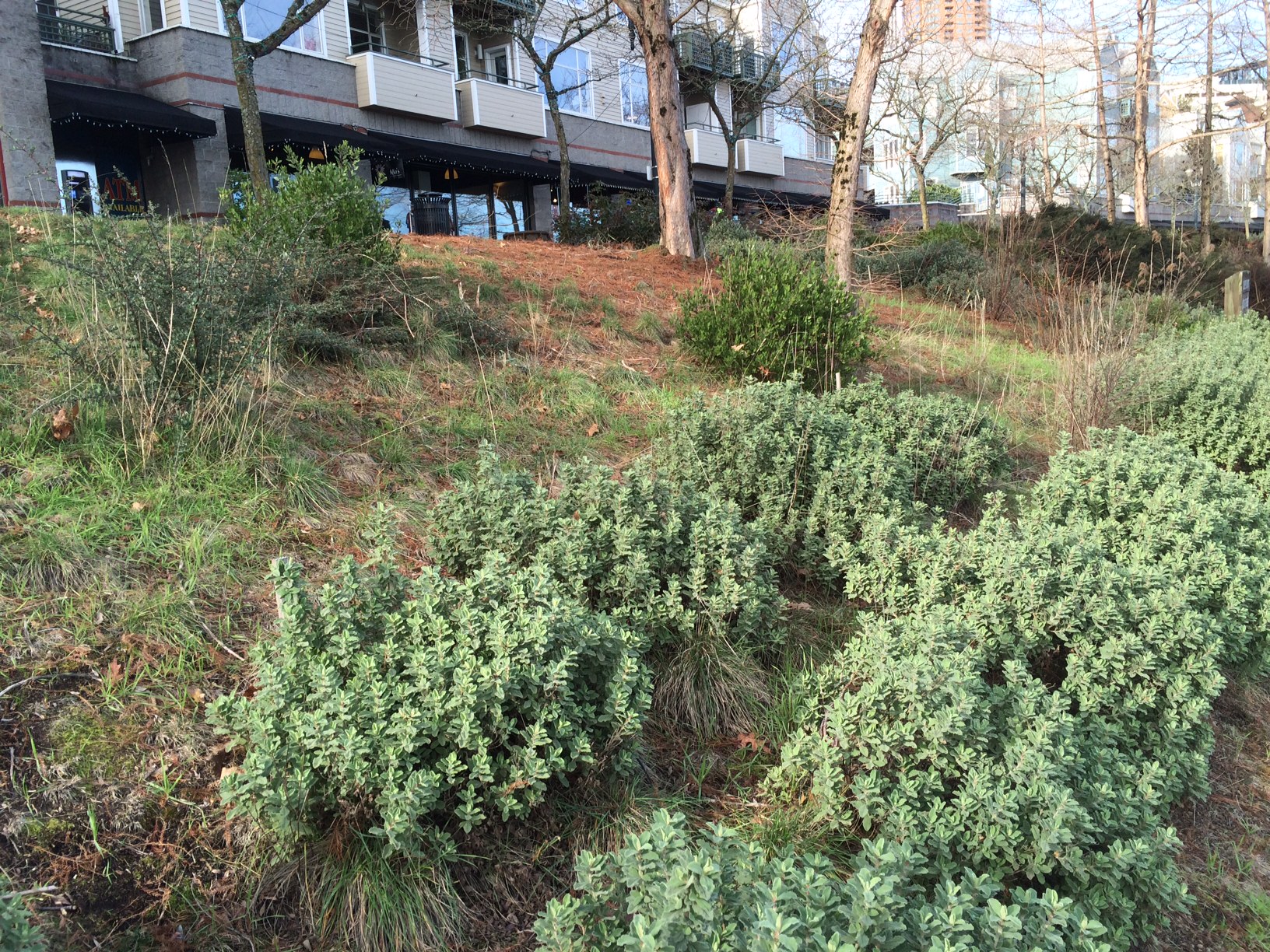
The second grassy bay, below the Harborside Restaurant, between the Taxodium clumps from the south end. A sweep of Cistus pulverulentus 'Sunset' at the bottom, Ceanothus cuneatus 'Blue Sierra' at the left and two Arctostaphylos x 'Harmony'. The grasses are Kohleria macrantha, native, Festuca rubra commutatta and a few nasty invaders.

The second grassy bay from the south end, below the Harborside Restaurant at Riverplace, above the marina, between the Taxodium clumps. The ’04 planting included no shrubs or perennial forbs in this area.  It was a monoculture of Koeleria macrantha, a native early season bunch grass that goes dormant by mid-July leaving the entire area vulnerable to invasion by weeds and offering no ‘barrier’ to either people or dogs, which enter frequently. A sweep of Cistus pulverulentus ‘Sunset’ at the bottom, Ceanothus cuneatus ‘Blue Sierra’ at the left and Arctostaphylos x ‘Harmony’ have been added to this site along with Festuca rubra var. commutata a low, fine textured spreader to help fill in the spaces and scattered native perennials.

We, all of us, are part of the landscape.  Just as individual plants belong to a local native plant community, and its place, so do we. That we live in highly disturbed and contrived landscapes does not change the fact that we live in relationship with it, that we are a functioning part of it. Deny this as we may, many of us as a group likely admit to very little connection to our ‘place’. It’s just where we live, for now. Our understanding of it and any involvement with our landscape, other than as a simple stage for our lives, is minimal, a condition which has become pervasive in modern society. Some professionals, who work with children have come to refer to this state as NDD, or Nature Deficit Disorder, a dissociative relationship now that was once basic to human survival. Today this condition is pervasive and our landscapes, as a result, severely disturbed, damaged and compromised, lack the capacity to return to their former state. There is a general ignorance amongst the public and our leaders of the severity of the problem and our necessary role and responsibility to correct it.  We are locked into a strategy that views landscape as incidental, the natural world as backdrop for our activities, not central to our well-being.  Today landscapes, as long as they meet our grossly simplified idea of our needs, a modern minimalist aesthetic, that does not over tax our ‘pocketbook’, are forgettable. From a horticultural viewpoint this is becoming an increasingly deteriorating disaster, something that not only we can do something about, but one that is imperative that we do so.  Adaptive Management describes a responsive relationship between people and the place in which they live. It is centered on a positive and workable strategy we can adopt that addresses this situation and turns it around, reengaging us with our landscape. Continue reading