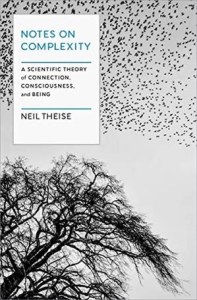
[My ‘reviews’ are not strictly book reviews. I’m not trying to distill the author’s ideas down into a simpler ‘bite-sized’ piece or discuss their ‘style’. These are my thoughts after having read these books. My attempts to make sense of them, usually after several rewrites, as I work to fit them into what I already ‘know’, an attempt to make the ideas presented in this book, consistent with those which I’ve read by other authors. They include ideas not covered by this author. Rarely, if ever, can you come to an understanding from a singular perspective. This is a link to an annotated bibliography on my Blog of several of the more significant books which have influenced me on this topic,]
Complexity theory? Do we need a theory to determine what is complex? No, that’s not what this is about. Theise’s book does not layout a system for determining what should be considered complex/complicated or not. This is a book about systems and structures in nature and how they come about. He discusses how mainstream science has fallen short in explaining this and why, the author believes, without changes in approach, we will continue to fall short. He goes on to present an alternative, or, rather, a ‘sister’ approach which can provide a previously excluded way of ‘knowing’, and in so doing, can account for the ‘gaps’. The problems are not just that this is a difficult concept to understand, but that at the most basic, quantum, level, that at which nothing can be divided smaller, where all things ‘begin’, actions and processes do not follow human logic and contemporary expectation….
I remember reading the book “The Limits to Growth” in the early ’80’s, which introduced me to ‘systems theory’, an approach which required looking at all of the parts and actions within a system, consider their relationships and how they work together, in order to understand its ‘working’. A system could be ‘modeled’, mathematically and the long complex equations run on a computer. There were generally multiple possible models to run. This gave us a degree of ‘predictive’ power, but these would always be approximations, because no model could be perfect and every situation, every starting point, would result in a somewhat different ‘answer’. I followed this with James Gleick’s book on Chaos Theory and its ‘ability’ to explain certain types of patterns, which appear spontaneously in nature, while introducing me to the idea and maths of ‘fractals’. There were multiple books on ecology which necessarily take a wholistic approach. James Lovelock and Lynn Margulis, published their book on Gaia Theory, a product of their collaboration which began in the 1970’s, a theory of the Earth itself functioning as a self-regulating system, as if it were a gigantic, single, organism of which we ourselves are a part. All of these were related, coming out over a short span of years. These were ‘new’ hypotheses and theories, never before seriously considered by science back then, but now being investigated, their validity, and the answers they suggest, impossible to ignore.
Science often advances this way. Seemingly radical ideas, rejected by the majority of the mainstream…until resistance worn down, their validity demonstrated through thoughtfully conducted and reviewed experimentation, the scientific community then coming around to more broadly adopt them and reshape science and our understanding. (Some argue that this ‘process’ requires some number of the old guard to literally die, younger minds being more free to consider the new.) Margulis and Lovelock’s ideas were just too far out there for most at the time. For many, such thinking then belonged to the realm of metaphysics, or fanciful science fiction, frivolous exercises in thought and belief. Exploring these ideas, testing their validity, only became possible with the computational capacity of ever more powerful computers and an openness to branches of thought once rejected by science. ‘Game Theory’ and cybernetics played a role in all of this as well. Complexity Theory has far more capacity to explain how matter and functional systems emerge, or manifest, than mainstream science could historically. Nature, through the conditions and forces in play at any given moment, ‘drive’ the universe toward order along with the ‘creation’ of complex structures and functions, at the cost of energy spent, ‘held’ in the new structures and dissipated away as lost heat. All of countless processes linked to one another through a myriad of relationships and the feedback loops which comprise them. The universe continues to evolve, and as it does, it continuously spins off everything in it, from sub-atomic particles to human beings over time, a process which it itself is directly influenced by its evolving ‘self’.
Continue reading →

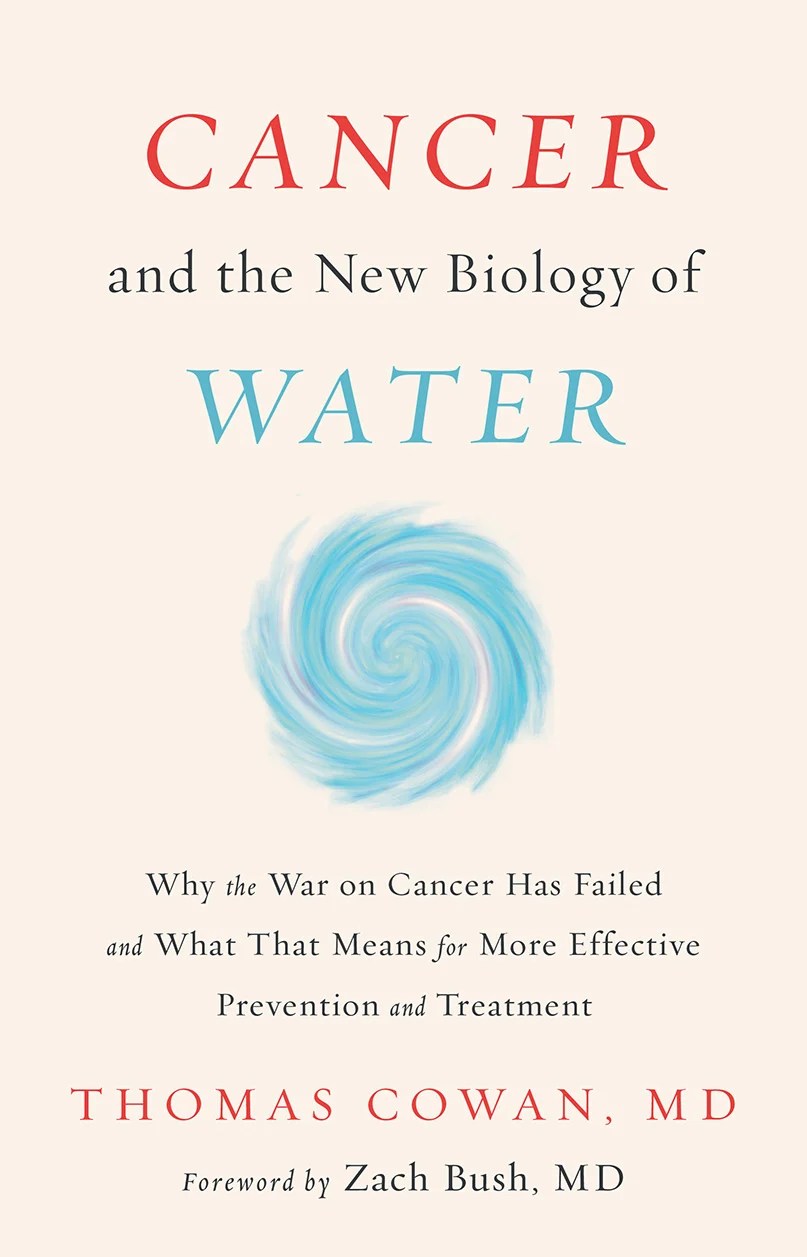

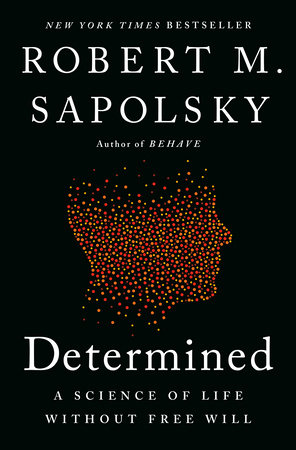
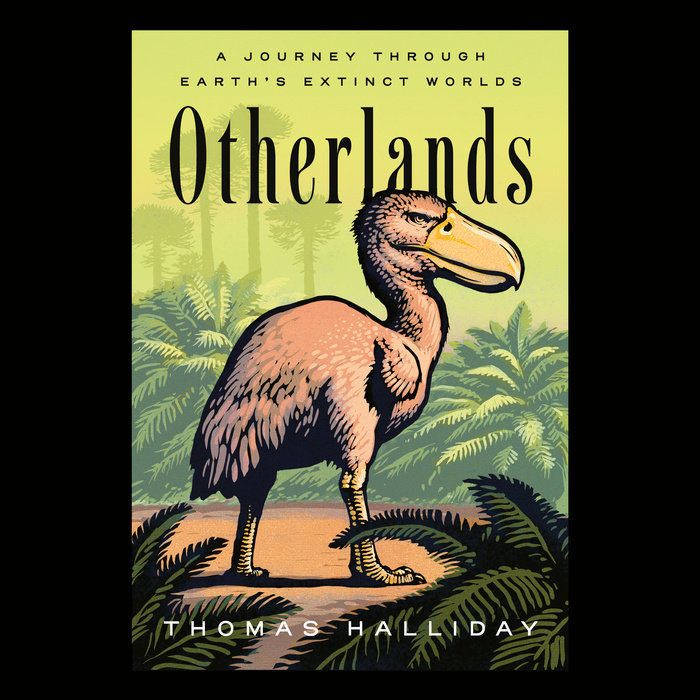 I mostly read non-fiction, books on history, the ‘natural sciences’, about life. I get my fiction in the form of television and movies, graphic novels and no, there is a lot more out there other than the limited, repetitive genre of super-heroes from the DC and Marvel universes. I’m drawn to the speculative stories, alternative tellings of this world, of life lessons, attempts to reimagine the past, or invent possible futures, stories that question what we are generally taught in this life. But really, I’m a science guy, reading those authors who draw from the leading edge of science, and the scientists themselves, who are skilled enough communicators, not something that necessarily is companion to those ‘doing’ science, those who can clearly discuss what they’ve learned and present reviews of entire fields of study, which strive to show the reader how our understanding of the world is changed.
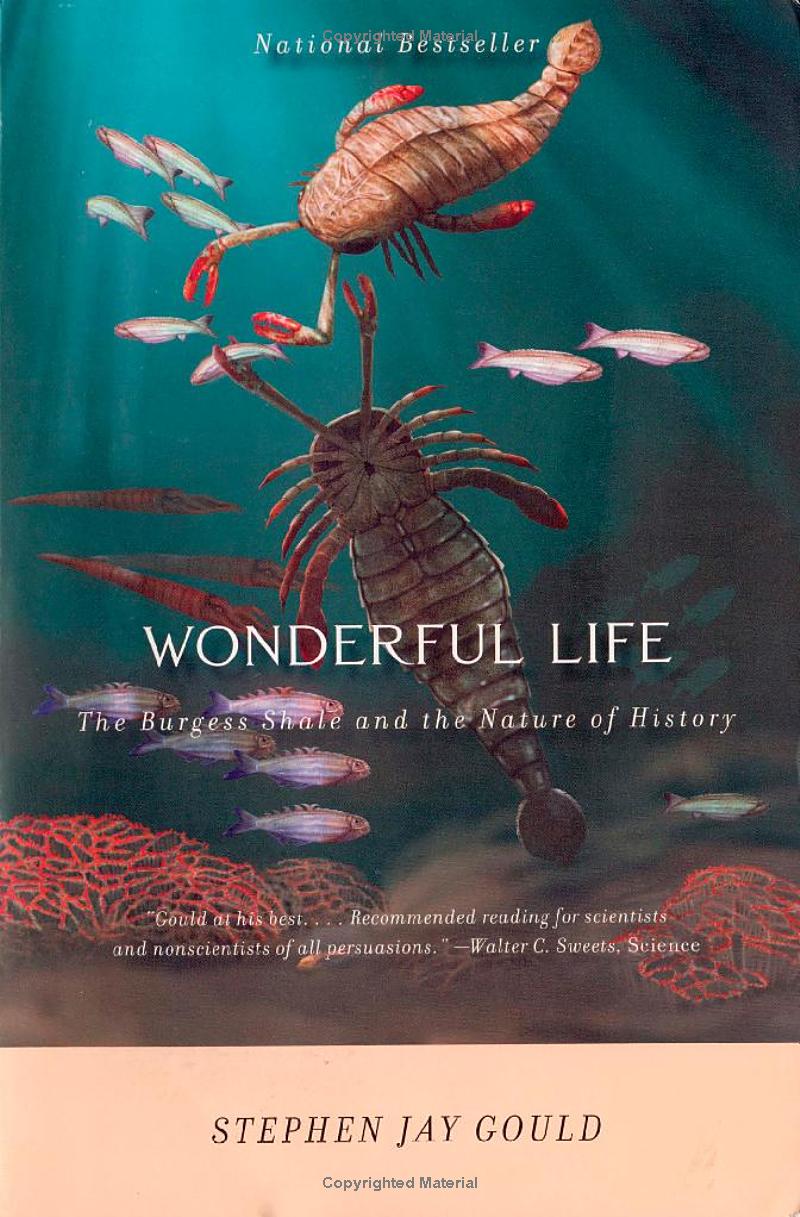
 David Graber, an anthropologist, and David Wengrow’s, an archeologist, book, “The Dawn of Everything: A New History of Humanity”, is more than ‘just’ a history of humanity, which would on its own suggest a massive tome of thousands of pages. it is an examination of how we ‘do’ history drawing many examples of peoples and societies across time from the Paleolithic through the colonization of North America. It is not simple reportage, rather a look into the correctness or accuracy, of how we have been telling history. I enjoy such questions and their capacity to rock the academic and intellectual ‘boat’. My reading has spurred the formation of links to two other books I’ve read recently, Stephen Jay Gould’s, “The Burgess Shale” and Pekka Hamalainen’s, “Indigenous Continent”. All three of these call into question previously widely accepted thinking on their subjects. More than this, they question foundational ideas upon which the science they examine are founded. This appeals to me. But more than this, there is an idea central to them all which really rings ‘true’ for me.
  We live today in a very divided and polarized world. You can take almost any characteristic used to define a group of people today and it is now being used to separate and divide. We do this sometimes out of pride, others, out of fear and desperation. We thus define our individuality, or our ‘people’, in a process of reduction, eliminating variation and possibility. This is who I am. This is my world, the world that matters. When we do this our world shrinks. That outside of it, becomes a threat and ‘threats’ proliferate. The causes of our problems are commonly reduced to ‘them’. Most of the divisions are, however inconsequential. Having been pried open we find ourselves separated by seemingly giant rifts, animosities greatly exaggerating the actual differences. Too many ‘leaders’, in bids to gain power themselves and cement their own advantage, beat the drums of division, gaining followers, customers and believers to their cause…which is often something very different than what they may publicly say. A world built on such differences is a precarious one, as groups strive for security by focusing on the differences rather than on the infinitely more common shared links which join us. This country was, in many ways, built on such differences.