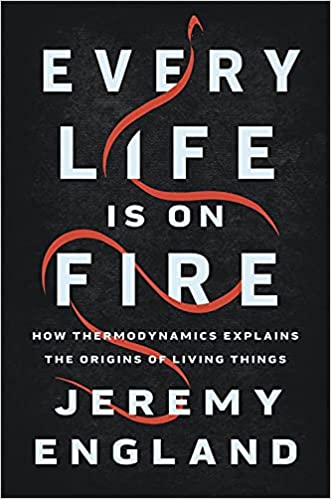
 This is a book about ‘life’, that which animates particular organic structures, organisms, while other, non-living, ‘structures’ remain fixed, but for the physical and chemical forces which wear them down. From our human perspective, this sets ourselves, and all other living things, apart from the inert, nonliving, matter that comprises our world and the universe. England, as a physicist, sees the world of nature and all matter within it, differently than most of us. Science has demonstrated that the universe tends to operates under consistent ‘laws’. Organisms, while a special ‘class’ of matter, are still ‘of’ matter, composed of the same atoms, only joined together in complex macromolecules not found outside of organisms, created wholly within organisms. They are a ‘family’ of complex, shared, organic structures. This complexity of structure goes to determining their functionality. Function increases and diversifies as complexity increases. Capacities are expanded with the flow of energy through them, an effective and sustaining agent in their ‘being’ and evolution. England’s view is consistent with the many other physicists who have looked into life and view it as an inevitable outcome of the processes, energies and materials that comprise Earth’s particular corner of the universe. Earth appears to be a relatively rare occurrence, but it is extremely doubtful that it is a singular one. The ‘ability’ of energy to organize and structure matter is universal. Given the particular mix of ‘ingredients’ and energies here on Earth, matter has come together over the course of over 4 billion years to form life as we know it, because it could, and whatever is possible/probable tends to happen with a degree of frequency. Particular patterns precede those to follow, not necessarily determining them, but increasing the likelihood that they will. The flow of energy through matter tends to ‘favor’ a range of outcomes. Those outcomes tend to favor the next, building from one ‘success’ to the next.
These patterns and energy flows occur at subatomic to molecular levels, well below our ability to observe and measure them. We can only directly observe the ‘results’. The underlying patterns are not generally obvious to us. Our perceptions are shaped by our the physical limitations of our sense organs and our beliefs about the world. We tend to ‘see’ what we expect to see, not necessarily what is there. We shape our perceived world into the commonly shared story that has been passed on to us, a very human story. Our particular indoctrination, our educations, all go toward determining what we see, how we interpret it, and then taking our experience, we use it to reinforce that understanding. In a sense we ‘choose’ and make our reality. From the moment we each open our mouths or put word to page, we do this. Our language and knowledge limit us. It requires that we distill our perceptions, our experiences and our understanding into a comprehensible form. We are all at a ‘remove’ in this sense, apart from the world in which we live, although we are intimately immersed in it. And that is the source of much of our difficulty, for like fish swimming in a stream, we are ‘of’ this place, a part trying to understand its extended self, our boundaries, self-imposed, insistent upon our individuality and our misunderstanding of what that means in a world that fully integrated and interwoven.
As ‘western’ people we tend to see ourselves as separate from it. Independent agents. When in actuality, we can never be so. To be so independent, separate, would negate that which is essential to our lives, the flux and flow of energies through us, as parts of a larger, complex and whole system. England looks into this question of what life is by taking our modern and still developing theories of ‘thermodynamics’, our study of energy and the way that it ‘works’ on the stuff of the universe, on matter, as his way into this ‘story’. Energy is transformative. Matter, is arguably, a particular expression of energy. One can be translated into the other.
England is a theoretical physicist. You will not find in this book a detailed explanation of the living organism or description of the flow of energy through one. That is within the purview of the cell biologist, the biochemist, the quantum biologist. Thermodynamics, and his understanding of dissipative adaptation are larger concepts that can give us a framework for understanding the bigger picture of an almost unfathomably complex topic. England joins with those today who would argue that any living organism is not so much a thing as it is a process, in a state of continuous change, a process which both follows a probable, understandable, path, and is itself a part of the larger/longer process of evolution, of becoming, building on itself and life’s many patterns, as it moves ahead through time toward something unknowable to us. We exist from moment to moment, a ‘response’. Fall out of that moment and we are dead. Through us, the flux and flow of matter and energy, drive an organism, along a path, a path that follows one of a particular and massive set of more or less likely probabilities, each which influences what will follow, within a universe of definable ‘law’. Here England gives us an intellectual framework for understanding the processes at play in this process of living. Living organisms are conductors of a continuous flow of energy through themselves, from outside and back, after it has degraded. This flow of energy acts in very particular ways on the molecules, cells, tissues and organs of an organism…until it no longer can. An organism, is in a sense, a conductor, a channel through which energy flows from a higher, more available state, to a lower, less available state. Energy drives them, permits them and enables them, so that they are in this sense ‘self’ sustaining…as long as the energy flows and the organism can maintain the integrity of its structure at all levels.
The following is an extensive quote from his book: Every Life is on Fire: How Thermodynamics Explains the Origins of Living Organisms, pp. 113-116.
“…a plant—for example—has to be thought of as holding steady on a steep [energy] hillside in a constant state of free fall. Much like the chemicals in a battery powering a flashlight, many molecules in a plant are constantly undergoing reactions that convert them into other, lower-energy forms. At the same time, randomizing thermal fluctuations are taking the specially ordered components of each cell that have been assembled in a particular fashion and wreaking havoc with them, either through chemical damage or via larger-scale physical rearrangements. In permanent darkness, a plant is therefore on a slow road to death, for dying in physical terms is nothing more than sliding downhill in a variety of chemical and physical ways. Of course, plants can survive just fine for a while in the dark, but not forever. [Animals, for the most part exist in a much more precarious balance requiring much higher energy flows for a given mass.] Eventually, the twin tendencies to lower energy and higher disorder that are required by the fall to thermal equilibrium will win out, and the pile of matter that was originally a live organism will start to look less and less like one.
Continue reading →










 GardenRiots