Category Archives: Climate

On Healing: Life, Place and Relationship in Oregon’s Great Basin Country

The massive fault block of Hart Mountain, Poker Jim Rim in the distance to the north. The gravel county road switchbacks up the more than 3,000′ beginning from the center in the distance here. From here this is how you get to Steens Mountain without doing miles of backtracking.

I woke up this morning to the sound of bird song…nothing else. There were Western Meadowlarks and a multitude of others, I’m sorry to say I don’t know, but beautiful and distinct. I was laying in bed, atop our truck, thinking about how rare an event this is for so many of us…not that the birds aren’t here greeting the morning every day, but that so many of us aren’t ‘available’ to hear them, sequestered away safely in our homes, otherwise occupied or, more commonly, the birds literally excluded from our urbanized and ‘modern’ places of residence, their own places developed/destroyed. Entire neighborhoods and cities excluding all but the most common songbirds and passerine species.  Little quarter is afforded most wildlife in modern development…and that upon which their lives depend.  Continue reading

Dry Canyon Proposal: the need for change in maintenance, use and planning

[The following is a piece I wrote and sent to our local Parks staff, its advisory citizens committee, mayor and city manager…I got little back in response. I’ve developed a relationship with one of the city arborists and the park’s planner as well as have met several active neighbors interested in protecting Dry Canyon’s natural areas, several of whom have natural resources backgrounds with agencies. The City has no natural resource or botanical staff. There is no formalized friends group, nor is their an outreach and public education program that addresses these problems and the role of residents in their solution. Signage is minimal and inadequate. Their horticultural expertise would also seem quite limited. This is understandable as the City’s population has grown very rapidly in recent years. The need for such programs and an increase in expertise on staff will only increase as Redmond’s population continues to grow.]
 

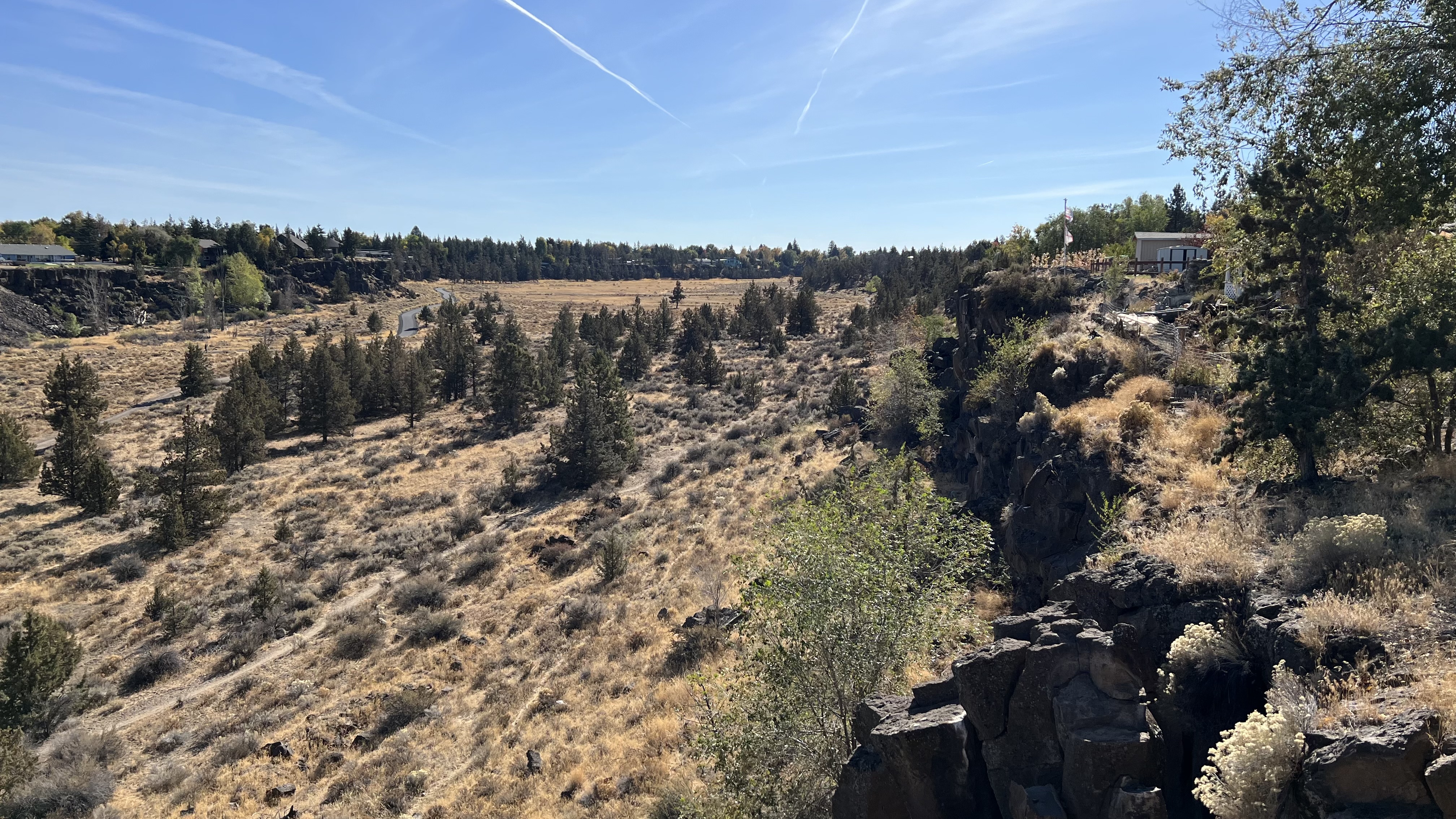
Redmond’s Dry Canyon looking south from the west rim on the Maple Street Bridge. The area in the immediate foreground burned this last summer.
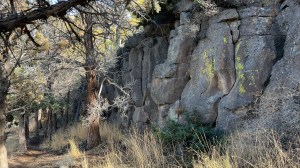
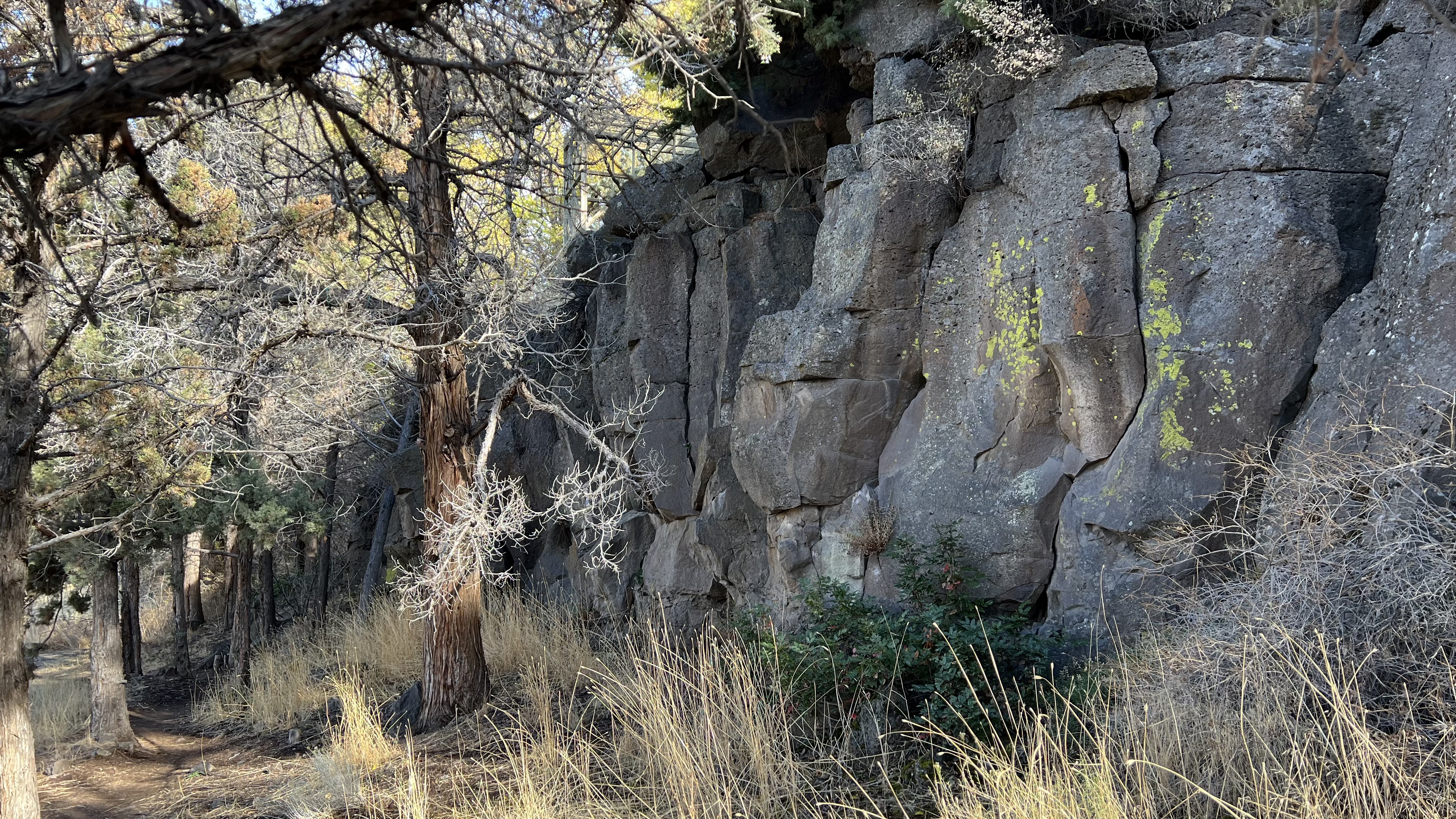
A typical view at the base of a section of relatively unbroken rim on the east side.
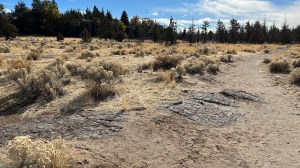
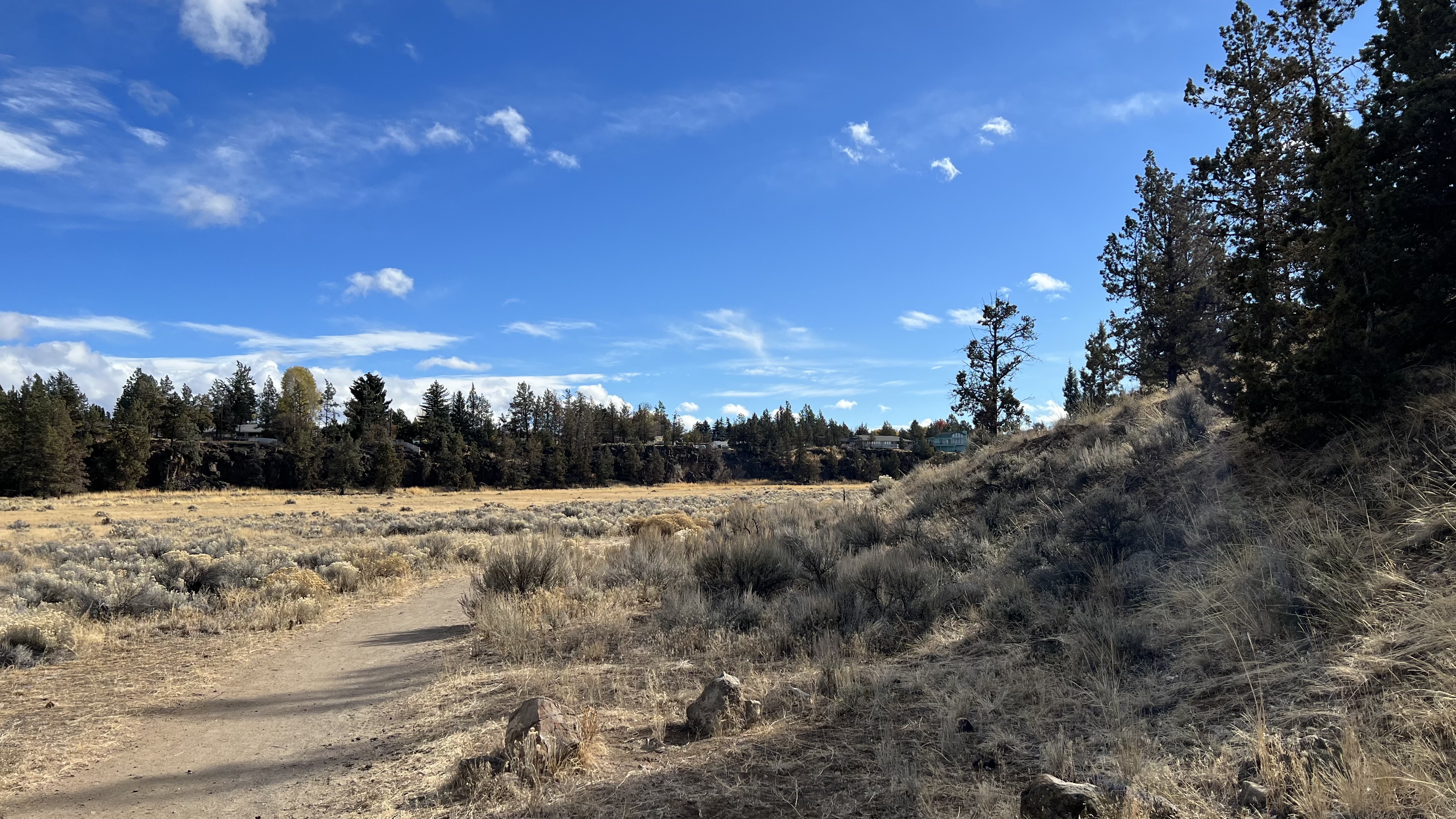
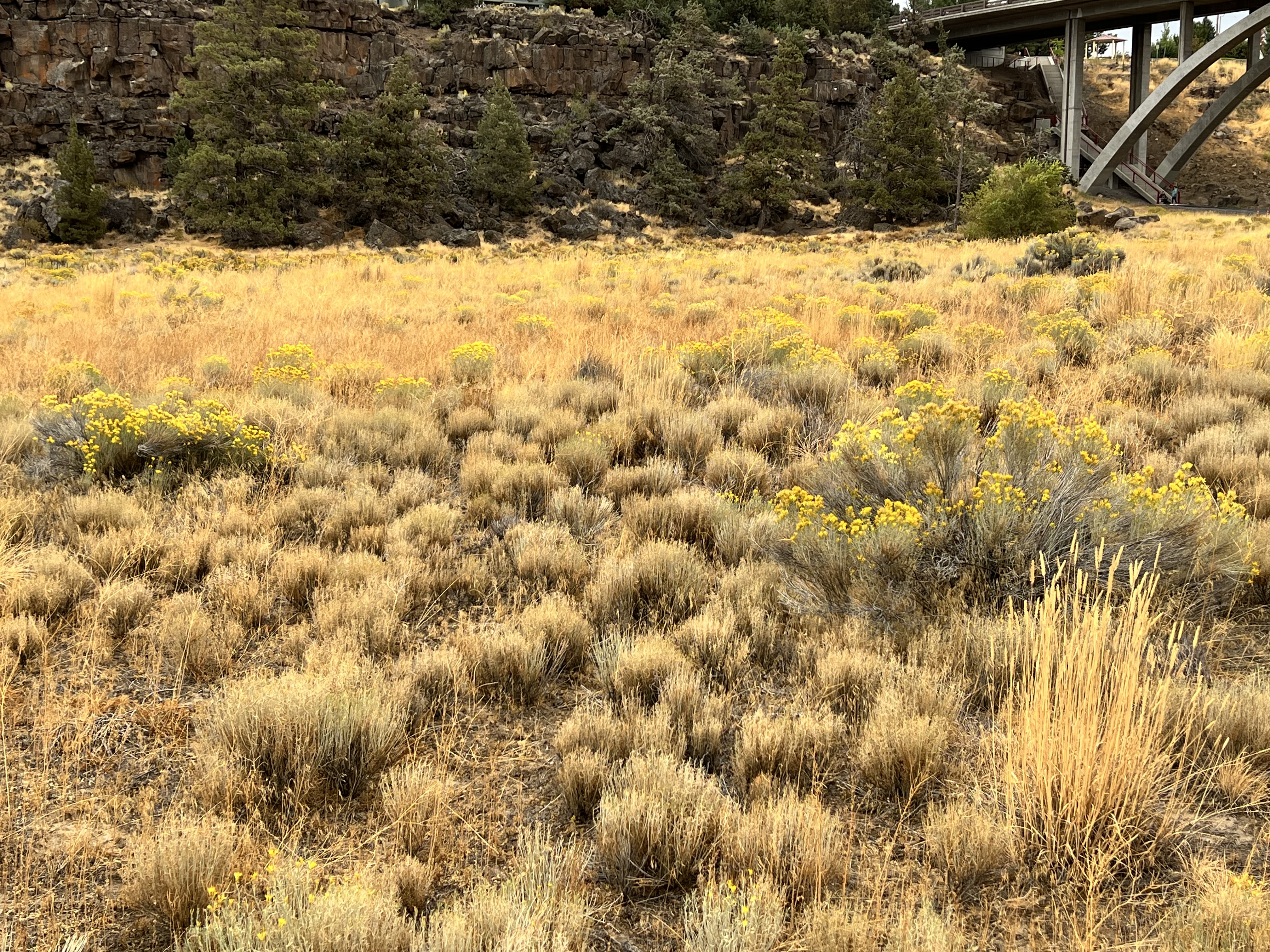
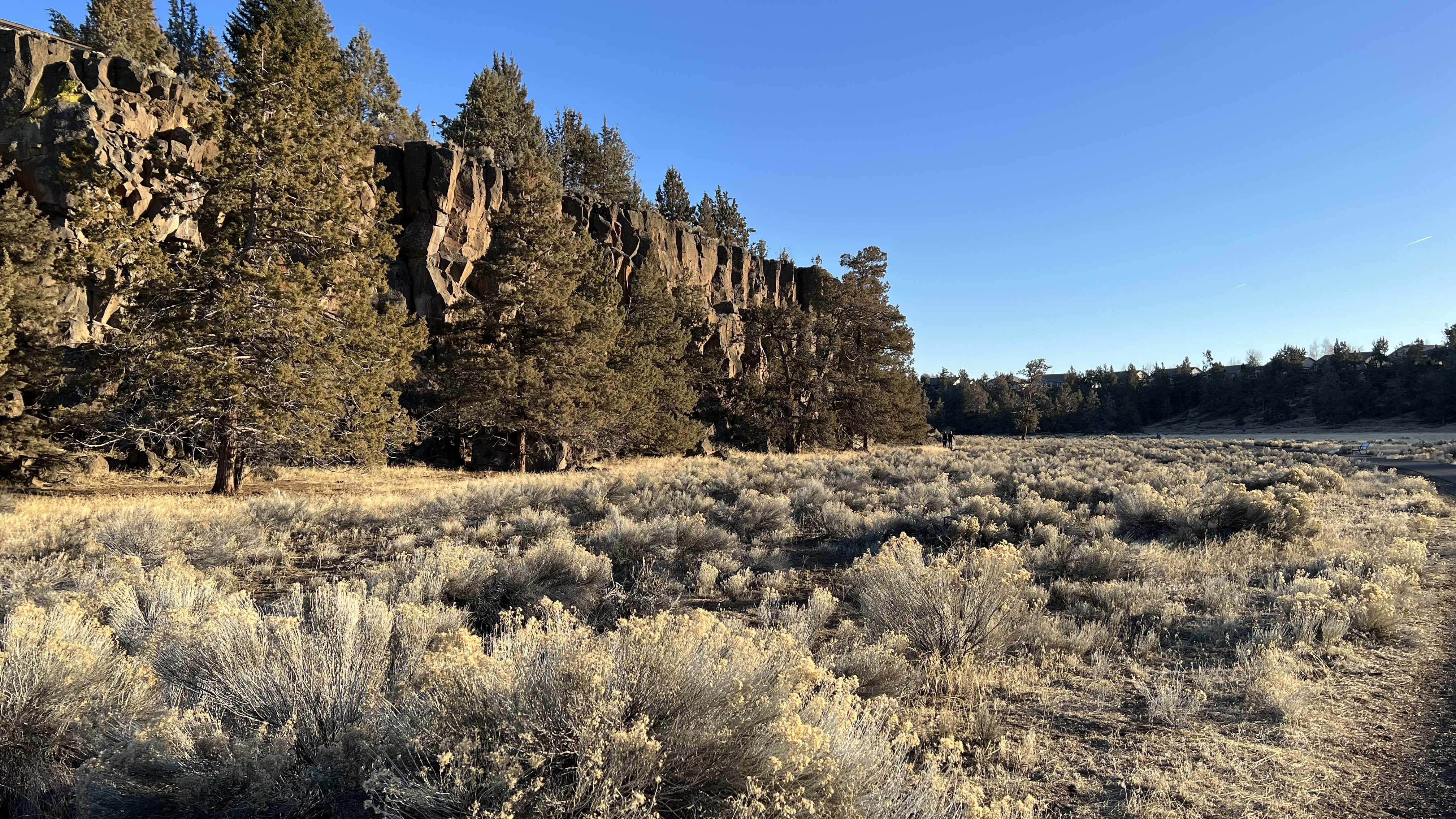
The canyon floor is variable, but as this pic shows, a solid layer of hardened lava underlies what soil is here, either blown in or washed in, a limiting factor of what can grow here. Rabbitbrush is a common and ubiquitous native pioneer.
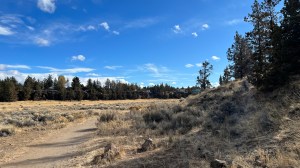
Match of the canyon floor is recovering from pasture use. These areas have relatively deep soils and are still transitioning with many weedy mustards, annual grasses like Cheat and planted grasses like Crested Wheat and Annual Barley. Native Bluebunch Wheat is scattered as are other natives. Gray Rabbitbrush, a native seral species has moved into much of it, but the weeds are dominant. Sagebrush and Bitterbrush are more at the edges and lower rim areas.

This section of bottomland, former pasture, probably burned not that long ago, has quite a colony of Rabbitbrush coming along, all it would appear of even age, suggesting a fire. Rabbitbrush are early colonizers and ‘prepare’ the way for natives to follow. This is just north of the Maple Bridge.
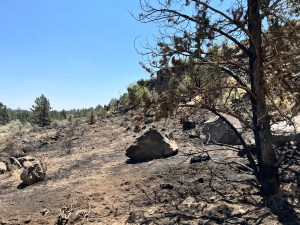
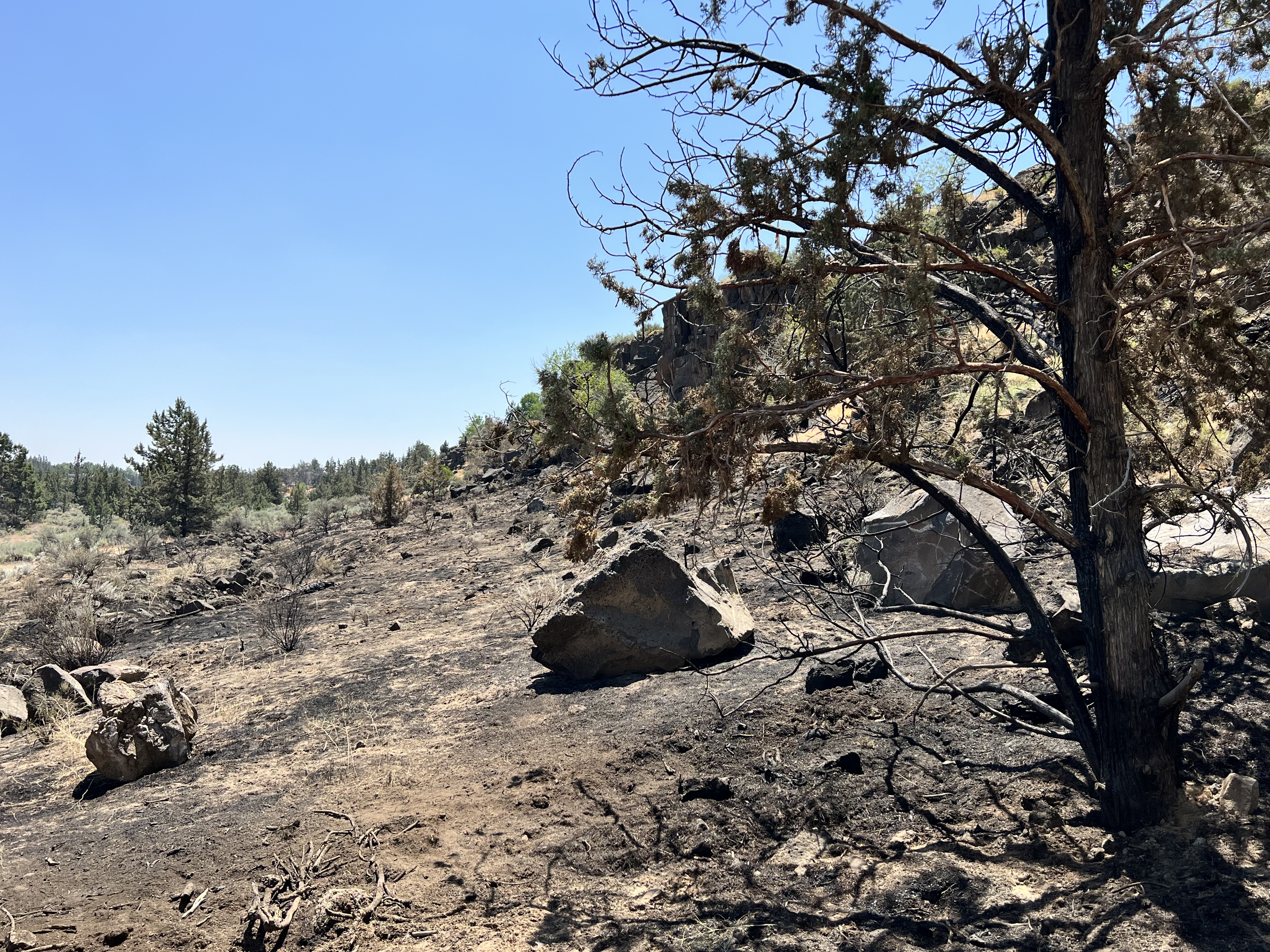
This area, maybe 5 acres, burned in July. It will be interesting to see what comes back and what the City may plant??? Fire kills Sagebrush and Juniper, while it seems to favor Cheatgrass. So far, April ’24, nothing has been replanted. The window for seeding is closed. Rabbitbrush can survive a burn. This site is unfenced, with very fragile soils and we’ve already observed new bike trails in it.

My wife and I are both recent returnees to Central Oregon having both grown up here. We are also frequent walkers in Dry Canyon, a place I spent many hours in playing and exploring as a kid in the 60’s. Redmond has changed a lot over the intervening years…change that continues apace as it grows. I’m not going to whine about the ‘good old days’ and things lost. Much of the change I welcome or at least accept (We did move back!), but population growth, in addition to bringing along economic vitality and stability, new and enriching opportunities and a more diverse community, increases the ‘pressures’ on the naturally limited assets that largely define the place and attract residents. I’m speaking here of the natural landscape, its features and the opportunities which it affords us for recreation and quiet enjoyment. Realtors were once fond of saying that no one is making new land, as a prompt for buying…it is a fixed and limited quantity. This limitation has profound implications for a growing population. We have far more people today ‘enjoying’ a limited, and increasingly over utilized landscape. Continue reading

Knapweeds in Redmond’s Dry Canyon and the Pursuit of a Healthy Landscape

Redmond’s Dry Canyon looking south from the west rim on the Maple Street Bridge. The area in the immediate foreground burned this last summer.

If you garden, or maintain a landscape, you come to understand that not all weeds are the same. Each will have its own ‘strengths’, or perhaps you might call it ‘virulence’. Any particular weed, just like any other plant, will respond ‘positively’ to supportive growing conditions, conditions which often closely align with those which exist in its place of origin. Plant explorers and nursery growers are always looking for ‘new’ plants for landscape use. in a way, they have to walk a fine line. They must find plants, that with reasonable effort on the part of the gardener, can thrive across a range of conditions, unless they are looking for specialty plants, for narrow, niche, markets. The introduction of new plants must be somewhat measured, our enthusiasm tempered, because plants which are too adaptable, too vigorous, may possess the ability to escape our cultured gardens and find a place in the surrounding, uncultivated, landscape.

For Central Oregon, when we look beyond our regional natives, we must keep this in mind. Exotics from similar growing and climatic regions around the world offer both promise and threat. We want our plants to be successful, but not too. Sometimes through the process of trade, the movement of livestock and agricultural products, particularly aggressive species hitch a ride. A few weed seeds can be easy to miss. If they are aggressive enough and go unnoticed, a distinct possibility, it is likely that they wont be detected until a sizable local population asserts itself…and if no one is watching, that can be a fateful error. One group of plants, with many wonderful possibilities, also include species which can be exceedingly problematic here in Central Oregon, these are from regions sometimes referred to as Steppe. Continue reading

Spruce Park, Redmond’s Newest Park and Our Neighbor: a horticultural critique

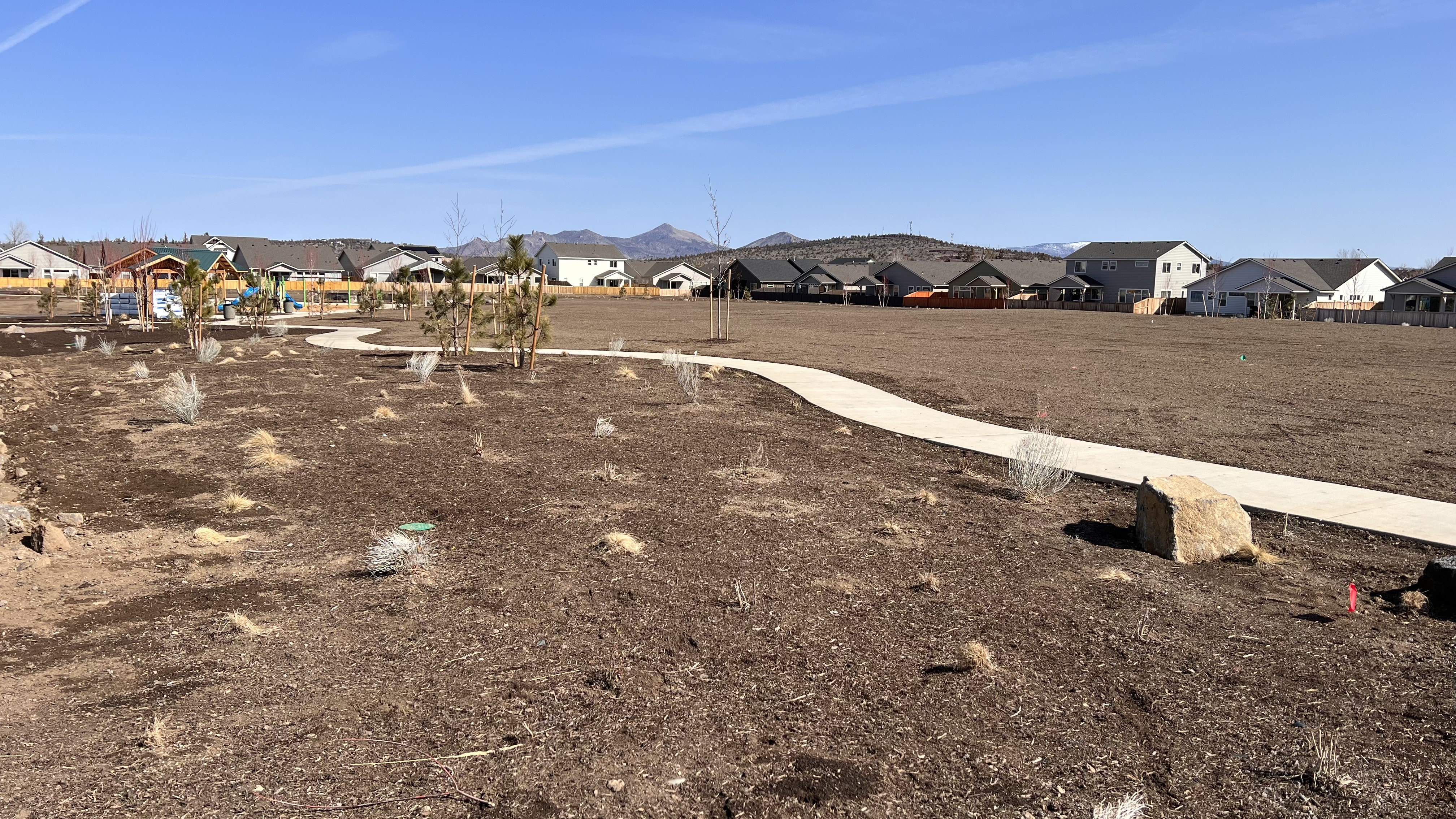
Redmond’s Spruce Park looking NNE from the SW corner toward Gray Butte and Smith Rock in the background. The border beds which follow much of the loop path are ‘native’ plantings according to the conceptual plan. It is common to claim that most of the plants are natives in designed natural areas, but native is not synonymous with ‘natural’. Although natives are used here concessions have been made including such plants as Echinacea purpurea ‘Pow Wow Wildberry’ and Rudbeckia ‘Goldsturm’. In a strict sense Ponderosa Pine aren’t native to this immediate locale either, they require more precipitation than we normally get and the Autumn Blaze Maples are a hybrid of two northeastern North American species.

A landscape, in nature, is a whole, functioning system, capable of perpetuating itself, through out the seasons and years, relying entirely on its own conditions and the cycling of energy and resources occurring on and within it. This is also the definition of a modern sustainable landscape. Ideally they require no inputs or energies supplied from offsite aside from the sun, precipitation and the normal cycling onsite of nutrients and water. A human made, contrived landscape, as all of those built by us today are, may be ‘judged’ by how well they function on ‘their own’, by how well they fit this ideal. Labor and outside inputs necessary to maintain a landscape are then indicators of how out of balance, how far from ‘ideal’ nature and genuine sustainability, a landscape is. A contrived landscape, which ignores the relationships integral to a healthy landscape community ‘demands’ more and more maintenance and support. Given its design and use, a landscape which ignores its site and relationship requirements will deteriorate from the intended design, losing to death component plants while gaining, increasingly, more unwanted available weed species. Design, conditions and use are essential to determine, in this sense, what a ‘good’ landscape is. Continue reading

The Owls of the Eastern Ice:A Quest to Find and Save the World’s Largest Owl, Jonathan Slaght, a review

Slaght holding one of the Blakiston's Fish Owls they captured and released.This is a story about the effort to understand and protect Blakiston’s Fish Owl, the largest owl in the world and its endangered population living in the Russian territory of Primorye Krai which lies along the Sea of Japan, north of the Russian port city of Vladivostok. It is a remote, sparsely settled and wild place, isolated from the rest of the world, and Russia as well, at a latitude close to our own, stretching 559 miles, between 42º and 48º north latitude. The author, Jonathan Slaght, a PhD candidate at the time, spent years in Primorye first in the Peace Corps and later working on a variety of wildlife projects before he took on the owls, a several years long study he undertook in association with the University of Minnesota, teaming up with Russian experts, and a loose international group of others doing research on other species resident there, like the Amur Tiger. His crew of Russian field workers, most of them hunters, skilled sportsmen, skilled as well in traveling through the wild landscape and survival there, were invested in the work they were doing. These people become his friends over the several years, despite or maybe because of their quirks, while both assisting and ‘training’ him as they do their primarily winter field work, under very harsh and often dangerous conditions, gathering data in the long months he spent back in the US. Along the way he lays out the work he must do to create an effective conservation plan, the goal of which was to secure the owl’s future, an owl about which relatively little was known. Continue reading

On Plant Drought Tolerance and Gardening in the Arid Oregon High Desert

The Dry Canyon in Redmond, Oregon, which for 200-300,000 years contained an earlier version of the Deschutes River. The rivers course was changed by an eruption from the Newberry Volcano, a massive shield volcano with over 400 vents 40+ miles to the south. A later eruption partially filled the canyon with lava. In this section the canyon was filled raising its floor so that it’s around 70′ deep, its two rims separated by about 700′.

Drought tolerance is an interesting topic. I’ve written on it before, but now have some additional thoughts to add, in part because we have recently moved to much more arid Central Oregon. A drought tolerant plant in Portland is a very different thing than one here where annual precipitation can vary from around 13″, very rare, down to as little as 5″, commonly 8″. While Oregon in general is considered to be a mediterranean type climate with dry summers and wetter winters, Redmond’s climate is strongly influenced by drier continental patterns. This last January, ’23, we received only 1/4″ of precipitation while Portland had 7.32″ about 120 miles to our northwest, on the ‘wet’ side of the Cascades. Drought tolerant then means different things in different regions and can vary widely within a region along with soil conditions, slope and aspect (which direction a site is oriented). Generally speaking, drought tolerance refers to the ability of a particular plant to endure periods in which available soil moisture is below that needed to support the plant’s metabolism. A tolerant plant can ‘bridge’ these naturally occurring ‘dry’ periods. An intolerant plant will suffer cellular, even structural damage and may be unable to flower and produce seed. Health is compromised should the drought last too long, resulting in internal physical damage and leaving it more subject to infection or infestation. A drought tolerant plant will have the capacity to respond in a healthy manner when soil moisture levels return to those that support active growth. Within these limits the stress it accrues does not compromise its health…beyond it though….Damage is accumulative. String a series of drought periods together and a plant’s capacity to recover is compromised. Because patterns of precipitation, of water storage and movement, vary widely across the earth, regions and sites have different plant communities associated with them. The condition of drought stress then varies with the location and the species. A drought tolerant plant on one site may crisp on another drier one. Of course this can work in the opposite sense as well, that a site may be too wet, but that’s another story. In the case of the PNW and many other regions, it is also the timing of the precipitation, when it occurs during a plant’s cycle of growth and dormancy. Continue reading

Fen, Bog and Swamp: A Short History of Peatland Destruction and Its Role in the Climate Crisis , a Review

For another review: link

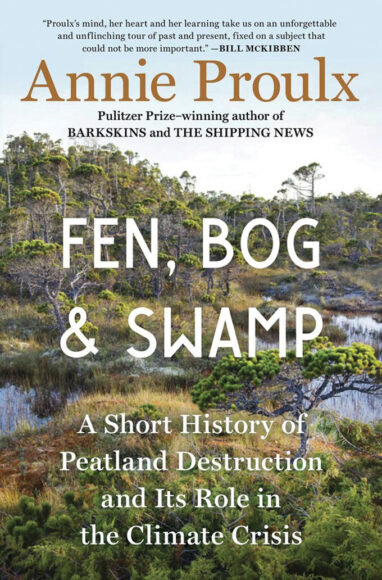
Novelist Annie Proulx, begins her book with her childhood, giving us an idea of who she is, her attachments to the living world. She takes us with her on a walk she took with her mother as a young girl, through the neighborhood wilds, to an ignored patch of swampland. Her mother loved such places. She places her story in the larger story of the times of her birth and coming of age, of the 1930’s and the cruelties we perpetrated on each other and our limited view of the natural world, a world set as a table before us, for our consumption. She writes of her attachments to these abused and devalued wet landscapes, their necessity for a healthy natural world and what their loss means. Earlier, I reviewed Edward Struzik’s book “Swamplands”. Struzik has spent years working with researchers and conservationists in the field, and writing of his experiences. Proulx’s approach is much more personal as she works to place bogs, fens and swamps into a human, historical and cultural context. Continue reading

Climate, Trends and Current Weather: A Nice Record Setting Fall Day

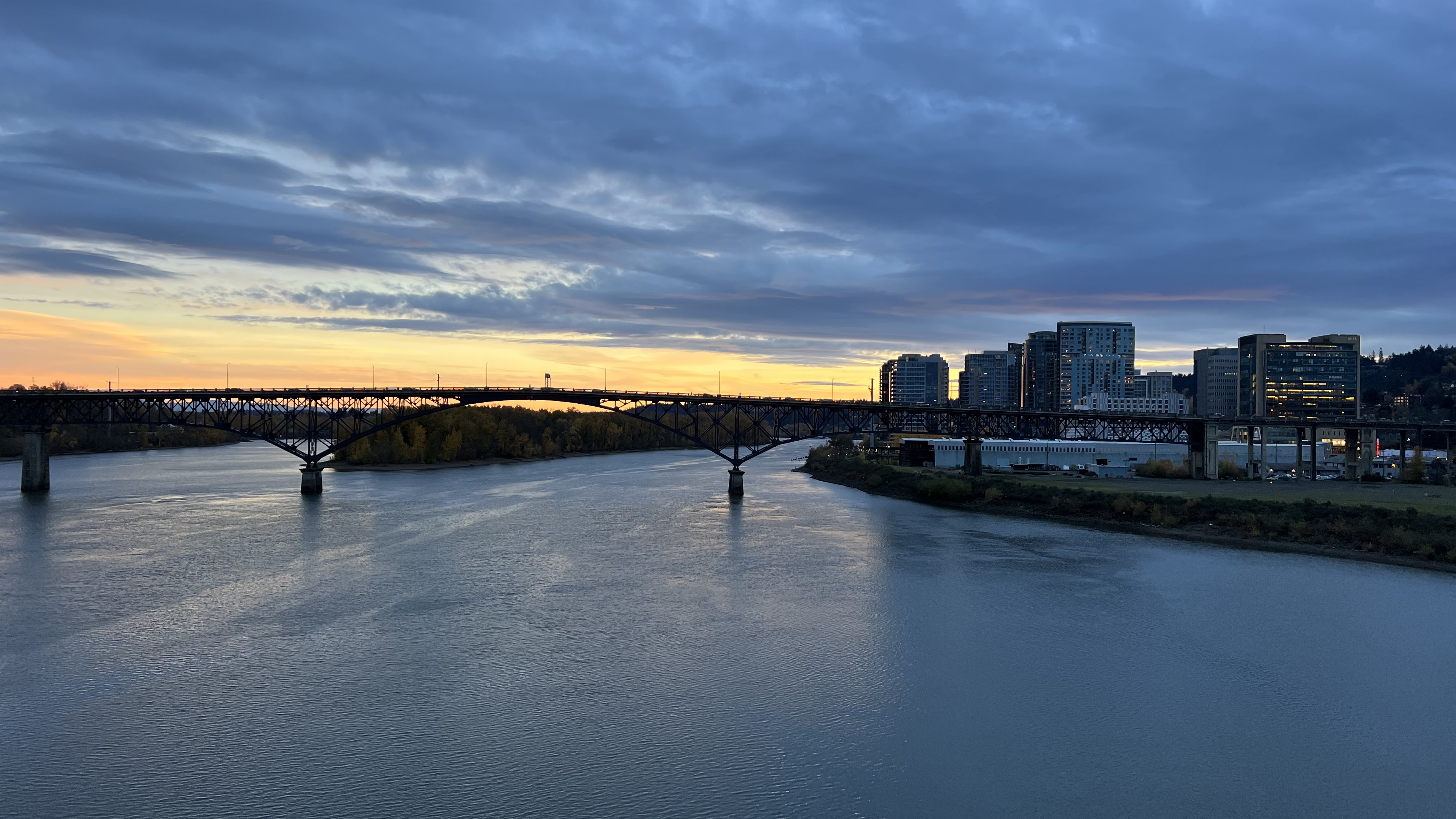
Looking south, upstream along the Willamette, to the Ross Island Bridge and the South Waterfront buildings hugging the western bank which house the pool in which I swim..

I puttered and pruned in the garden today until I produced enough waste to fill my yard debris wheelie bin, it didn’t take long. After lounging around and reading for awhile I walked the 2 and 3/4 miles to the pool at OHSU where I swam for 40 minutes, then spent another 1/2 hour doing yoga and some core exercises in my efforts to slow down my inevitable decline…then, I walked back home across the river. It was a bizarrely warm afternoon, and early evening, and I covered the distance in a tee shirt…and pants and shoes of course. Lots of walkers out crossing the Tilikum Bridge and walking along the river. People were taking advantage and enjoying the day. I wonder how many understand just how ‘weird’ this weather is? Continue reading

Musella lasiocarpa: An Adaptable, Smaller Banana for Warm to Mild Temperate Gardens

I’ve been growing Musella in a larger pot as well. It performs much as it does in the ground reaching similar size, getting along with comparatively little water. This plant suffered no leaf scorch even during our record breaking streak of 108º, 110º and 116º in late June ’21. It was protected in shade in the afternoon. Here it sits on the deck next to my Musa accuminata ‘Zebrina’, a Malaysian tropical, which did suffer a lot of marginal leaf burn, losing several of its softer, newer, leaves, even with daily watering of its pot during the hottest stretch (It quickly recovered after the temps settled down.).

Musella lasiocarpa may be the most easily recognized of the 48 species within the small but economically important Banana family, Musaceae. It is distinguished from all others by its small size, its congested, quickly tapering pseudo-stem, which is nearly bulbous at its base, its leaf blades extending upward from its relatively long petioles, shaped much like the traditional blades of Aleut kayak paddles and its unique flowering structure. Like all bananas the pseudo-stem is made up of tightly clasping, channeled, petioles, and its inflorescence which resembles a golden lotus flower in bud, with tightly held yellow to orange bracts having very little separation from one to the next, shielding its later emerging flowers tightly held beneath.  The shape of this plant and its texture lies somewhere between the more commonly grown ,and proven, hardy members of its Order Zingiberales, the Hedychium spp. and both Musa Basjoo and Musa sikkimensis, which often fill a role in providing many mild to cool temperate gardens with their ‘tropicalesque’ characteristics. If your garden resides in climatically colder areas than those experienced by topical plants in the wild, then any of these may succeed as permanent contributors to a tropical ‘feel’ in your garden. Of course you can also choose to grow true tropical and subtropical species if you are committed to the necessary protections they will require over your cold season. Continue reading

On Life: An Annotated Reading List of Titles Exploring the Physics, Biology, Evolution, Natural Selection and the Generative Power of Far Out of Equilibrium Dissipative Structures (Organisms)

Nurse, Paul, “What is Life?: Five Great Ideas in Biology”, WW Norton and Co., 2021. I’m placing this book out of order here, its American edition just released this year and I’ve only just read it, because I concur that this is an excellent introduction to its topic and should be accessible to a broad audience, one without an academic background in biology. It does what Carlo Rovelli’s “Seven Brief Lessons on Physics”, does for its readers, presents in a compact and cogent way the central ideas for understanding the science of life. Nurse, is a Nobel Prize winning geneticist and cell biologist, who has dedicated his research life to the study of the cell and what sets this class of matter apart and unique, looking into its structure, chemistry/metabolism, reproduction, evolution and the relationships and communication which must occur within and between cells. He looks into what genetics is and isn’t capable of, what it seems to control, the genes for 20,000 some different proteins included within our DNA, while leaving open to question the instructions and detailed directions, how the growth and development of an organism is actually determined. The reader will benefit from having some basic understanding of chemistry to fully grasp what he writes here, but this is an excellent starting point.  At 143 pages this book shouldn’t scare off the reader.  This is a window into life and should peek the readers interest as Nurse reveals what he still finds so fascinating about life and this world. Al-Khalili, Jim and Johnjoe McFadden, “Life on the Edge: The Coming of Age of Quantum Biology”, Broadway Books, 2016. In the world of science, quantum biology is a toddler.  Quantum mechanics itself only began a hundred plus years ago and quickly began redefining the way that physicists look at the world.  Today most branches of science are transforming themselves, aligning themselves with this new reality of physics.  This may be impacting none of the sciences more than it is biology and the life sciences.  What was once limited to the quantum world of elementary particles so much smaller than we can see even with technology’s assistance, today we are finding quantum actions behind even the most simple processes up to and including the energy and origins of life.  Mass and energy lie at the heart of everything and life is a very particular case of highly complex ordering of that mass and energy, intricately linked in coherent relationships, borne out of seemingly random, chaotic, actions at a subatomic level.  In these systems/organisms life has evolved effective patterns that ‘feed’ on themselves, self-regulating, self-maintaining, able to reproduce with great ‘fidelity’ to one’s parent organisms, energy dissipating structures, dynamic, balanced between stasis or death and a runaway consumption of one’s self,, a conflagration.  Patterns built on more basic patterns, conformed into very particular resonant structures which are additive and transformative, never perfect, evolving towards greater complexity and capacity, structures that ‘live’ in relationship to one another in a supportive manner, dynamic, time limited and ‘stable’ in a self-reinforcing sense…existing in different states, simultaneously.  Follow Al-Khalili and McFadden down part of a ‘proven’ path. Continue reading