Category Archives: Evolution

Climate Change and the Limits to Life: a couple reviews and examination

Not to ‘rain on anyone’s parade’, but walking home last night at 10:30 from a neighbor’s, the air was still, it was 81F and 51% humidity…ugh. Normally, it cools off significantly here in the high desert once the sun goes down. This summer is different.
Today, August 2, we’re forecasted to break 100F again. That will be the 26th day over 90 this year, the ninth over 100F…with less than 1/4” of rain since June 1. I’ve mentioned before that our average high temp for July is 85F. We were at or below that only four days in July.
Our old normals no longer hold. They are shifting consistently higher from year to year. This is happening worldwide. Its effects are greater, and more devastating, at equatorial latitudes and polar.
It is estimated that at or above a wet bulb (W/B) temperature of 35C the human body cannot cool itself. We cool down by evaporating away sweat on our skin surface. W/B temps mimic this by placing a wet cloth sleeve around a thermometer bulb, the evaporation taking away heat in the same way. W/B temps are then cooler, ‘chilled’ by the water evaporating away, drawing heat away from the thermometer’s temperature sensitive bulb, than ‘dry bulb temps. When these rise higher than W/B 35C, our internal organs and systems begin to falter and will fail in relatively short order, depending on our state of health. Some of us will have greater tolerance than others, but all will die at these levels if they have no way to cool their core temperatures. Some argue that this begins happening below this. Many areas are already experiencing such ‘events’. Governments are still slow to act We continue to build out our cities in patterns that maximize energy use and consume resources and products from around the world which must be transported to us, removed from where they other wise occur. Profit driven businesses, still refuse to change their practices and goals, insisting that the market will solve this…the same market that has created the problem…and we ‘demand’ this, these patterns, goods and services, ever more ‘divorced’ from the places we actually live, the limits and constraints with which we’d otherwise have to live.

Continue reading

On Healing: Life, Place and Relationship in Oregon’s Great Basin Country

The massive fault block of Hart Mountain, Poker Jim Rim in the distance to the north. The gravel county road switchbacks up the more than 3,000′ beginning from the center in the distance here. From here this is how you get to Steens Mountain without doing miles of backtracking.

I woke up this morning to the sound of bird song…nothing else. There were Western Meadowlarks and a multitude of others, I’m sorry to say I don’t know, but beautiful and distinct. I was laying in bed, atop our truck, thinking about how rare an event this is for so many of us…not that the birds aren’t here greeting the morning every day, but that so many of us aren’t ‘available’ to hear them, sequestered away safely in our homes, otherwise occupied or, more commonly, the birds literally excluded from our urbanized and ‘modern’ places of residence, their own places developed/destroyed. Entire neighborhoods and cities excluding all but the most common songbirds and passerine species.  Little quarter is afforded most wildlife in modern development…and that upon which their lives depend.  Continue reading

Notes on Complexity: A Scientific Theory of Connection, Consciousness and Being, Thoughts on the Book

[My ‘reviews’ are not strictly book reviews. I’m not trying to distill the author’s ideas down into a simpler ‘bite-sized’ piece or discuss their ‘style’. These are my thoughts after having read these books. My attempts to make sense of them, usually after several rewrites, as I work to fit them into what I already ‘know’, an attempt to make the ideas presented in this book, consistent with those which I’ve read by other authors. They include ideas not covered by this author. Rarely, if ever, can you come to an understanding from a singular perspective. This is a link to an annotated bibliography on my Blog of several of the more significant books which have  influenced me on this topic,]

Complexity theory? Do we need a theory to determine what is complex? No, that’s not what this is about. Theise’s book does not layout a system for determining what should be considered complex/complicated or not. This is a book about systems and structures in nature and how they come about. He discusses how mainstream science has fallen short in explaining this and why, the author believes, without changes in approach, we will continue to fall short. He goes on to present an alternative, or, rather, a ‘sister’ approach which can provide a previously excluded way of ‘knowing’, and in so doing, can account for the ‘gaps’. The problems are not just that this is a difficult concept to understand, but that at the most basic, quantum, level, that at which nothing can be divided smaller, where all things ‘begin’, actions and processes do not follow human logic and contemporary expectation….

I remember reading the book “The Limits to Growth” in the early ’80’s, which introduced me to ‘systems theory’, an approach which required looking at all of the parts and actions within a system, consider their relationships and how they work together, in order to understand its ‘working’. A system could be ‘modeled’, mathematically and the long complex equations run on a computer. There were generally multiple possible models to run. This gave us a degree of ‘predictive’ power, but these would always be approximations, because no model could be perfect and every situation, every starting point, would result in a somewhat different ‘answer’.  I followed this with James Gleick’s book on Chaos Theory and its ‘ability’ to explain certain types of patterns, which appear spontaneously in nature, while introducing me to the idea and maths of ‘fractals’. There were multiple  books on ecology which necessarily take a wholistic approach. James Lovelock and Lynn Margulis, published their book on Gaia Theory, a product of their collaboration which began in the 1970’s, a theory of the Earth itself functioning as a self-regulating system, as if it were a gigantic, single, organism of which we ourselves are a part. All of these were related, coming out over a short span of years. These were ‘new’ hypotheses and theories, never before seriously considered by science back then, but now being investigated, their validity, and the answers they suggest, impossible to ignore.

Science often advances this way. Seemingly radical ideas, rejected by the majority of the mainstream…until resistance worn down, their validity demonstrated through thoughtfully conducted and reviewed experimentation, the scientific community then coming around to more broadly adopt them and reshape science and our understanding. (Some argue that this ‘process’ requires some number of the old guard to literally die, younger minds being more free to consider the new.)  Margulis and Lovelock’s ideas were just too far out there for most at the time. For many, such thinking then belonged to the realm of metaphysics, or fanciful science fiction, frivolous exercises in thought and belief. Exploring these ideas, testing their validity, only became possible with the computational capacity of ever more powerful computers and an openness to branches of thought once rejected by science. ‘Game Theory’ and cybernetics played a role in all of this as well. Complexity Theory has far more capacity to explain how matter and functional systems emerge, or manifest, than mainstream science could historically. Nature, through the conditions and forces in play at any given moment, ‘drive’ the universe toward order along with the ‘creation’ of complex structures and functions, at the cost of energy spent, ‘held’ in the new structures and dissipated away as lost heat. All of countless processes linked to one another through a myriad of relationships and the feedback loops which comprise them. The universe continues to evolve, and as it does, it continuously spins off everything in it, from sub-atomic particles to human beings over time, a process which it itself is directly influenced by its evolving ‘self’.

Continue reading

Determined: A Science of Life Without Free Will, a Review and Look Into its Consistency With the Sciences

Long ago I took a couple philosophy classes at U of O; one on existentialism, in which we read several novels and discussed their themes; and another, an upper division, class on ethics, because I was curious…I dropped the ethics class after sitting around the table in seminar discussing particular authors’ thoughts, like Kierkegaard and Butler. Majors seemed to take pleasure in making fun of what I got from them in discussions. Hated this. I still have trouble reading philosophy. It seemed like a game to them in which they argued a position to show off their cleverness, their superiority, the ideas themselves of relatively little importance…while hiding their biases. It must have been so self-assuring for them to ‘know’ these author’s precise thoughts and bash those who don’t get it…or saw something different (like the newbie, me). To quote someone isn’t to understand, it is only miming, presumably in hope of getting a reward. I read for understanding. It’s not a competition. So, this book, “Determined: A Science of Life Without Free Will”, taking a science approach to evaluate a philosophical concept, was difficult to begin. The author, neuro-biologist Robert Sapolsky, argues that those philosophers and theologians who claim that people have free will to do whatever they desire or set their minds to, are wrong. This appealed to me immediately. Continue reading

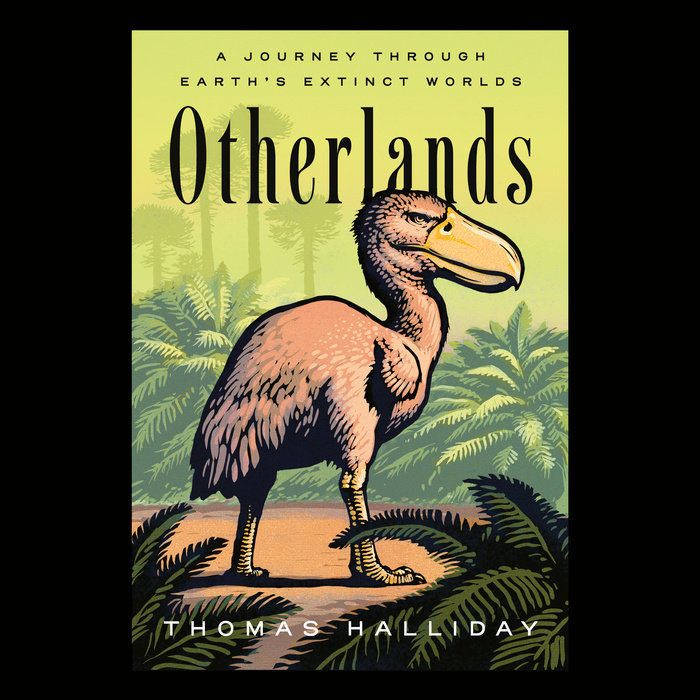
Otherlands: A Journey Through Earth’s Extinct Worlds, a Valueable Entry into Understanding This World

Otherlands by Thomas Halliday | Penguin Random House AudioI mostly read non-fiction, books on history, the ‘natural sciences’, about life. I get my fiction in the form of television and movies, graphic novels and no, there is a lot more out there other than the limited, repetitive genre of super-heroes from the DC and Marvel universes. I’m drawn to the speculative stories, alternative tellings of this world, of life lessons, attempts to reimagine the past, or invent possible futures, stories that question what we are generally taught in this life. But really, I’m a science guy, reading those authors who draw from the leading edge of science, and the scientists themselves, who are skilled enough communicators, not something that necessarily is companion to those ‘doing’ science, those who can clearly discuss what they’ve learned and present reviews of entire fields of study, which strive to show the reader how our understanding of the world is changed.  Continue reading

The Dawn of Everything: The History of Humanity; a Review

David Graber, an anthropologist, and David Wengrow’s, an archeologist, book, “The Dawn of Everything: A New History of Humanity”, is more than ‘just’ a history of humanity, which would on its own suggest a massive tome of thousands of pages. it is an examination of how we ‘do’ history drawing many examples of peoples and societies across time from the Paleolithic through the colonization of North America. It is not simple reportage, rather a look into the correctness or accuracy, of how we have been telling history. I enjoy such questions and their capacity to rock the academic and intellectual ‘boat’. My reading has spurred the formation of links to two other books I’ve read recently, Stephen Jay Gould’s, “The Burgess Shale” and Pekka Hamalainen’s, “Indigenous Continent”. All three of these call into question previously widely accepted thinking on their subjects. More than this, they question foundational ideas upon which the science they examine are founded. This appeals to me. But more than this, there is an idea central to them all which really rings ‘true’ for me. Continue reading
On Weeds, Disruption and the Breaking of Native Plant Communities: Toward a More Informed Working Definition of Weeds

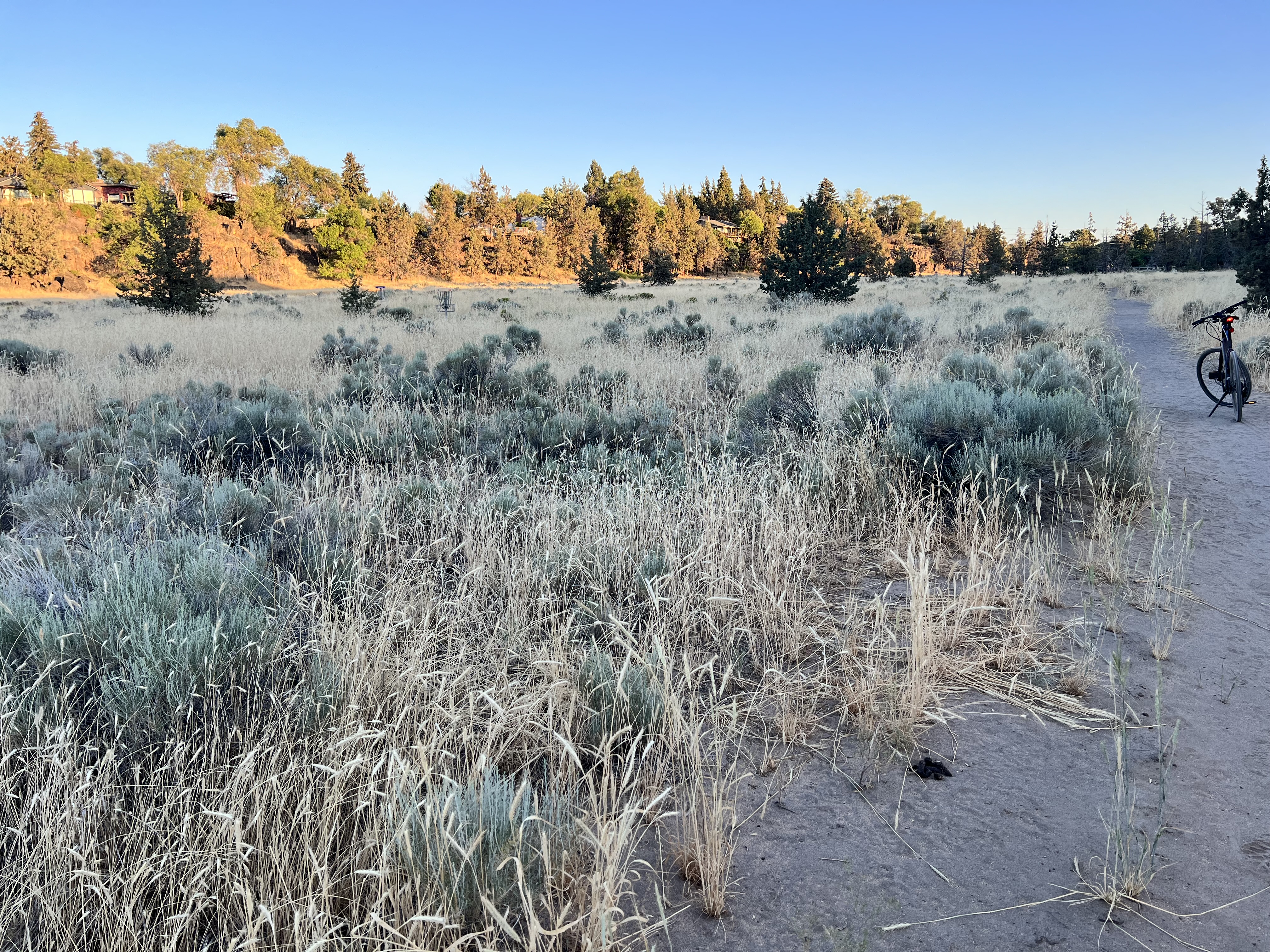
The bottom land in Redmond’s Dry Canyon was used for decades as low quality pasture, the native community pretty much obliterated. Those areas with surface rock are more likely to retain more of the original plant community, although Cheatgrass has invaded much of those areas as well. The is looking southerly over one of the larger ‘pasture’ areas near the disc golf course. There is very little Cheatgrass through this section south of West Rim Park. It includes a few native seral species which typically occupy disturbed sites as a site transitions, including Gray Rabbitbrush you see here. Found in this area too is Secale cereale, Annual Rye, a non-native, which appears to have been planted along more formal paths to limit Cheatgrass spread(?).  Junipers are moving in. Sagebrush hasn’t yet.

It is commonly said that a weed is a plant out of place…and of course ‘we’ are the one’s who decide this. Some will try to argue that there are no weeds, that all plants belong and if we only left weeds alone landscapes would reach a balance on their own. If one’s time frame is long enough this may be the case, though this will take considerably longer than one of our lifetimes, and then there is our inability to actually leave landscapes on their own, or to at least consciously moderate our disturbance of them. Weeds are plants. They are not a separate classification of plants. They are plants removed from their places of origin and released into another where they have competitive advantages. Most people still simply tend to refer to plants they don’t like or want as weeds. These positions are at odds with one another. This leads to confusion and a lack of clarity, undermining any urgency to take action.

Weeds have become ‘personal’, their status a matter of ‘opinion’….A weed is a weed only if “I” agree that it is, or perhaps some ‘expert’, such as when agricultural scientist identify them as an economic threat to farms and label them as ‘noxious’. Without agreement and urgency there is a tendency to do nothing about them. Plants in general are attributed little intrinsic value. For many people they are just there. Native plants we vaguely understand as belonging to a place, but most people would be hard pressed to identify and name many at all. Quite different species are often lumped together, their relationships unnoticed. Natives are reduced to being ‘background’, their status reduced to decoration, attractive or not, a ‘space’ filler, perhaps a hinderance to what we would chose to do with a place. Continue reading

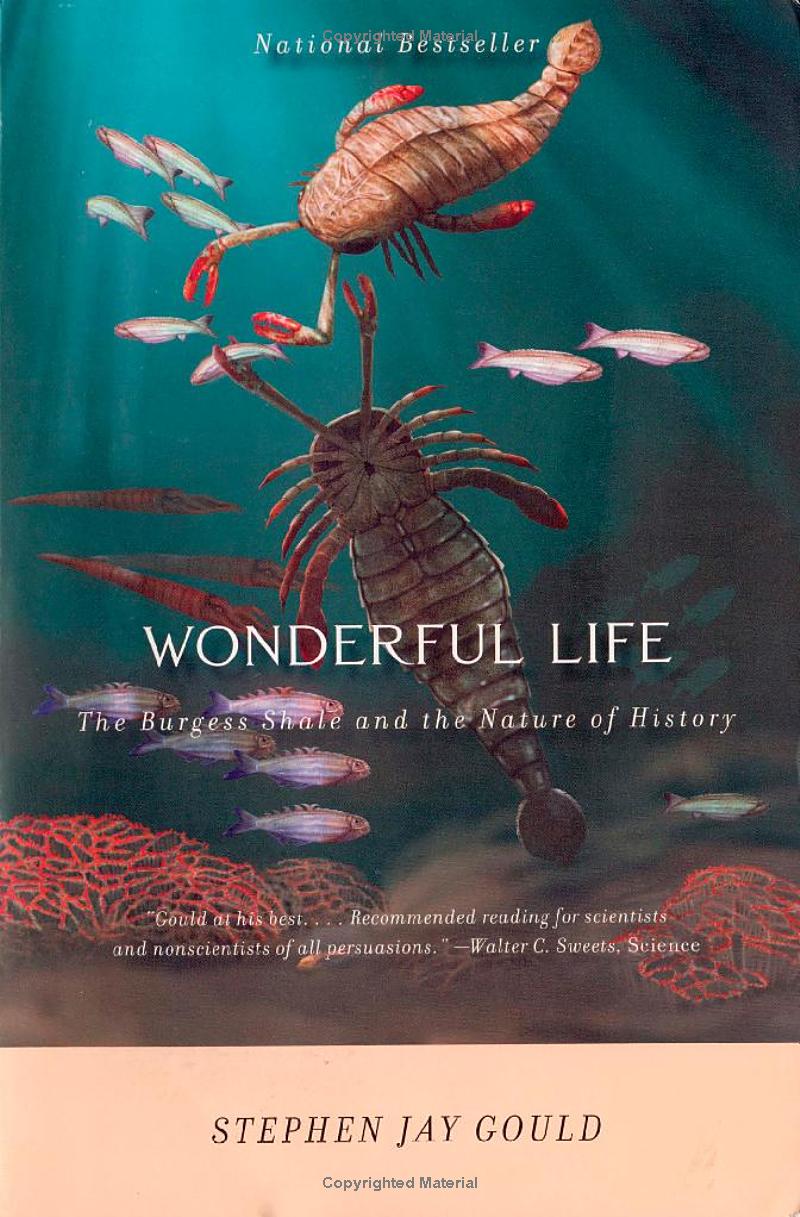
Wonderful Life: The Burgess Shale and the Nature of History, A Review

I am a newbie to the writing of Stephen Jay Gould, a paleontologist who has attracted a sizable share of critics and detractors for his reasoned and outspoken views on our understanding of evolution, the history of science, humanism and  ‘Man’s’ place in the overall scheme of things. I find this book an ‘eyeopener’. Previously my education on the topic of evolution has been casual, incidental, social, something I’ve observed and absorbed as a product of living my own life, a book here and there, not formal or studied. Over the last ten years or so I have been more focused on the science of life, that defining ‘force’ which animates all organisms, what it is to be alive at a time when the traditional divisions between the sciences, particularly between physics, biochemistry, what has come to be known as ‘systems science’ and cell biology are beginning to dissolve and merge. Science continues down its more traditional pathways with its atomistic, reductionist, approach, which has dominated most of the accepted work up until today. Under the ‘old rules’ scientists utilize what we understand as the ‘scientific method’ in which they conduct ‘controlled’ experiments, repeatedly, to understand a particular action or process. Such demand for control leads them to break problems down into limited, often tiny ‘bits’, in which it is more easy to examine and evaluate a single isolated process with ‘confidence’. Others then assemble all these bits that they’ve learned into a theory of the whole. Traditionally conducted science works from the idea that we can understand the whole by studying a problem in its parts, often ever more minute. While this has proven to be a very valuable strategy, improving our understanding, shaping the way we act in the world and our technologies, it has also become more evident that this approach has left something out, that by limiting our examination of life in this way we are missing something essential. What actually constitutes life? The study of life’s origin and its evolution expose the shortcomings of relying on this approach alone. Continue reading

Song of the Cell: An Exploration of Medicine and the New Human, A Review

The cell is the basic, irreducible, unit of life. Whether an organism is animal, plant, fungal or bacterial, the cell is its basic unit. While it can be broken down into its ‘parts’ for examination, none of those parts are capable of independent life, none are able to continue fulfilling their functions on their own. The cell and its ‘community of parts’ operate as a ‘social’ unit, as a whole. Each ‘part’ fulfills one or more roles in the ongoing life of the cell. This book is a review of cell biology, of the development of our, human, understanding of the life of the cell and its centrality to our understandings of what it is be alive, how it has and continues to transform our practice of medicine. The author, Siddhartha Mukherjee, is a doctor and researcher who has spent his professional life studying blood and its cancers, trying to understand and treat disease. Continue reading

Spillover: Animal Infections and the Next Human Pandemic, David Quammen, WW Norton & Co.,2012; a Review

If you were perusing the library shelves and came across this book, the title “Spillover” may leave you a little uncertain in terms of its topic, without reading the subtitle and having some understanding of the processes described in the book, the emergence, evolution and ecology of ‘new’ diseases, human diseases. When we speak of them we understand them as conditions, assaults on our health and human bodies, which result in an array of symptoms, with wide ranging severity, ranging from mild and asymptomatic; to bothersome with knowable, short lived cycles; through chronic and debilitating; to those entailing a series of feverish cycles we simply must endure; to those often painful and fatal which wreck havoc on our systems and organs. Quammen, the author, is as always, an intelligent and thorough researcher able to interpret complex topics for the layman while staying true to the science and the people whose stories he tells as he weaves together the larger narrative. Continue reading