Category Archives: Plant Communities

On Our Western Juniper Survey in Redmond’s Dry Canyon

This is an explanation of the importance of the survey work being done by the Friends of North Dry Canyon Natural Area, FNDCNA, and it’s role in the creation of a broader management plan, and a fire management plan, that addresses both community safety needs, as well as those of the Western Juniper and Sagebrush steppe plant communities in Dry Canyon. This is a 160 acre portion of the Canyon Park that stretches 3.7 miles, north to south, through the City, a remnant of one of the canyons formed by one of the previous courses of the paleo-Deschutes River, (There were at least two, one some distance east of Redmond’s location, joining with the Crooked River at present day Smith Rock State Park. The current Deschutes River flows 4 miles to the west of this location through a canyon carved in its earlier stages by Tumalo Creek.) Continue reading

On Biology, Ecology, Evolution: Health as a Product of an Engaged Life Aided by Science

Biology, the ‘life sciences’, botany, evolution, cell biology, ecology, health and disease, plant communities, our relationship as humans with each other, geology and the life around us, are all topics that interest me. My most recent reading choices have focused on embryology and an organism’s capacity to maintain homeostasis, what is meant by ‘health’. Earlier I focused on the big question of ‘What is life?’ I’m an integrator, an intuitor, an assembler of conceptual puzzles. For me understanding is the goal and that usually involves understanding the ‘pieces’ of the puzzle and fitting them together into coherent wholes. That’s what I do when I select books and read. While my fiction choices are relatively wide and varied, when it comes to this question, I am far more focused, purposeful. I am not overly concerned with being correct in terms of conventional thought or even regarding that which is accepted as being scientifically correct. I’m looking for what makes ‘sense’. I ‘test’ what I read.

Science is conservative and rightly so. It works to define a foundation from which we may build on. Many, if not all scientific advances, came at the expense and pain of researchers who reach beyond the established to address the problems that accepted theory has revealed as the process advances. Egos and careers can get crushed. Arguably, every significant advance in science began as a controversial idea. Over time, with repeated experimentation, advances in technologies that enable scientists to address questions not previously possible, new insights and ways to ask the ‘question’, the new gains support, or alternatively, is revealed to be ‘wrong’. In this process other questions arise, that move us toward a more complete ‘truth’, a truth that enlightening and revealing, can never be the ultimate answer. What preceded it was not necessarily ‘wrong’, but more likely incomplete, unable to fully explain the world as our understanding of it itself changes. Science becomes a process of understanding at an ever finer scale. What once served, still does, but in a coarser grained way. Occasionally, it demands a radical rethink of our basic understanding of reality. Continue reading

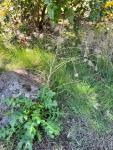
Holodiscus microphyllus, Rock Spiarea in Dry Canyon

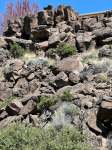
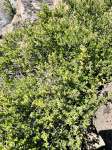
Another less common slope dweller is Holodiscus microphyllus, or Bush Ocean Spray, a deceiving name, or Rock Spiarea, which is also somewhat confusing. Confusing because Spiarea is the genus name for an entirely different genera of shrubs. So I call it simply Holodiscus. ( Botanical names can be confounding to the uninitiated. I’m not a big user of mnemonics, but I still remember first learning this plant’s close relative, Holodiscus bicolor, and the phrase immediately came to mind, ‘Holy Discus, Batman!” I know, silly, but I doubt I will ever forget that plant.)

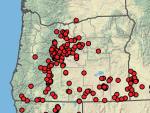
This typically occurs on the eastern flank of the Cascades and in the mountains of SE Oregon. The common name, ‘rock’, suggests its preferred sites. I’ve not seen one in Dry Canyon bottomland. It seems most common below the east rim north of the Maple Bridge. Continue reading

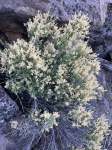
That Gray Stuff? It’s All Sagebrush…Nope

Part of the Dry Canyon plant series

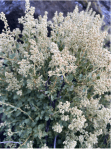
Everybody knows Juniper and I suspect that a lot of people who think they know Sagebrush, that ubiquitous gray shrub you see everywhere, may be confusing it with other plants, blurring all ‘gray’ shrubs into one. Now this may not seem to be a big deal, but if you are trying to manage a landscape with these in them or trying to create a landscape which reflects the local plant communities, then it becomes much more important that you know what you have so that you can evaluate your landscape’s condition and decide upon what you may need to do, or stop doing, to meet your goals. Continue reading

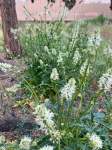
The Cut Leaf Thelypody in Dry Canyon

[Plants of the Dry Canyon Natural Area – This will be the start of a new series focused on the plants of Redmond’s Dry Canyon. I’m creating them to be posted for ‘local’ consumption on the Friends of North Dry Canyon Natural Area. It’s a City Park including about 166 acres at the north end of Dry Canyon Park which the City has identified as a Natural Preserve. The group works as an advocate with the City, on public education and helping with on the ground work projects. I’ll identify each such post here.]

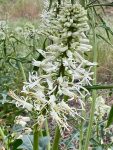
As you walk the trails below the canyon rims you will be seeing these growing scattered and in bunches. This is the Cut Leaf Thelypody, Thelypodium lacinatum. These are common where ever there’s a bit of soil between the rocks on the slopes below the rims growing amongst the tumble of massive basalt. I’ve seen these elsewhere growing in other eastside Oregon canyons with similar conditions.
These are members of the Mustard family, prolific seed producers and quite competitive. Another plant that, at least so far, doesn’t venture out into the canyon’s bottomland.
Elegant when it first starts flowering, like so many native annuals and perennials, these start declining while they proceed through their flowering season detracting from their appearance. What do I mean…each spent flower, begins to form its narrow, linear, Mustard seed capsule, quickly maturing its tiny seed and then drying, twisting and browning, while the inflorescence continues to bloom out towards its terminal end. A little messy, yes, but characteristic of these plants. We humans are relatively intolerant of such decline in our garden plants and so generally refuse them admission. Under the local wild conditions, as dry as they are, species tend to either be early flowering, when soil moisture is still most available or those like this that begin to decline before the show is over. Summer drought is a ‘cruel’ taskmaster. There are exceptions to this rule but….

https://oregonflora.org/taxa/index.php?taxon=8778

The Serviceberry: Abundance and Reciprocity in the Natural World, A Review

Robin Wall Kimmerer is a botanist, ecologist, a teacher and a member of the Potawatomi people of the Great Lakes region, from whom she learned her people’s particular world view, one once common amongst many indigenous peoples and in stark contrast to that of our present day dominant culture, which has lead us to powerfully shape our our world today. Her three popular books, “Gathering Moss”, “Braiding Sweetgrass” and her latest, “The Serviceberry”, present to the reader a glimpse into the natural world as seen from this ‘alternative’ world view. All three are enlightening reads and not overly technical. They are ‘invitations’ to see the world from a different perspective. The latest is the smallest, a book barely over 100 pages, with large type and in a small page format…a quick read, unless you pause to give what she presents some additional thought. The best, and the one I read first, is “Braiding Sweetgrass”.  Continue reading

On Ornamental Trees and the Remaking/Unmaking of Place: Revising the City of Redmond’s Tree List, part 2

How Much to Water?

Recommending trees from climates with significantly wetter growing seasons needs to stop if we are to continue growing our population. Landscapes as designed, and managed, are the single largest user of residential water. Recommending trees which ignore this problem is irresponsible. Lower water use residential landscapes are possible. Local codes and recommendations must, however, reflect this priority.

Additionally, how much to water is a bit of a mystery to all of us and especially so to non-gardeners. How much? How often? Our watering practices should be determined by the local precipitation and the tree’s needs. What is commonly done, however, is that we water for our lawns and that largely determines what our trees receive, unless we have separate drip systems. A tree’s root system doesn’t stay neatly between the lines. They quickly extend out well beyond the span of the tree’s leafy canopy. In many cases even 2-3 times as far, taking up water and nutrients. A roots of a tree, planted in a small bed, adjacent to an irrigated lawn area, will move out into the lawn. A tree isolated in a xeric bed with only a few drip emitters, will quickly demand more than such a meager system affords it and such a tree, if it requires summer moisture, will struggle while competing with its nearby  ground level growing neighbors. Again ‘neighbors’ should share compatible requirements so all can thrive on the same ‘diet’ and moisture regime. Continue reading

On Ornamental Trees and the Remaking/Unmaking of Place: Revising the City of Redmond’s Tree List, Part 1

Perhaps an odd tree to start this with, Juniperus scopulorum ‘Woodward’, is not a ‘shade tree’. It is not deciduous. It is a narrow, fastigiate form of Rocky Mtn. Juniper that, growing to a height of 20′ with a 2′-3′ spread can serve as a formal accent in colder climates like ours as a ‘replacement’ for the more tender Italian Cyperss, and it can do quite well here with very little supplemental water.

Trees, specifically ornamental shade trees, have become an expected and desired part of our urban lives, at least util their leaves fall and await our cleanup. Many associate long tree lined streets and avenues with urban living. Broad Maples. Lofty Elms. Plane Trees and, in tighter spaces, perhaps Cherrys, Crabapples and flowering Plums. Urban trees provide several notable ‘environmental services’ increasing our comfort level with their cooling shade, their capacity to remove pollutants from the air, cover and nesting places for birds and the sequestration of carbon. Trees are generally viewed as a public good, necessary even for our lives. We can get quite emotional about them. So it seems a bit ‘wrong’ to suggest that this ‘ideal’ may not always be ‘best’ or even desirable.

Broadleaved deciduous shade trees are ‘naturally’ members of mesic, temperate to cold-temperate regions of the world. That is where they evolved and where when we plant them out, where they do best. When we begin planting them outside of their historic natural ranges, especially when we ignore the conditions, the disparities and the extremes between their natural ranges and those where we choose to plant them, then we can have some serious problems. The trees may struggle along, or if we remain committed to making up for our local area’s lacking, usually in the form of supplying more water, they can do reasonably well. But this suggests possible real problems as one moves further away from the conditions of a tree’s natural limits and increase the numbers planted out. Where is this water coming from and what are the impacts of removing this water from its normal and healthy cycling of which it is a part? What will be going without? And, is that cost worth the losses it creates? Our selection and planting decisions depend on how we value that which is lost! In short, the typical deciduous shade tree of our imaginings does not belong here in a desert. Continue reading

Mowing Firebreaks Across the Dry Canyon Bottom, Good Idea or No?

Mowing weakens the native plant community and aids the growth of weeds.

Mown adjacent to unmown. Aggressive spreaders will fill in more quickly and because of the weeds already in place, they will sieze a larger proportion of the mown area as they grow and spread.

While recently walking home through the Canyon, last month in December, I noted 8 new  strips, presumably ‘fire breaks’, mown across relatively flat and uniform sections of bottomland, each maybe 50’+ wide, spanning the bottom between the paved eastern path and the the main dirt western bike path. While I understand the thinking here, removing ground level fuels, this is a single purpose treatment that works counter to the Park’s purpose as a natural area preserve. Mowing down the Rabbitbrush, a ruderal, transition species of the Sagebrush Steppe plant community, delays the development of a healthy native plant community and encourages an increased array and density of weeds and invasives. Mowing this way provides open space for weed species already in Dry Canyon, as well as those not yet here, giving them larger ‘launch points’ from which they can spread into the rest of the Canyon. Mowing weakens natives, which are naturally slower to rebound from the damage than the aggressive weed species. Continue reading

From 0’ – 3,000’ in 70 Million Years:  Building Oregon, Dry Canyon, The Shaping of Redmond and the Geology of the Paleo-Deschutes, Part 3

Cascade Volcanic Arc –

Over the last 2.5 million years, roughly corresponding with the Pleistocene Ice Age, there have been at least 1,054 volcanoes in a ‘belt’ from Mt. Hood running 210 miles south to the California border and then, after a break, continuing to Mt. Shasta and Mt. Lassen, in a band 16 to 31 miles in width. These latter two, southern most of the Cascades, show no effect of glaciation from Glacial Periods. They were far enough south of the Glacial Ice to be unaffected. The material ejected and flowing from these many volcanoes and vents come from the crustal material of the subducting Juan de Fuca plate. The Cascades are a defining feature of our region in terms of aesthetics, but also as a shaper of climate, as well as being a physical barrier limiting the movement of organisms and thus goes to determining the ‘shape’ of our lives here. The Arc is still active, magma is still being ‘delivered’, building incredible pressure below through these same processes which have shaped this place to date. While we may assess its various mountains as ‘active’ or not, the volcanic arc, is still very much a factor in determining our long term future. Where it will next erupt from, and what form that will take, is impossible to say within any degree of confidence. But the earth’s tectonic plates are still in movement. Magama is still slowly, but inexorably, coursing through its crustal layers and the movement and pressures will continue to result in further eruptions. Continue reading