
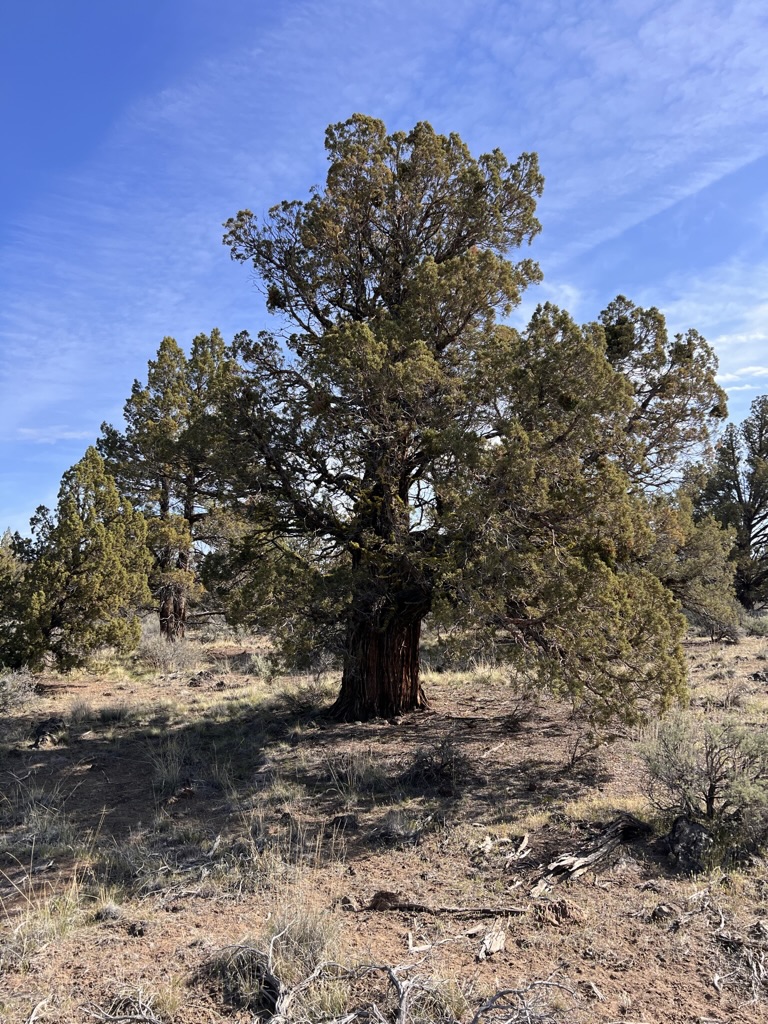
A Juniper like this one, growing out on BLM land around Cline Buttes, attains this squat and sturdy stature only after hundreds of years. Growing as they do on shallow, raised rocky areas, not only do they grow slowly, but there tendency is to caliper up. In irrigated pastures, these grow overly fast, spindly and upright. Look at that taper!
Ecologists will regularly claim that fire plays an essential role in the life and dynamics of the Juniper woodland, our sagebrush steppe and the grasslands of our arid and semi-arid plant communities, that without it, the landscape will deteriorate. Okay, but what does that mean? How can fire actually lead to a landscape’s improved vitality and diversity? What does fire actually do and what happens when it is eliminated? The short answer is that fire, in burning the collected fuels on the ground, breaks them down and returns them in nutrient form to the soil and the cycle of life. It provides the space necessary for a healthy and diverse landscape. To get there requires more thinking.
First some essential definitions and clarifications are needed: what are these ‘types’ of landscapes that together can be found in the arid reaches of Central Oregon; all landscapes are dynamic, evolving, changing over time according to the forces in effect on them, they are not static or fixed; what is meant by arid and semi-arid; fire, what is it, what is actually occurring when something ‘burns’; what is going on at a molecular level when an arid landscape burns; if this is so necessary, what fulfills this role in wetter landscapes; what’s the relationship between fire, rot and digestion; how, and does it, serve the nutrient availability and the necessities of organic growth. In understanding these basic parts we can better understand the self-renewing CYCLE of life as an ongoing process and how disruptions to it negatively influence its capacity to continue. Continue reading

