Category Archives: Adaptive Management

Dry Canyon Proposal: the need for change in maintenance, use and planning

[The following is a piece I wrote and sent to our local Parks staff, its advisory citizens committee, mayor and city manager…I got little back in response. I’ve developed a relationship with one of the city arborists and the park’s planner as well as have met several active neighbors interested in protecting Dry Canyon’s natural areas, several of whom have natural resources backgrounds with agencies. The City has no natural resource or botanical staff. There is no formalized friends group, nor is their an outreach and public education program that addresses these problems and the role of residents in their solution. Signage is minimal and inadequate. Their horticultural expertise would also seem quite limited. This is understandable as the City’s population has grown very rapidly in recent years. The need for such programs and an increase in expertise on staff will only increase as Redmond’s population continues to grow.]


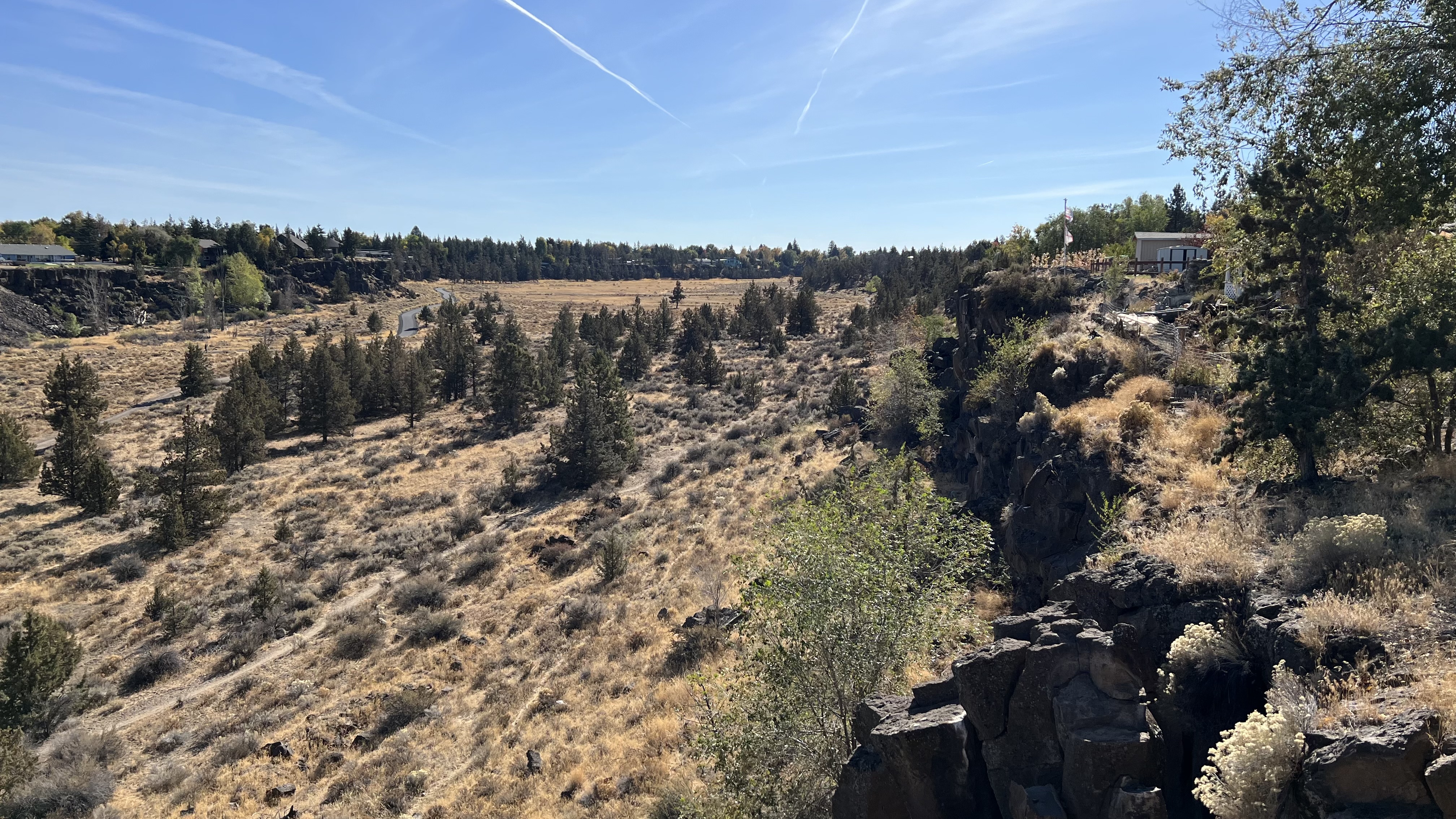
Redmond’s Dry Canyon looking south from the west rim on the Maple Street Bridge. The area in the immediate foreground burned this last summer.

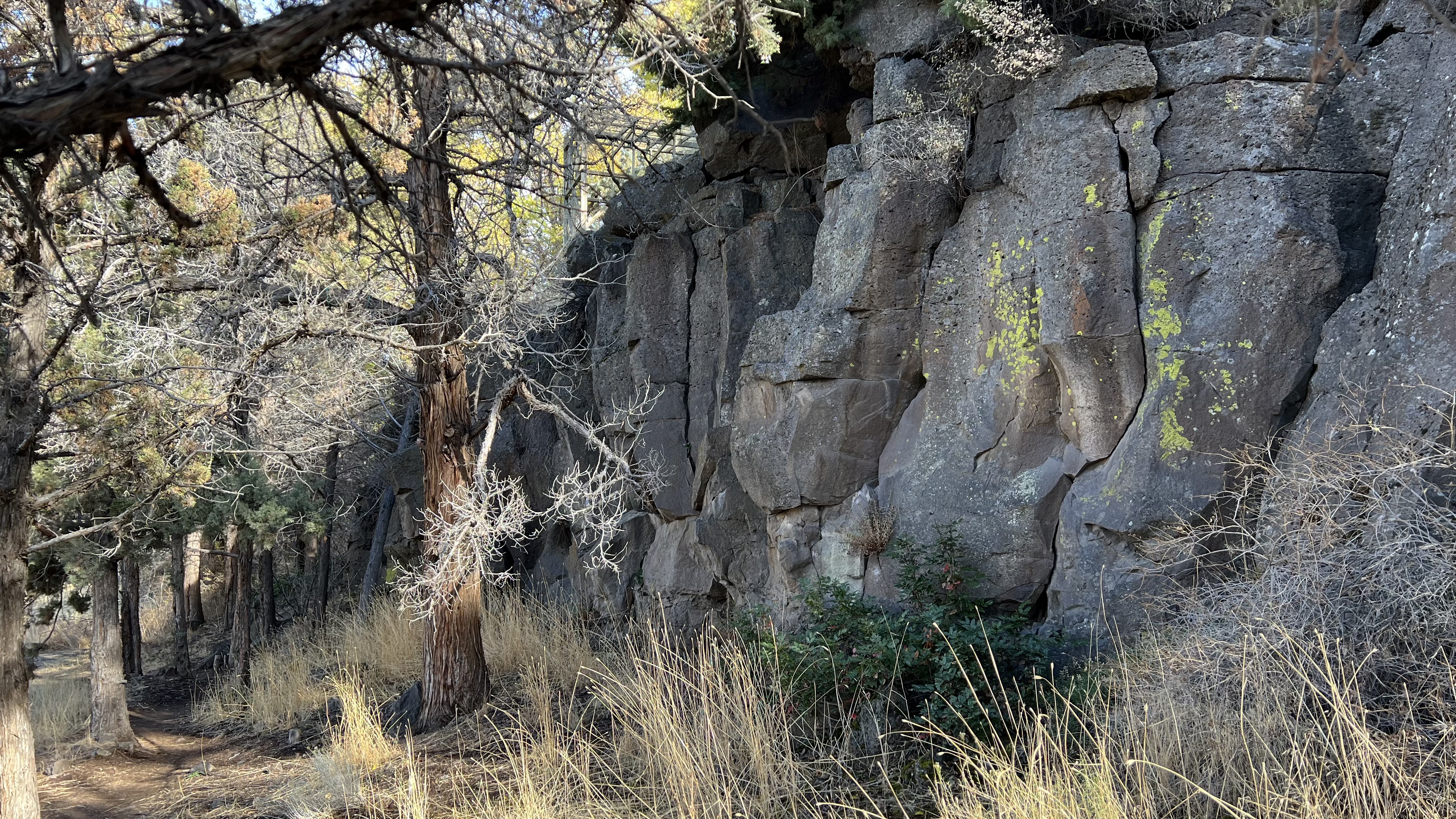
A typical view at the base of a section of relatively unbroken rim on the east side.

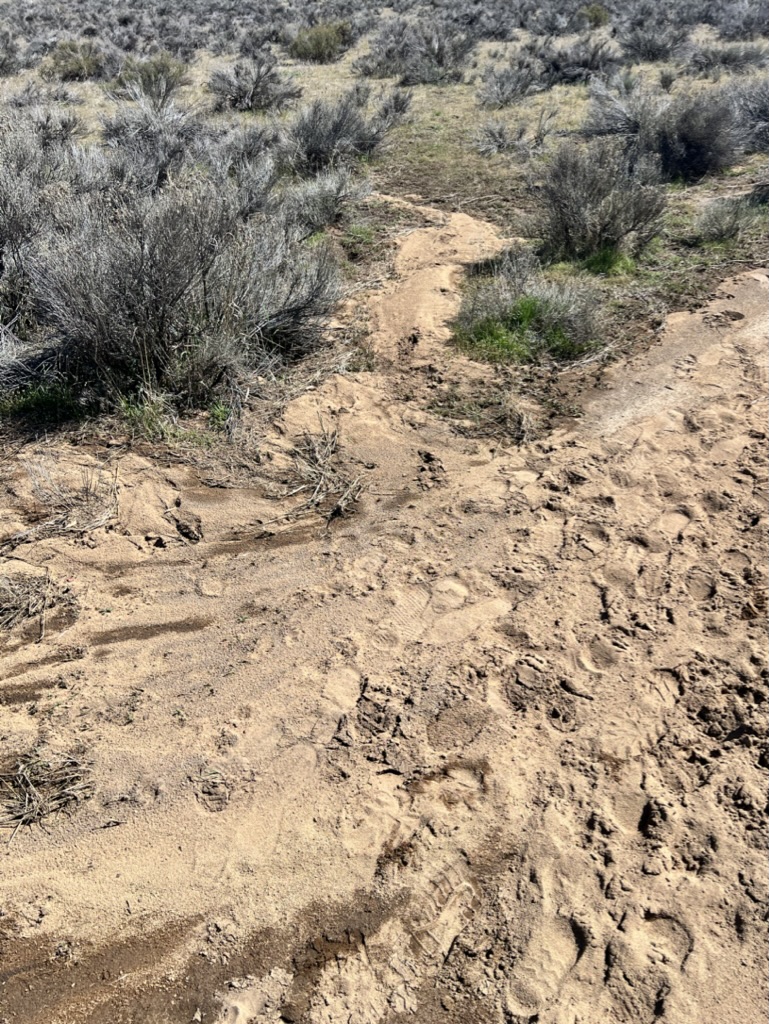
The canyon floor is variable, but as this pic shows, a solid layer of hardened lava underlies what soil is here, either blown in or washed in, a limiting factor of what can grow here. Rabbitbrush is a common and ubiquitous native pioneer.

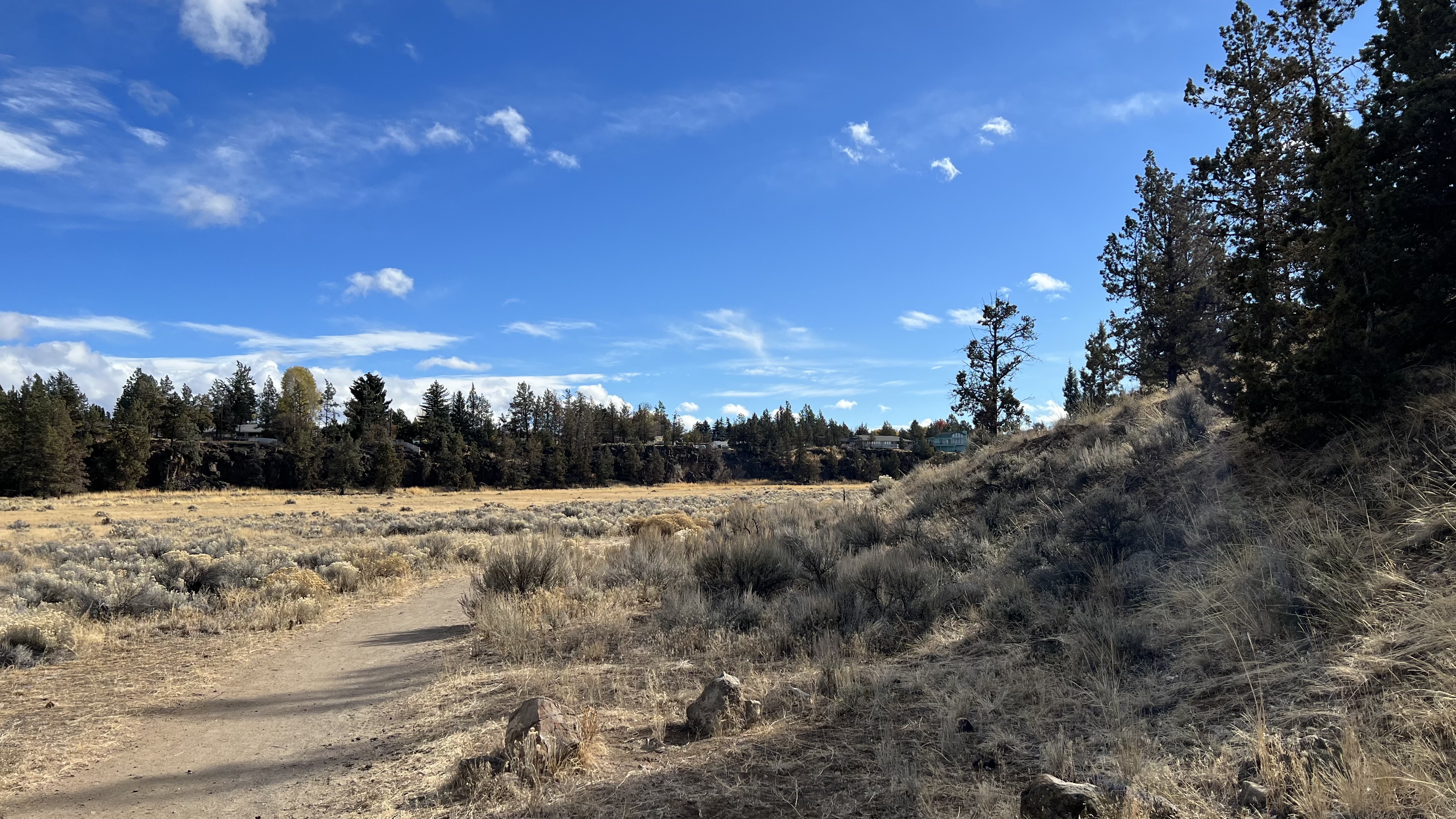
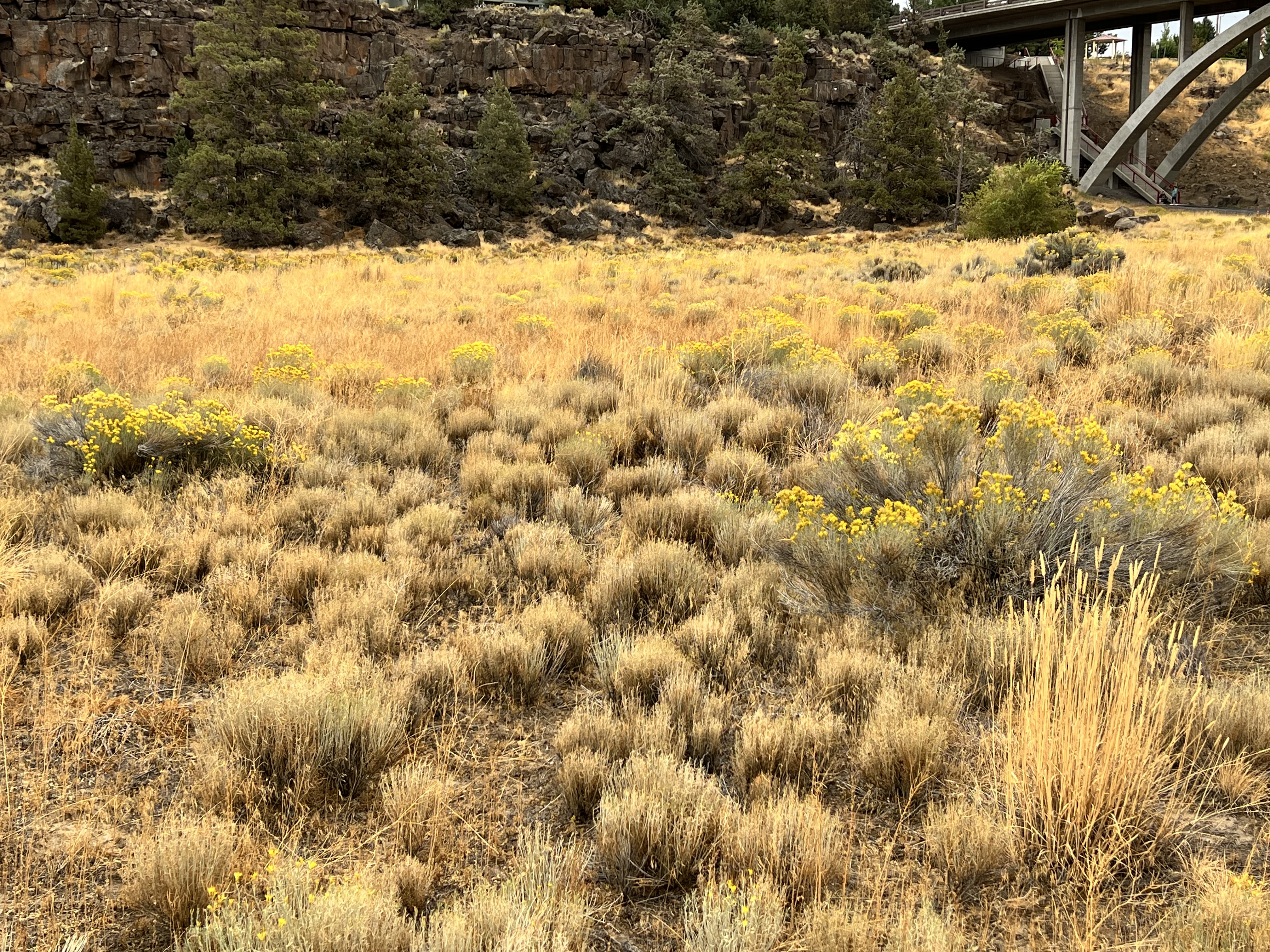
Match of the canyon floor is recovering from pasture use. These areas have relatively deep soils and are still transitioning with many weedy mustards, annual grasses like Cheat and planted grasses like Crested Wheat and Annual Barley. Native Bluebunch Wheat is scattered as are other natives. Gray Rabbitbrush, a native seral species has moved into much of it, but the weeds are dominant. Sagebrush and Bitterbrush are more at the edges and lower rim areas.

This section of bottomland, former pasture, probably burned not that long ago, has quite a colony of Rabbitbrush coming along, all it would appear of even age, suggesting a fire. Rabbitbrush are early colonizers and ‘prepare’ the way for natives to follow. This is just north of the Maple Bridge.

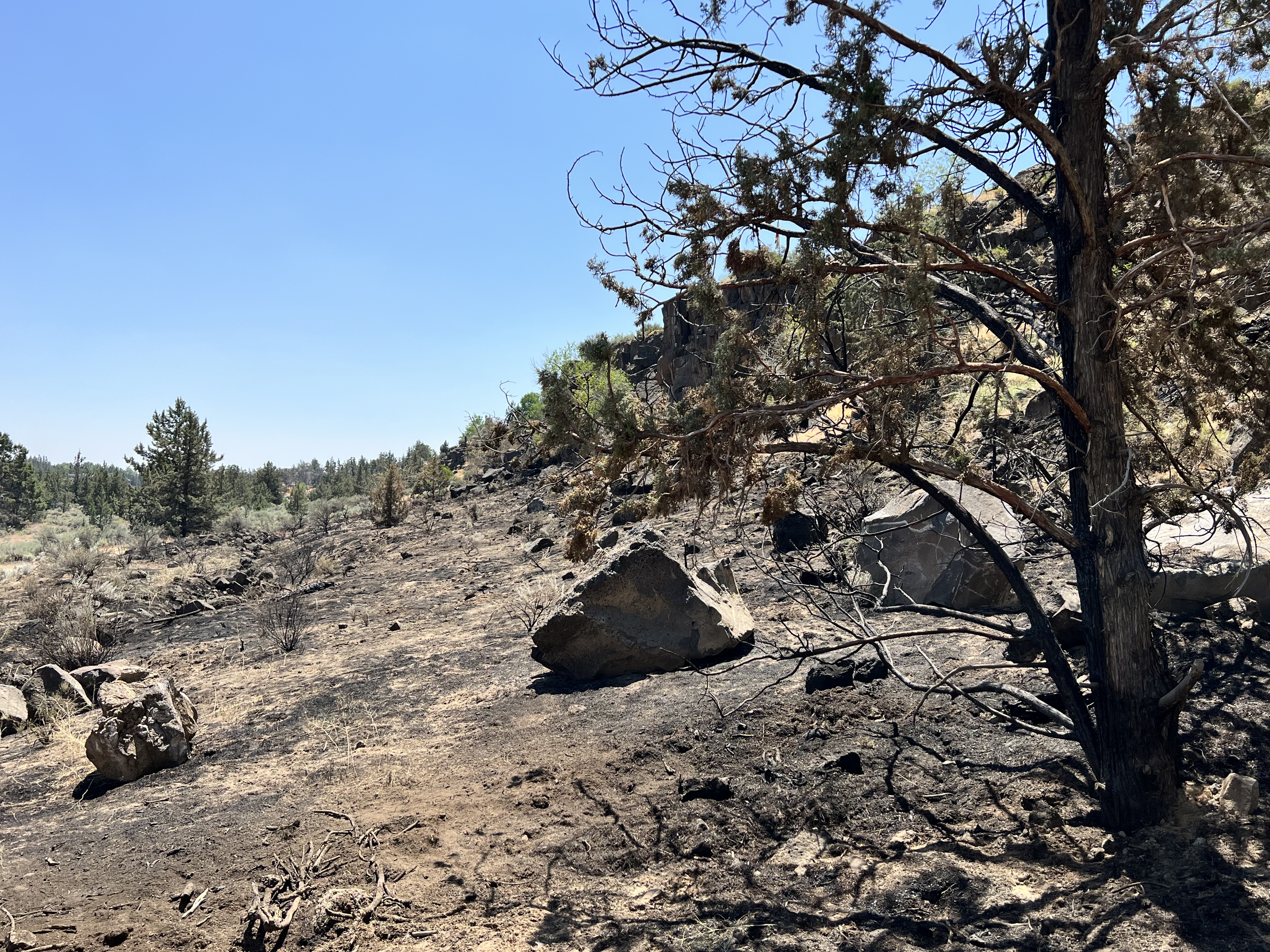
This area, maybe 5 acres, burned in July. It will be interesting to see what comes back and what the City may plant??? Fire kills Sagebrush and Juniper, while it seems to favor Cheatgrass. So far, April ’24, nothing has been replanted. The window for seeding is closed. Rabbitbrush can survive a burn. This site is unfenced, with very fragile soils and we’ve already observed new bike trails in it.

My wife and I are both recent returnees to Central Oregon having both grown up here. We are also frequent walkers in Dry Canyon, a place I spent many hours in playing and exploring as a kid in the 60’s. Redmond has changed a lot over the intervening years…change that continues apace as it grows. I’m not going to whine about the ‘good old days’ and things lost. Much of the change I welcome or at least accept (We did move back!), but population growth, in addition to bringing along economic vitality and stability, new and enriching opportunities and a more diverse community, increases the ‘pressures’ on the naturally limited assets that largely define the place and attract residents. I’m speaking here of the natural landscape, its features and the opportunities which it affords us for recreation and quiet enjoyment. Realtors were once fond of saying that no one is making new land, as a prompt for buying…it is a fixed and limited quantity. This limitation has profound implications for a growing population. We have far more people today ‘enjoying’ a limited, and increasingly over utilized landscape. Continue reading

Knapweeds in Redmond’s Dry Canyon and the Pursuit of a Healthy Landscape

Redmond’s Dry Canyon looking south from the west rim on the Maple Street Bridge. The area in the immediate foreground burned this last summer.

If you garden, or maintain a landscape, you come to understand that not all weeds are the same. Each will have its own ‘strengths’, or perhaps you might call it ‘virulence’. Any particular weed, just like any other plant, will respond ‘positively’ to supportive growing conditions, conditions which often closely align with those which exist in its place of origin. Plant explorers and nursery growers are always looking for ‘new’ plants for landscape use. in a way, they have to walk a fine line. They must find plants, that with reasonable effort on the part of the gardener, can thrive across a range of conditions, unless they are looking for specialty plants, for narrow, niche, markets. The introduction of new plants must be somewhat measured, our enthusiasm tempered, because plants which are too adaptable, too vigorous, may possess the ability to escape our cultured gardens and find a place in the surrounding, uncultivated, landscape.

For Central Oregon, when we look beyond our regional natives, we must keep this in mind. Exotics from similar growing and climatic regions around the world offer both promise and threat. We want our plants to be successful, but not too. Sometimes through the process of trade, the movement of livestock and agricultural products, particularly aggressive species hitch a ride. A few weed seeds can be easy to miss. If they are aggressive enough and go unnoticed, a distinct possibility, it is likely that they wont be detected until a sizable local population asserts itself…and if no one is watching, that can be a fateful error. One group of plants, with many wonderful possibilities, also include species which can be exceedingly problematic here in Central Oregon, these are from regions sometimes referred to as Steppe. Continue reading

On Weeds, Disruption and the Breaking of Native Plant Communities: Toward a More Informed Working Definition of Weeds

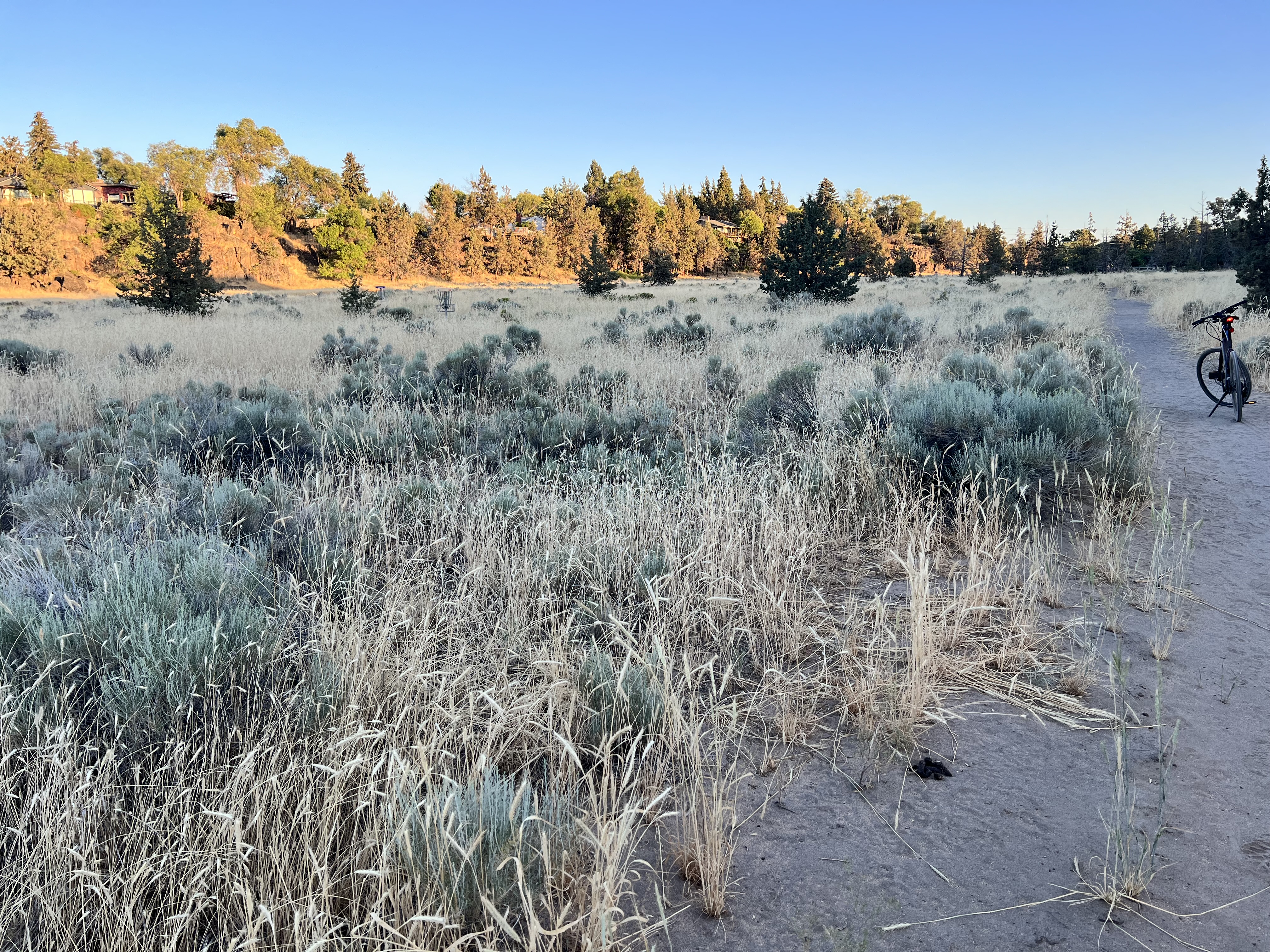
The bottom land in Redmond’s Dry Canyon was used for decades as low quality pasture, the native community pretty much obliterated. Those areas with surface rock are more likely to retain more of the original plant community, although Cheatgrass has invaded much of those areas as well. The is looking southerly over one of the larger ‘pasture’ areas near the disc golf course. There is very little Cheatgrass through this section south of West Rim Park. It includes a few native seral species which typically occupy disturbed sites as a site transitions, including Gray Rabbitbrush you see here. Found in this area too is Secale cereale, Annual Rye, a non-native, which appears to have been planted along more formal paths to limit Cheatgrass spread(?).  Junipers are moving in. Sagebrush hasn’t yet.

It is commonly said that a weed is a plant out of place…and of course ‘we’ are the one’s who decide this. Some will try to argue that there are no weeds, that all plants belong and if we only left weeds alone landscapes would reach a balance on their own. If one’s time frame is long enough this may be the case, though this will take considerably longer than one of our lifetimes, and then there is our inability to actually leave landscapes on their own, or to at least consciously moderate our disturbance of them. Weeds are plants. They are not a separate classification of plants. They are plants removed from their places of origin and released into another where they have competitive advantages. Most people still simply tend to refer to plants they don’t like or want as weeds. These positions are at odds with one another. This leads to confusion and a lack of clarity, undermining any urgency to take action.

Weeds have become ‘personal’, their status a matter of ‘opinion’….A weed is a weed only if “I” agree that it is, or perhaps some ‘expert’, such as when agricultural scientist identify them as an economic threat to farms and label them as ‘noxious’. Without agreement and urgency there is a tendency to do nothing about them. Plants in general are attributed little intrinsic value. For many people they are just there. Native plants we vaguely understand as belonging to a place, but most people would be hard pressed to identify and name many at all. Quite different species are often lumped together, their relationships unnoticed. Natives are reduced to being ‘background’, their status reduced to decoration, attractive or not, a ‘space’ filler, perhaps a hinderance to what we would chose to do with a place. Continue reading

Spruce Park, Redmond’s Newest Park and Our Neighbor: a horticultural critique

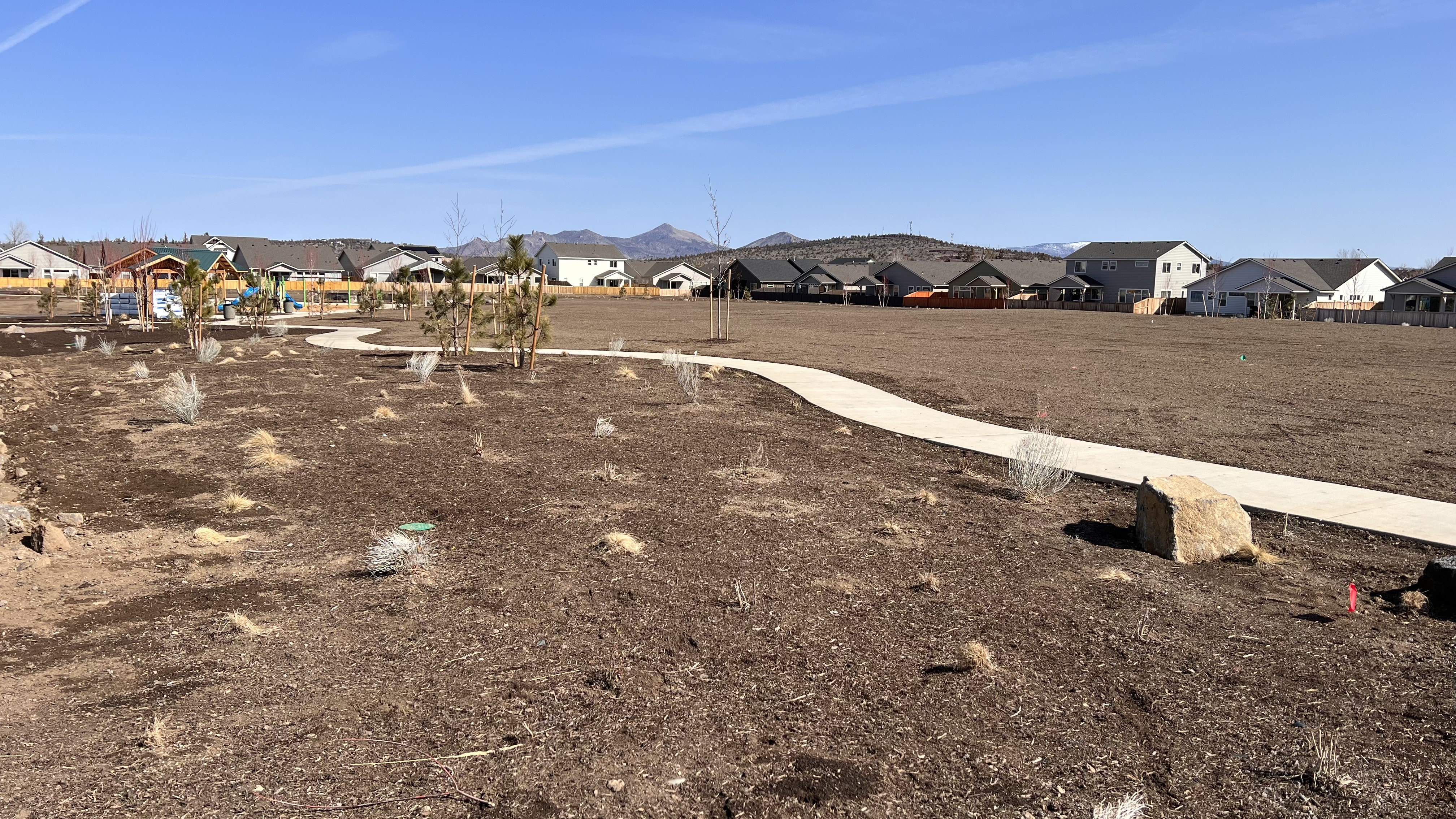
Redmond’s Spruce Park looking NNE from the SW corner toward Gray Butte and Smith Rock in the background. The border beds which follow much of the loop path are ‘native’ plantings according to the conceptual plan. It is common to claim that most of the plants are natives in designed natural areas, but native is not synonymous with ‘natural’. Although natives are used here concessions have been made including such plants as Echinacea purpurea ‘Pow Wow Wildberry’ and Rudbeckia ‘Goldsturm’. In a strict sense Ponderosa Pine aren’t native to this immediate locale either, they require more precipitation than we normally get and the Autumn Blaze Maples are a hybrid of two northeastern North American species.

A landscape, in nature, is a whole, functioning system, capable of perpetuating itself, through out the seasons and years, relying entirely on its own conditions and the cycling of energy and resources occurring on and within it. This is also the definition of a modern sustainable landscape. Ideally they require no inputs or energies supplied from offsite aside from the sun, precipitation and the normal cycling onsite of nutrients and water. A human made, contrived landscape, as all of those built by us today are, may be ‘judged’ by how well they function on ‘their own’, by how well they fit this ideal. Labor and outside inputs necessary to maintain a landscape are then indicators of how out of balance, how far from ‘ideal’ nature and genuine sustainability, a landscape is. A contrived landscape, which ignores the relationships integral to a healthy landscape community ‘demands’ more and more maintenance and support. Given its design and use, a landscape which ignores its site and relationship requirements will deteriorate from the intended design, losing to death component plants while gaining, increasingly, more unwanted available weed species. Design, conditions and use are essential to determine, in this sense, what a ‘good’ landscape is. Continue reading

Physics, Evolution, Natural Selection and the Generative Power of Far Out of Equilibrium Dissipative Structures (Organisms), part 2

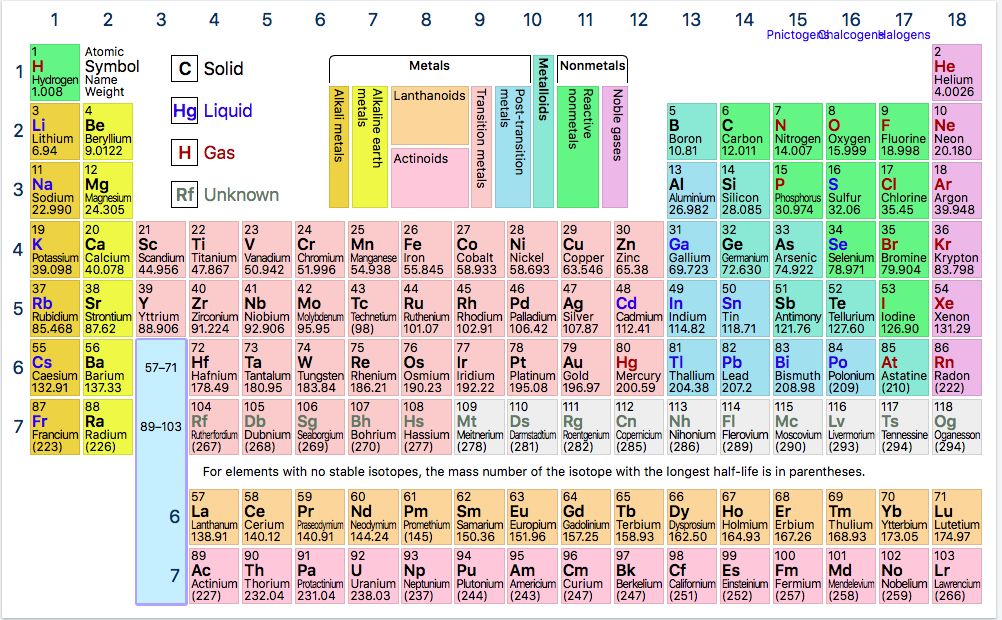
Chemists have often argued that everything is chemistry and if you don’t know about it, what can you really know of the world? A current Periodic Table, one with considerably more elements than were contained in the table from my high school chemistry days, this one including many of those transient elements created in particle accelerators. These ‘new’ elements are very unstable and breakdown rapidly. Some are thought to have existed only at the beginnings of the universe…sometimes in its first moments or during vanishingly rare exceptions. I know, this is very ‘nerdy’, but I go to the interactive table on the linked site frequently to learn about the particularities of elements of interest to me. That table responds to your questions about changing ambient conditions and their physical ‘behaviors’ and capacities for particular reactions. Check it out.

On Pattern, Chemistry and Life

Pattern builds upon pattern.  Whatever you start with effects and limits everything that follows whether we are talking about masonry bricks and stone or Eukaryotic cells and organic molecules.  A different starting point or ‘decision’ at any point in the process, effects every ‘decision’, or even possibility, there after, effects the likelihood of what is to follow, shapes the possibilities, the future, through the evolutionary process…but does not determine it.  To speculate whether other amino acid groups are theoretically possible does nothing to change the course we are on.  The capacities and characteristics of your most basic components set the stage for all that follows, the brick analogy only takes you so far.  Bricks, no matter what you do with them, are very limited in what they can create…how they will ‘behave’ when structured as a wall.  They do not, when combined into a structure, acquire properties that no single brick had before their assembly…their futures were ‘decided’ the moment they were made into bricks.  They remain bricks. Continue reading

What Do We Do When the Whole World Feels Like its Falling to Pieces?

In this blog I focus on plants.  Any gardener, botanist or horticulturist knows that plants, all living organisms, live in an incredibly complex, interwoven network of systems, each affecting the others, the health of anyone, in large part determined by the health of the ‘whole’.  Life does not and cannot exist in a vacuum.  We humans are also very much living organisms and subject to the same kind of limits as any species.  What we build and produce, including those more abstract things like our social and economic systems upon which we are very much dependent, are subject to the same natural laws and limits, whether we recognize them or not.  Very much a part of this is how we value other life collectively.  Just because many may say other people and species are of less value, does not make this fact.  The laws and ways of ‘man’ must remain within, and consistent with, the laws of nature.  We are not at liberty to treat other life as expendable.  We owe a debt and responsibility to all life.  Life permits and supports us so it is incumbent upon us to do the same for it.  Such is the natural law of reciprocity. Continue reading

Our Gardens as Teachers


Of all the things our gardens do for us, arguably the most important is their role as our teachers, even in winter when a temperate garden ‘rests’, its surface crust or top few feet, frozen, maybe sheltered beneath the cover of snow, or, as ours so often are, simply too cold for active plant growth, the soil wet, the rain too heavy to percolate fast enough down through its layers, without the active aid of either the direct heating of the sun or its effect on plants, through evapotranspiration, pumping water back into the air as the plants grow.  Gardens teach patience.  They encourage us to become more careful observers…to think and plan, to anticipate and prepare, to understand that there is more going on here than we can readily see…and they teach us about faith and trust in the natural world, that there is always more going on than we can see. Continue reading

Argyle Winery: A Look at a Landscape in Dundee as an Example for Those on the Trail to Xeric Design and Sustainability

IMG_9186

This strip planting dominated by a Carex and a taller, 7′ or better, spine of the feathery Rhodocoma capensis from South Africa, rated at zn 8b. Mine, in my home garden, survived two nights down to 15ºF this last January with very little damage.

I don’t usually do this, write about a particular landscape with which I have no history, so this is a bit of  a departure for me.  I’ve know Sean Hogan for quite a few years, consider him a friend and a highly influential mentor of sorts.  His encyclopedic knowledge of plants, his boundless enthusiasm, has been infectious and inspirational over much of my career as a horticulturist while I was working for Portland Parks and Recreation.  I’ve benefited from the existence of his nursery and his commitment to horticulture picking his brain for plant and design suggestions as I attempted to broaden my own repertoire. Continue reading

Failing Landscapes, Failing Practices: A Look at Tri-Met’s Landscapes and How We Could Do Them Better!

img_6991

I include this photo, taken beneath the west approaches to the Marquam Bridge, an ODoT property not Tri-Met, as a reference for what is commonly found in transportation rights-of-way. This is not a problem solely with Tri-Met’s landscapes. It crosses the southern end of South Waterfront Park which was one of my responsibilities for 15 years and so I’m familiar with its level of care or lack thereof. The nearest portion, to just beyond the nearest piers, was entirely neglected for the entire period except for where I cut it down to reduce the amount of weed seed I had to deal with in the Park. There is literally nothing that was intentionally planted in the entire space. It is a landscape composed entirely of weeds and it is possible because landscapes for ODoT are of an extremely low priority. It is the neighboring properties that bear the brunt of their decision. It will be interesting to see if they come under increasing pressure over the years as the expensive and undeveloped properties to their south are developed. Currently the Knight Cancer Institute is developing a hundred yards or more away. The Marriot Residence Inn, immediately to its north, has had no effect on its level of care.

About a year ago I posted a series of three articles on Tri-Met’s landscapes along the new Orange Line.  They were a critical assessment of their design with many photos and explanations for my criticisms.  I had a brief correspondence with the project manager after the first two before he stopped responding.  I had asked about the maintenance schedule that they had with the contractor who would be doing the work.  I did not receive it.  Part of the reason was mine, as new ideas came up for me, my interest wavered and I moved on.  Still, I’ve never received anything.  Now, a year later, I decided to reassess the first portion of the landscape that  I wrote about, as it is a section I regularly walk and ride by bike to downtown or to just get out.  I would encourage readers to see my previously posted reviews. Continue reading

Portland Sustainable Landscapes: Toward Health and Diversity – Creating an Organizational Structure for Implementation


img_5221

Urban landscapes can and must vary across a wide spectrum of types from natural to highly contrived display and educational beds. All will require their own maintenance regime that should minimize impacts while supporting the expression of the particular landscape. Good horticultural practice will minimize negative impacts and costs and is largely ‘determined’ by the design.

Introduction

An Office of Sustainable Landscapes that oversees all landscapes within the City and provides active leadership to both private and commercial property owners through the following:

Public Landscapes (active urban contrived) Horticultural Management

Public Landscapes (urban plant communities)

Corridor Management: Transportation and Riverine

Division of State Lands

Tri-Met

P-BoT

O-DoT

Multnomah County Bridges

Outreach and Education

‘Regulatory’

Introduction

Landscape is the setting, matrix and backdrop for everything that we do as humans.  It is where we live, work and play, the places, on which the infrastructure that enables our modern day life, exists.  It is both essential and peripheral, always present and, too often, taken for granted, so much so that we often view it incidentally.  Like many other things in our lives it may go unnoticed until it is so degraded that we can no longer ignore it.  Overall, our care of it, reflects a similar low priority.  It becomes largely ‘invisible’, behind the more recognized needs of a modern City.  Individual mobility, food, water, shelter, energy, economic opportunity and growth, the transportation infrastructure that keep us supplied with these things, all and more take precedence, the landscape subsumed and secondary, inferior and problematic.  Overall, it is not generally viewed today as having inherent value.  Its value, as a living system that allows and enriches biological life, seems almost irrelevant as we are able to satisfy our needs and desires via the economic engine that propels us along.  The landscape, nature, seems relevant only in so far as it can meet our recreational needs providing us a base on which to build and resources that we can manipulate/convert to satisfy our ‘needs’.  Lost in all of this is our relationship with nature, with the landscape, its essential role in the creation and sustenance of all of the resources upon which we and the rest of life depends, and so, it has suffered.  We have lost the ability, or willingness, to use nature as a gauge that shapes all of the other decisions we routinely make in order to meet our ‘economic’ needs.  As both a society and as individuals we have learned to see these as separate and unrelated, so we routinely neglect the landscape.  The problem is pervasive and integrated with how we live our lives.  To correct this we must first acknowledge this and address it on many fronts. Continue reading