Author Archives: gardenriots

Unknown's avatar

About gardenriots

I'm a horticulturist with 35 years experience primarily in the maintenance and management of public landscapes and gardens, including, renovation, construction, planting design, doing horticultural reviews of capital projects and creating and implementing maintenance plans that recognize the dynamic nature of these places. I have a strong interest in sustainable/ xeric landscapes and view the landscape as an opportunity to create places of beauty in an all too often utilitarian urban world while at the same time using them as a teaching tool for the public and peers. I recently retired from Portland Parks and Recreation where I was responsible for many of our downtown landscapes for 16 years. I have a degree in ornamental horticulture and a life long interest in science, beginning when I was ten or eleven with astronomy. I became fascinated by physics and the paradoxes and conundrums theory left us with in the '60's. I moved on from this to an avid interest in nature, biology and the living world around me in Central Oregon. I did not find a mentor so instead spent many hours by myself exploring and wondering and became largely self-taught, a pattern that has continued through my adulthood. Some of my postings are a direct result of my curiosity and are a result of my learning style, submersing myself in a topic that interests me, generally related to a plant I have grown and then building a fuller understanding of what is going on. Topics as diverse as general evolution to quantum biology and learning the biogeography of regions from which my plants come are continuously fascinating to me. These interests can become consuming 'rabbit holes' for me taking me places my wife does not understand. The world to me is a beautiful, fascinating place filled with puzzles to be understood and thereby more fully appreciated.

The 2018 Garden Riots Awards for the Northwest Perennial Alliance Seattle Study Weekend!

Abies koreana, in Jim Gutherie’s garden, looking exquisite.

These are my own personal favorites for the Northwest Perennial Alliance’s Study Weekend in Seattle. This is not official, nor the result of even a casual survey of attendees, just my own selfish opinions….

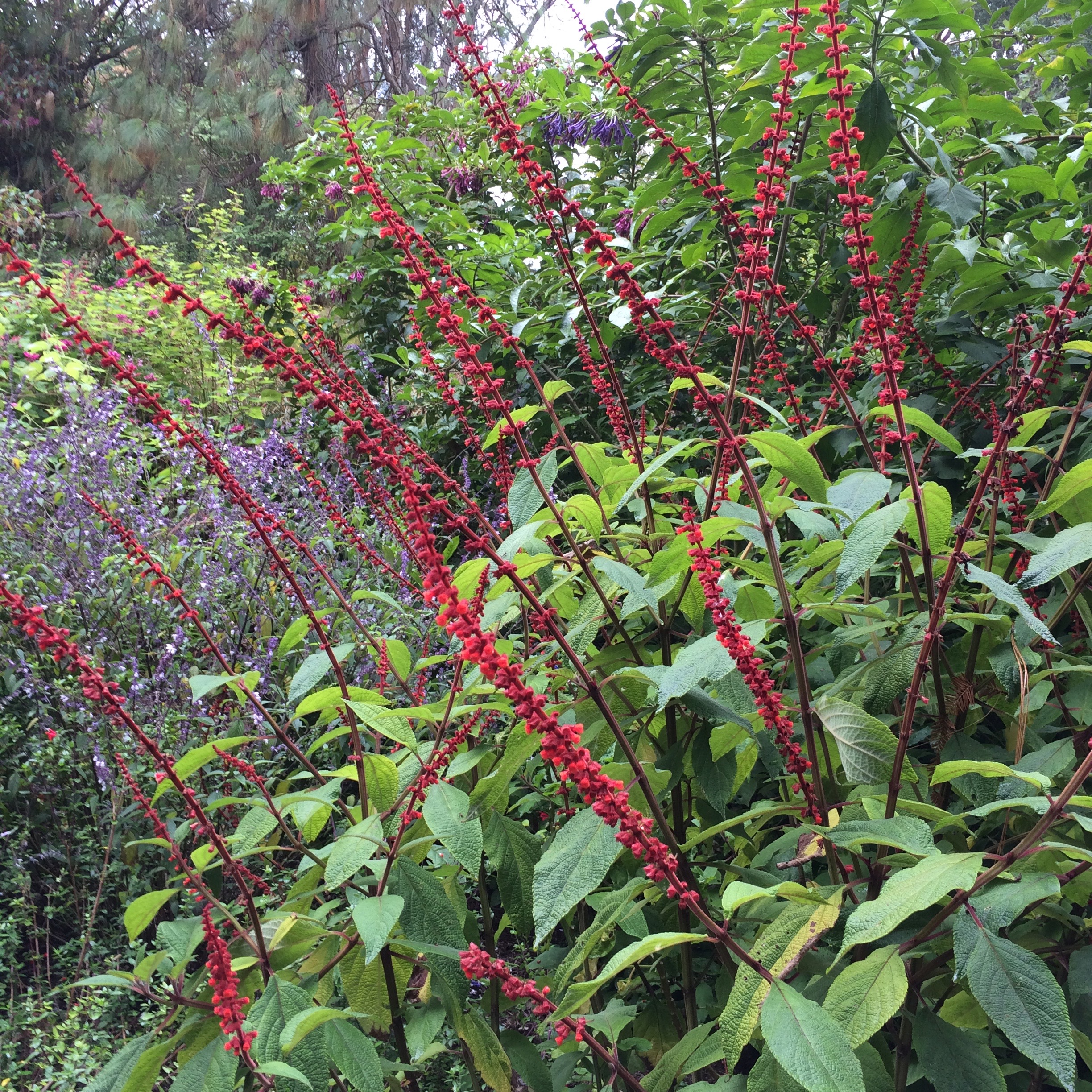
All of the speakers were great!!! I mean this, seriously. I am not known for my PC’ness or empty platitudes. First, goes to the brother and sister team Jimi and June Blake from Ireland for their informative and infectious talks on their gardens and plant loves, for the attention that June brought to us of the history and unique contexts of the place where she gardens, her design sense and ways of working. I particular enjoyed Jimi’s understated wit and sense of humor and our shared plant sympathies, including his for Salvias and his many other favorites as well as willingness to tear into and completely revamp his own garden. If I’d only had the list of plants that they chose to talk about, that would have been plenty enough to have gotten my attention, but their abilities as presenters, as interesting people and characters, brought it all ‘home’. Loved the ‘blue’ Jimi. You’d never catch me dead in it, but on you…it fit perfectly. Continue reading

Cottonwood Canyon on the John Day River: Place, Plants and Experience

IMG_1077

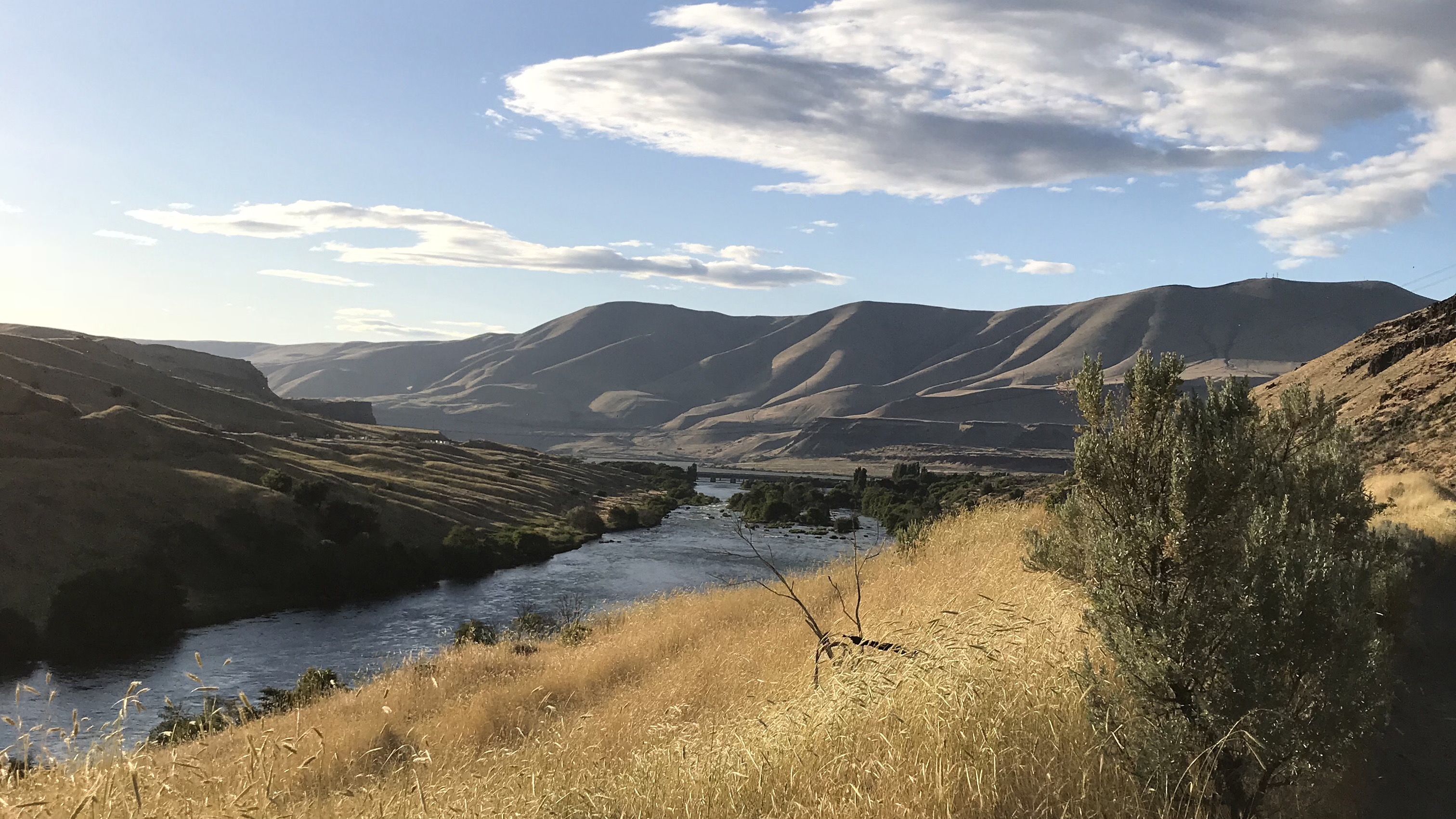
Cottonwood Canyon State Park, near the campground, looking upstream toward the old Murtha barn and common buildings, the evening sun climbing the worn canyon sides. The Park retained some of the old ranch equipment.

Massive lava flows pushed around the lower John Day and Deschutes rivers over the course of several million years leaving them to find and carve new routes, often next to the very ‘plugs’ that filled their former canyons!  Today, deep below the layers of hardened basalt that form the palisades and ramparts projecting out in tiers from the smooth full curves that rise above us, we look through 15 million years of accumulated history.  The fine grained basalt shatters and fractures in line with their mineral structure under the forces of water, weather and gravity.  Sagebrush and grasses dominate revealing an oddly ‘netted’ pattern across the sloping canyon hillsides, lit by the often harsh sunlight, illuminating some kind of subsurface movement of the thin soils that soften the slopes.  The ‘net’ looks as if it had been draped across the land then stretched sideways catching and snagging on what lies beneath in a never the same, but consistent repeating pattern.  It shows best when the angle of the sun comes across the pattern, not when it hits it head on or when clouds make it too diffuse.  Coarse falls of shattered basalt spill down to the canyon’s bottom always seeking their angle of repose.  The sagebrush steppe plant communities cover the surface and in their richness and vigor speak to the soils beneath.  Along seeps and drainages cutting verticallly down the canyon’s face, spring lasts weeks longer, and species crowd in that you won’t see other than near the river.  The surface botanical palette in this way reveals what lies beneath…if one knows what to look for.  Cottonwood Canyon State Park is a great place to observe this. Continue reading

Hiking at Riley Ranch Nature Reserve and Along the Deschutes River

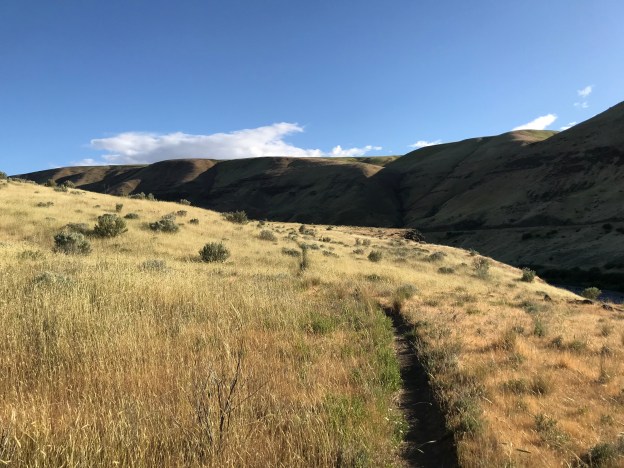
It’s the edges, the margins, that always contain the most diversity.  Large expanses of unbroken landscape take a portion of their character from their scale, a vastness, that the uninterested can often view as monotonous.  Seemingly endless expanses of ocean, desert, prairies even forests, can lull some into indifference, a kind of blindness, in which they lose interest and fail to see the intricacy and richness of that which surrounds them….By overlapping two different landscapes places can take on a complexity that neither has alone…and may even arouse many of those inured to the natural world surrounding them.  Two different landscapes sharing a common edge can form ecotones, where each landscape contributes species in patterns not found across the vastness of each alone.  Cut a river through an arid landscape and it becomes altogether different often with stark changes within a few feet.  Such is the arid canyon landscape of the Deschutes River immediately north of Bend, OR.


Continue reading

Echium wildpretii in Bloom

IMG_9915

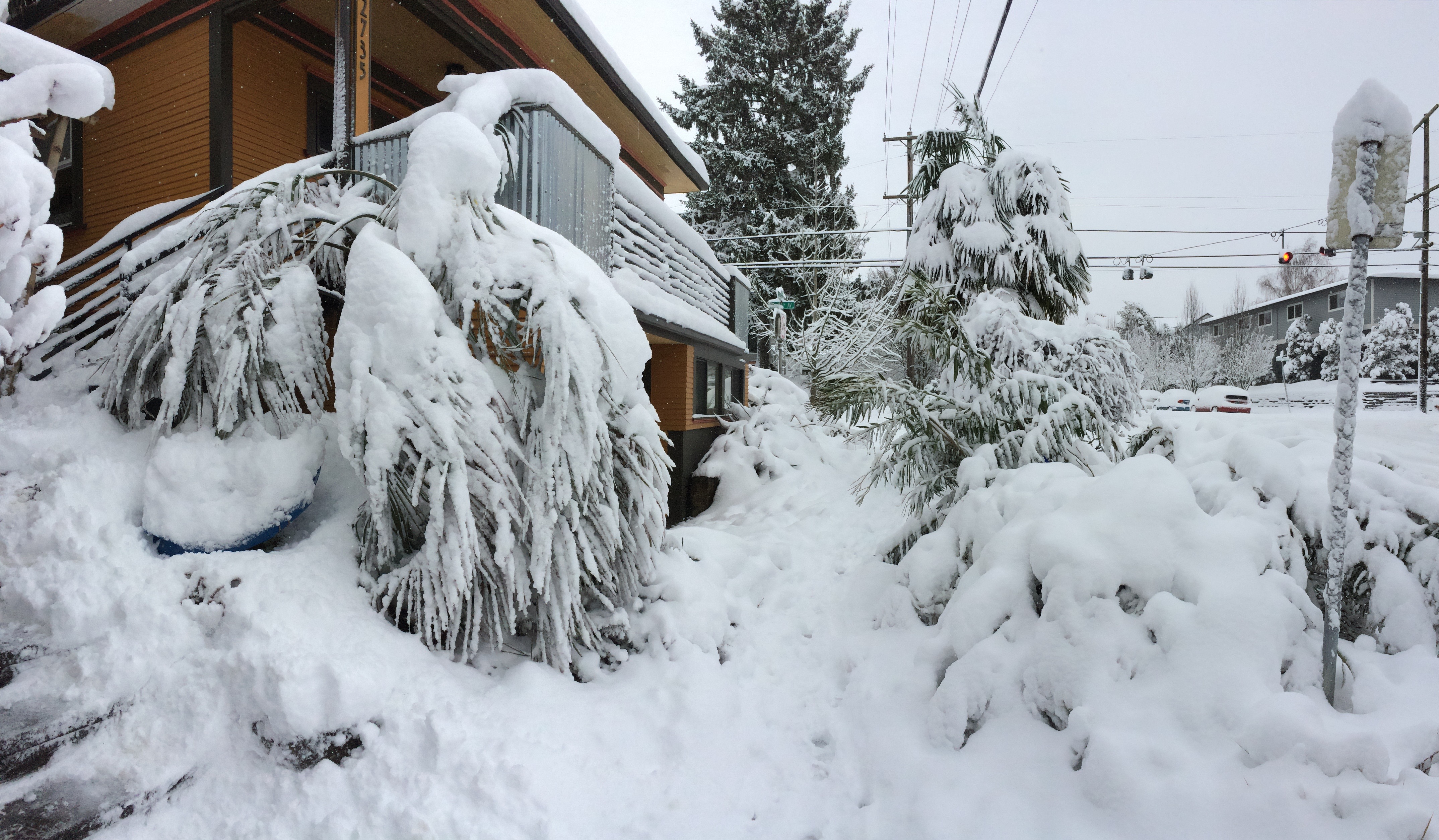
This Canary Island native has a tougher winter climate here to endure than back home.  As an alpine growing on Tenerife, this plant is said to tolerate down to 20ºF with its characteristic dry winters…not so here.  After a relatively mild winter here in inner SE Portland the later half of February chilled down with a little snow as shown here on Feb. 22.  The official weather station at PDX recorded nine days at or below freezing in February ranging down to 23F on the 21st.  This was a fairly ‘normal’ February temperature wise for us, though with just less than 2″ of precipitation, about half of normal, which could have aided its survival.  At my location in inner SE we can record 5-6º warmer than PDX though we often move right in step,  January was milder PDX recording below freezing temperatures on only two dates, the first and second…and we were right around freezing both of those days with just under 5″ of rain for the month.  During December we were ‘blocked’ from lower temperatures that hit most of Portland.  PDX recorded 14 lows below freezing, we suffered only six getting as low as 25º on one of them.

Continue reading

On the Demise of my Ensete ventricosum ‘Maurelii’ (Red Abyssinian Banana

And how did your Red Banana, Ensete, do?  Mine didn’t make it having left it planted outside until after Christmas. In my part of SE, December was mild, until the 26th or so, with lows just below freezing a few times. Then we were out of town a few days and it dropped into the mid- and upper 20’s. I had thought it was okay for awhile, as it pushed out a leaf while sequestered in the basement where I had belatedly moved it, but that is all that it was able to do.  It’s meristem, at the base of the plant, was damaged. I did the finger test at the top of what I had left in place of the pseudostem, about 4′ of it, and the core, through which new growth should have been pushing was mushy and smelled of rot. I cut it down with my machete in a series of cuts, illustrated here, and you can see the soft brown center surrounded by what appears to be healthy tissue. It was still able to push out a few white new roots over its winter storage. Apparently, the meristem is less cold hardy than the rest of the plant. If you could smell it you’d smell strong rot!!! After 12 + years I have found this plant’s limit! The last pic shows its dismembered carcass, reminiscent of the Tibetan Sky burial ritual, to dry away its stink before I dump it in the bin!

IMG_0519A few days later….This was the business end of my Ensete, Red Abyssinian Banana. You can clearly see that the starch storing rhizome, modified stem tissue, 12″ in diameter, is crisp, white and healthy!  I’ve split it down the center, top to bottom, through the meristem. The meristem, the site of cell division and the initiation of all top growth, is black, dead and rotting.  Each leaf begins here.  As new leaves form at the center, the older leaves ‘migrate’ outward forming the tightly packed ‘pseudo-stem’.  This plant, my plant, was unable to initiate any new leaves and with last year’s leaf blades removed, was dead on its ’feet’.  The rot would have continued to spread from the center out.  New root growth is also compromised.  It shares this growth pattern with other monocots much like bulbs.  In others, like the woody Palms, the maturing layers of tissue around their meristems, provides some buffering from cold as they caliper up.  Obviously Ensete are very limited in their ability to do this!

See my other posts on growing this plant.
Winterization
Planting out your ‘winterized’ banana
My initial winter assessment
A more in depth look at the growth of Monoctos as a group

Rimrock Springs, on the Crooked River National Grasslands: A Look at the Eastside’s Sagebrush Steppe Region

IMG_6395

In the comics world this would be called my ‘splash page’, a picture related to but not exactly honest, done for effect. This is taken from the top of the popular destination Smith Rock State Park, on top of Misery ridge, the trails up and down of which have been the cause behind many an emergency run to the local hospital. Here we’re looking across irrigated pasture lands in the middle distance, that would be steppe if not for all of the added water and on to the Cascades along the horizon.

You cannot make someone like something.  To many, a desert will always only look brown and dead, but for those attuned to them, deserts can be beautiful, awe inspiring, expansive, places of raw earth and geology, intimately tied to sky, filled with little jewel boxes, hidden just out of view and down at your feet…places of rock, delimited by the scarcity of water, with plants that not only tolerate its paucity, but require it, where the sun and wind seek it out.  My wife and I grew up in the ‘Sagebrush Steppe’, the Oregon High Desert and on its edge where it meets the Ponderosa Pine Forest.  I often spent hot summer days with my family water skiing on reservoirs in the dammed up canyons of the Deschutes and Crooked rivers, while she often found herself living out of places like Summer Lake and northern New Mexico for the summer.  We both still feel the draw of these places, while others only hunger for more green and lush landscapes where the scale is shifted and plants cover the earth often with flowers that you can’t help be pulled to.  As a horticulturist, I actually appreciate both. Continue reading

Podophyllum and the Sometime Quixotic Life of Plants in My Garden

IMG_0207

Podophyllum x ‘Spotty Dotty’ emerging this Spring.  Remember that these leaves aren’t small.  When they open to their mature size, at about 18″ across,  they’ll absolutely dwarf the vari-colored leaves of your Pelargoniums.

People will often ask me how I grow something, generally when its something they’ve killed, when our conditions, exposure etc, seem pretty close. I’ll shrug, because I may not have done anything special for my plants beyond, hopefully siting them appropriately. Then, there are all of the plants I’ve killed, sometimes repeatedly, that others seem to have success with while doing little more than ‘dropping’ them in the dirt.

I have a bit of a thing for the members of the Podophyllum…and almost everyone I know, who grows them, does so more successfully.  I do have a very ‘happy’ clump of P. pleianthum, and I’ve grown it in Park beds very successfully downtown, but until now I’ve had very little success with any of the others.  Most have lead short, tragic lives….P. delavayi…dead; an unnamed P. delavayi hybrid…dead; P. versipelle…dead; P. x ‘Kaleidoscope’…dead; P.(Sinopodophyllum) hexandrum…dead; P. x ‘Spotty Dotty’…dead; even P. peltatum...dead.  Some of these I’ve killed more than once.  These are usually relatively costly plants to acquire and their loss is more than emotional.  Sometimes I’ve grown them on in their pots for a year before I’ve thrown them into my garden to their deaths.  I’ve lost several other plants from the Barberry family as well, having consistent success only with the shrub forming species and Epimedium spp..  I’ve lost both NW species of Vancouveria as well as Achlys triphylla, one of my favorite ground covers, all of which I’ve grown successfully when I worked in Parks. These shouldn’t be hard.  I’ve grown quite a few different Epimedium spp. and varieties at home and several in Parks, all of which have been consistent and dependable performers.  For a long time, my failures with Podophyllum and assorted woodlanders,  was an embarrassment.  I couldn’t figure out why I kept losing them.  I have a hard time with many Himalayan plants in my garden and a lot of woodlanders in general, I think because it may just get too soggy over the winter.  They’ve taught me to shrug when they fail to emerge in spring.

Epimedium g. Lilafee4362

A cluster of flowers on Epimedium x ‘Lilifee’

Continue reading

Evolution, Speciation and What it Means to the New Phylogeny: A Primer for Gardeners, Part 2


Understanding the New Phylogeny of Angiosperms, part 2

We tend to think of evolution as a historical process, something that occurred in the past which has resulted in life today, with us at the pinnacle.  Humans with our opposable thumbs, our relatively high ratio of brain to body mass, our consciousness…our souls, we often argue, are the ultimate life form.  We have a hard time imagining that this is not the case, that we as a species, are a part of a continuing process, that some day will fade from the Earth, as other species, more evolved and complex, develop.  This is what happens to organisms over seemingly impossible long periods of time. It has happened and is still happening to plants.   It won’t happen today or tomorrow and this doesn’t mean that what we are or what we do doesn’t matter…because in evolution…’everything’ matters. Continue reading

Life Inside the Cell: Waking Up to the Miracle, part 1

[This is the first in an extended series of three posts, this one on life within the cell, the second, on the evolution of plants, and the third on the New Phylogeny and Eudicots.  This first ‘installment’ concerning life within the cell, is divided into two parts, the first covers the function of the cell itself and, importantly, the role of water in the cell.  The second, part 2, will examine the concept of quantum biology and its explanative necessity for life beyond the ‘simple’ construct of cells, tissues and organisms. While trying to understand the ongoing reorganization of and classification of plants, I found it necessary to better understand these other topics, what it is that we are ‘messing’ with! ]

———————————————————————-

I begin here with the cell, what I’ve learned about what makes the cell, its existence and life within it, so amazing, something which should give us all pause, when we consider our own lives and what we do.  When scientists ‘split hairs’ in their arguments on which group to assign a species, when they attempt to link them to their ancestors, many of which are now long extinct, to understand their relationships with other organisms, they have a purpose.  They are often looking much deeper into what a plant is, what constitutes life and how it evolved.  Phylogeny, the science that attempts to establish relationships between different organisms, different species, to link one to the other across time, is about both the history and the continuing journey of life on this planet.  It promises to tell us much about our own place as well as that of the hundred’s of thousands of other species with which we share it.  Ultimately, if we choose to understand this, it will change the way we garden and our relationship with the many landscapes that cover the Earth.  Our gardens are our own personal expressions, works of ‘art’, and must live within the ‘limits’ both permitting and governing life on our little pieces of ground and the Earth.  They reflect our understanding of the limits and possibilities at work here.  The better that we understand this the ‘better’ our gardens will be, the more in synch they will be with life.   Continue reading

My Father’s America and Tomorrow

My father in 1930 on the Green Ridge family farm

My father was born in 1922 on Denman Island, a small island, roughly 12 miles long, on the coast of British Columbia, located about 124 miles north of Victoria, BC.  His family lived there on a small subsistence farm without electricity, indoor plumbing, a car, a truck or a tractor.  To get work done required their own muscle or the help of their horses or neighbors.  Water came from a hand pumped well, heat from trees they took down on their land.  They produced much of what they ate in a large vegetable garden and orchard storing it in the root cellar below their house, and the occasional deer and fish they could make time to catch.  They had chickens for their eggs and meat and kept pigs to sell as well as for meat.  They kept bees for honey.  A herd of dairy cows, Guernsey’s, because of their high butter fat milk, was their primary source of income, separating out the cream each day, storing it in large cans that they would lower down into their well to keep cool so that it wouldn’t spoil.  Once a week they and other farms hauled it by wagon to the general store.  There it would be picked up by a truck that came over on the ferry which would carry it to the plant in Courtney for processing into butter and other products.  What skim milk they didn’t use they fed to the livestock.  They would slaughter extra calves for their own consumption.  It was a relatively common life, not that many years ago, that to today’s highly urbanized, consumer population, might seem light years ago.  I’ve often wondered at the ‘adjustments’ my parents had to make to make sense of this world today.  I’m beginning to understand now that I am well into my 60’s and retired myself. Continue reading