Category Archives: Practice

Weeds, Weeding and the Health of Our Public and Private Landscapes: an example from the ‘hood

Every gardener is a weeder. Gardens are created landscapes, often expressions of the individual gardener or, lacking of intent and design sense, those of a chosen designer. We live in our landscapes as active, responsible, creators, participants and stewards. Gardeners are trying to create a particular look or to grow particular plants native to their area, or with ornamental value or food plants to feed themselves and their families. Some of us are simply pursuing what we understand to be a healthy relationship with one’s place, to undo the damage and allow a new healthy and vital landscape to grow. These are landscapes of our choice. Our intention and control results in various volunteers and weeds finding their own place and so follows the need for weeding. 

We watch carefully, monitor the impacts of our work, attempt to understand what result is moving us closer to our goal and which might be indicators of further loss. Landscapes and gardens are incredibly complex systems and anyone who claims to have all of the answers is fooling himself and you. Our landscapes are broken, by us and our predecessors. The Pandora’s Box of weeds and disruption was burst open long ago. The only way ahead is to find a new path.  Weeds are here filling the niches we have collectively made and maintain for them. The more one is surrounded by aggressive, well adapted weeds, the more time we must spend controlling them. While this can be significant, gardeners mostly take the work in stride, a necessity to reach our goal, a goal which may be the simple act itself, of working in concert with our place…open to its teachings. Gardening, is a way of life, a smaller scale version of farming and the management of large ‘natural areas’ with their attendant commitment, rhythms and demands. Continue reading

Spruce Park, Redmond’s Newest Park and Our Neighbor: a horticultural critique

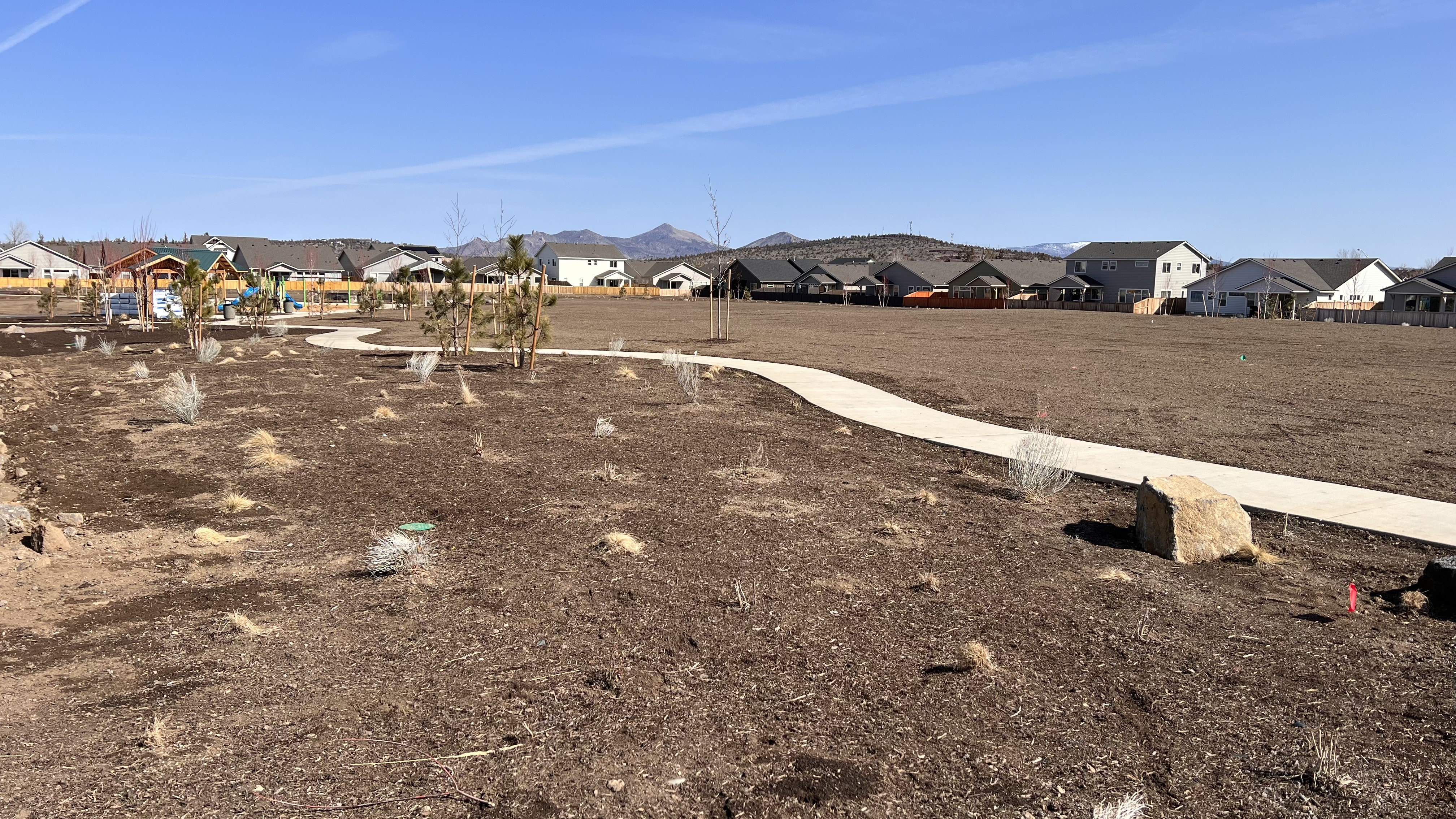
Redmond’s Spruce Park looking NNE from the SW corner toward Gray Butte and Smith Rock in the background. The border beds which follow much of the loop path are ‘native’ plantings according to the conceptual plan. It is common to claim that most of the plants are natives in designed natural areas, but native is not synonymous with ‘natural’. Although natives are used here concessions have been made including such plants as Echinacea purpurea ‘Pow Wow Wildberry’ and Rudbeckia ‘Goldsturm’. In a strict sense Ponderosa Pine aren’t native to this immediate locale either, they require more precipitation than we normally get and the Autumn Blaze Maples are a hybrid of two northeastern North American species.

A landscape, in nature, is a whole, functioning system, capable of perpetuating itself, through out the seasons and years, relying entirely on its own conditions and the cycling of energy and resources occurring on and within it. This is also the definition of a modern sustainable landscape. Ideally they require no inputs or energies supplied from offsite aside from the sun, precipitation and the normal cycling onsite of nutrients and water. A human made, contrived landscape, as all of those built by us today are, may be ‘judged’ by how well they function on ‘their own’, by how well they fit this ideal. Labor and outside inputs necessary to maintain a landscape are then indicators of how out of balance, how far from ‘ideal’ nature and genuine sustainability, a landscape is. A contrived landscape, which ignores the relationships integral to a healthy landscape community ‘demands’ more and more maintenance and support. Given its design and use, a landscape which ignores its site and relationship requirements will deteriorate from the intended design, losing to death component plants while gaining, increasingly, more unwanted available weed species. Design, conditions and use are essential to determine, in this sense, what a ‘good’ landscape is. Continue reading

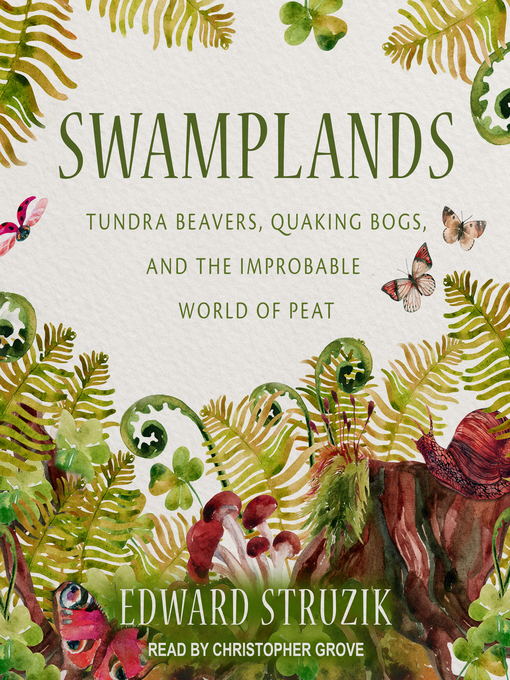
Swamplands: Tundra Beavers, Quaking Bogs and the Improbable World of Peat, a Review

The idea of individuality and control, key elements of the American psyche, are a self-deception. We can take an individual action, guided by an intention, and see its effect in the world around us, but after that, the first ‘tier’ of effects, there are secondary, tertiary and others beyond them, as what we have effected spreads out across space and time, effecting those things, beyond our focus, that nevertheless are in relationship, and do and must respond. If we’re paying attention we can see them and attribute them to others, unaware of our impact. The world is so large and complex, while we individually, commonly see ourselves as relatively ineffectual. We often don’t recognize our own agency and how collective effects propagate from our action. This can also support the idea we ‘can’t’, in a significant way, damage the systems and cycles that support life on Earth. What we must understand though is, that as members of societies and cultures, which share economies and technologies, our ‘individual’ actions are ‘shared’, they are multiplied, often many millions of times. We act individually, but we have tremendous collective impacts. By denying this we deny individual responsibility, which in effect, is a cultural denial, permitting the negative impacts to continue. “It’s just me!” “It doesn’t matter.” “It’s their responsibility, not mine!” These collective problems are then left unaddressed.

It is easy to believe this way. There is so much beyond our own control, so many problems, that it must be this way right? No. We are responsible, collectively. We never truly act independently, because we live in relationship with those around us and their, and our, influence over one another blur. Like it or not, we are a part of a larger society. To go against the conventions and norms of society, to act independently, is risky, to ourselves and the world around us…a risk which can bring with it changes, either positive or destructive. However, going ‘along with’ the norms and conventions of society, unquestioningly, is to possibly continue a potentially destructive practice. We are responsible. We have necessary roles o play. We have been relatively bad as a society at discussing our wider actions, of working to understand our impacts and insuring the security of life and its necessary conditions. Too often we comply, go along and continue doing those things simply because we ‘always’ have, forgetting that as our numbers and use continues to grow, so does the potency of our impact. We have been habitually confusing short term gain and comfort, with longer term survival and good. The consequent results of those unexamined actions can become devastating. To continue ignoring our negative impacts on others, in its broadest sense, is ultimately a threat to our own well being and security. Uninformed actions, actions taken selfishly at other’s expense, threaten the whole, because of the ubiquitous and pervasive connections to the world and between all people, places and organisms. Our denials will not change this. So, why do I bring this up? This is a gardening/horticultural post…because, what we do, or don’t do, in our gardens and across our shared landscapes, has impacts well beyond their borders. Continue reading

Why Bad Things Happen to Good Plants?: On Root Problems, Root Washing, Nursery Practices and Customers

“To be, or not to be? That is the question—Whether ’tis nobler in the mind to suffer The slings and arrows of outrageous fortune, Or to take arms against a sea of troubles, And, by opposing, end them?”  Hamlet.

Is the question we face as gardeners as simple as, To ‘root wash’ or not to ‘root wash’, before planting?  To some today it has become ‘heretical’ to suggest that it might not be just a necessary corrective, but an unmitigated good…and not doing so dooms a plant to failure.  The practice of ‘root washing’ in its present form, is relatively new to gardeners.  Horticulture, which is a system of techniques, traditions and science, that goes back to our own species’ first intentional involvement growing and selecting plants, has not always included it.  Practices develop over wide spans of time.  Many are retained, others pass away. Root washing has been around as a method to assess damage to root systems, to ease and make more efficient division, to study root growth or cleanse them of particular infestations.  ‘Bare-rooting’, during a plant’s winter dormancy in temperate regions, has historically been done in the field when harvesting or transplanting many deciduous trees and woody plants for shipping and ease of transport.  In some circles today root washing has become an almost literal flash point, pitting proponent against opponent, ‘science’ against ‘tradition’…yet another fracture line to divide society. The road of the absolutist, as with many other human practices, tends to create conflict as evidence of correctness is lobbed back and forth.  My own view is that, like so many other things today, the subject is somewhat ‘grayer’. Science can be on both ‘sides’, or neither, and reality is rarely so simplistic. Continue reading

Controlling English Ivy and Clematis vitalba in the Landscape

I wrote the piece that follows while still a horticulturist working for Portland Parks about 20 years ago. It remains largely in its original form with a few additions, corrections and updates.  Both plants are still under addressed in the landscape today.  While employed I maintained my license as a public applicator of pesticides, a job requirement.  I no longer have one, nor do I have a consultant’s license.  In many cases herbicides can be an essential part of an effective strategy for the control of an established population of invasive plants.  Invasive plants, like these, which are listed on your State’s Noxious Weed List,  are there because of the the threat they pose to the environment and their capacity to infect and dominate a landscape, any landscape, across our region.  In more than a few cases manual and mechanical methods of control alone are insufficient to ‘control’ the invasion and sole reliance on them will assure the failure of the establishment of a desirable landscape on a site.  Herbicide use is thus justified.  Large scale restoration projects are often dependent upon it.  On a smaller residential property, with commitment and persistence, a homeowner may be successful, but even then they need to understand that there will be a continuing and significant threat of reinfection from surrounding properties, via birds carrying the fruit of Ivies and wind blown seed from Clematis.  For some species, especially when the scale of the invasion and property are larger, its use may be essential.  For many weeds this herbicide ‘threshold’ is very low before its use is a requirement.  In this way scale works for homeowners as their properties and problems are smaller.  Too often though properties are neglected and then the buyer inherits a serious problem.  Using any herbicide will always have potential adverse effects on the environment, so if you choose to use it make sure you do so effectively. If you choose to use any of my herbicide suggestions, you are on your own.  Do your research, understand your problem, to assure that your actions are effective, safe and responsible.

Getting Down to it: Your Viney Culprit is Probably Hedera hibernica, Irish Ivy, or More Rarely H. colchicum

English Ivy, a friend and co-worker announced early on in a then still continuing series of work meetings concerned with various issues of invasive plants, has been a kind of “anti-poster child” for those working in the regional conservation and restoration field.  Its spread and control has been the subject of innumerable meetings, proposals and actions both fruitful and not.  Eradication is no longer considered a realistic goal by many.  The focus, rather, is on limiting its spread and control.  Like other exotic invaders and introduced guests now run amok, from diseases to various shellfish and weeds, once a particularly well adapted species establishes a viable population base, it becomes a part of the disturbed novel landscape…it’s here and we’re going to have to figure out how to deal with it.  This has always been the way of the world.  The difference today is the rapidity with which these changes have been introduced through trade, the peripatetic travels of man (Man in the generic sense) and our never ending appetite for the consumption and disruption of land.

Continue reading

On Our Expulsion From the Garden: How Our Ideas of the Garden Shape What We Do

There are those who argue that life is short and violent, that we have nothing to look forward to other than our deaths…so we might as well grab for whatever we can now!….that is the path of the nihilist and the greedy, it serves as an excuse, a rationale for their choices, following an ethic of ‘why the hell not!’  This is consistent with the ‘beliefs’ of those who feel the weak get what they deserve, that anything that opposes their idea of dominance, is weakness and failure and they pursue it with the righteousness of a ‘true believer’.  “Only the strong survive”.  If our gardens can teach us anything it is instead that, ‘He/She who has the graciousness to take only what they need and gives back whatever they are able to, live on through the love and lives of those and that which they’ve nurtured, helped, befriended and mentored along the way and in this way have helped build a richer, more complex and diverse world.’  Our true legacy will be best expressed in the richness and health of the world we leave behind, of those that we’ve loved and taught.  As competitive as the world is, it is this positive, cooperative, supportive aspect of life that makes it all possible.  While the world is divided into heterotrophs and autotrophs, those that must consume to live and those able to grow and metabolize that which they need from the world around them, it requires them both, working in a balance to sustain them all.  We humans, ultimately, cannot be any different if the world is to continue on. Continue reading

Winter 0f ’18 -’19: Cloudy, Mild With a Chance of….On Weather, Zones & Plants

It’s 41ºF at 5:30am on Mar. 12 as I begin to write this.  We appear to have come out of the longest sustained ‘cold’ period of the winter of ’18-’19 which began on February 4 and continued through Mar. 11, a period of 36 days.  Over those days we had freezing minimum temps at PDX, the official NOAA reporting station for the Portland area, on 26 of them.  On two of those days, Feb. 6 and 7, PDX recorded the winter’s lowest temp, 23ºF, making it a zn 9a winter, mild for us historically and especially so for the temperate US as a whole, much of which was experiencing its own much colder temps.  It’s mid-March and our high temps have climbed well above what they were and our forecasts call for milder, more ‘normal’ highs and lows now locally.  It looks likely that not only are we going to be on the ‘warm side’ of normal, but that our lows have shifted into a pattern well out of the freezing range.  (State ODF meteorologist, Pete Parsons, calls for a pattern of slightly warmer and drier weather than normal over March, April and May with the highest chance of this during May.) 

While weather consists of moments, recorded data points, we attempt to make sense of it in its patterns over time…our experience of it.  In this we are much like our plants.  Plants too have their ‘expectations’ of the weather and those conditions that take them outside of them, outside their familiar patterns, the relatively quick changes and perturbations, as well as the longer sustained patterns, and extremes, are ‘noticed’ and make a difference.  How does this winter compare? Continue reading

The Fascicularia and Ochagavia Question: Two Worthy and Relatively Hardy Bromeliads


The inflorescence of Fascicularia bicolor with its blue flowers. The center of the foliage on a blooming rosette, turns red when the flowers appear and then, like many Bromeliad, that rosette dies replaced be previously formed offsets. My blooming plant had multiple rosettes at the time, three of which bloomed. Taken in my garden, Sept. of ’17.

If you’re not into blood and guts, consider this genus, as on my scale of one to ten as described above with ten warning of near complete evisceration if one is fool hardy or reckless, this one’s a solid 4, dangerous enough but not stupidly so.  Fascicularia pitcairniifolia.  You would think that in a genus composed of one or two species things would be pretty well settled taxonomically, guess again. Originally described as F. bicolor it was reclassified as F. pitcairnifolia and later changed back to F. bicolor.  Subspecies were proposed.  Changes retracted.  There are significant differences in the sampled populations, but were they sufficient to constitute separate species??? Adding confusion at a different level are those who say the species name indicates that it is from Pitcairn Island.  It is not.  The specific epithet simply recognizes a similarity to the foliage in genus, Pitcairnia, another Bromeliad member.  This Fascicularia is from the lower Chilean Andes, allegedly north of the other Fascicuaria species, F. bicolor which is suppose to be slightly hardier and occurs at least occasionally as an epiphyte!  Some botanists have argued that F. pitcairnifolia possesses thicker, slightly wider leaves. and some minor differences in the timing of flowering and is reputedly slightly less hardy.  The ranges of both overlap  Good luck sorting this out. Continue reading

Our Gardens as Teachers


Of all the things our gardens do for us, arguably the most important is their role as our teachers, even in winter when a temperate garden ‘rests’, its surface crust or top few feet, frozen, maybe sheltered beneath the cover of snow, or, as ours so often are, simply too cold for active plant growth, the soil wet, the rain too heavy to percolate fast enough down through its layers, without the active aid of either the direct heating of the sun or its effect on plants, through evapotranspiration, pumping water back into the air as the plants grow.  Gardens teach patience.  They encourage us to become more careful observers…to think and plan, to anticipate and prepare, to understand that there is more going on here than we can readily see…and they teach us about faith and trust in the natural world, that there is always more going on than we can see. Continue reading

Roldana cristobalensis (formerly Senecio cristobalensis…now, Roldana petasitis var. cristobalensis)


Roldana petasitis var. cristobalensis shown here looking amazing with Aeonium arboretum ‘Zwartzkop’.  Its substantial leaves are some 8″ across, thick and velvety, the undersides of which are red/purple, like the stems.  The color often comes through in the veins along the top surface.  A very striking foliage plant.  Picture this with its close relative, Pseudogynoxus chenipodiodes, the Mexican Flame Vine, formerly known as Senecio confusus!

Sometimes called Velvet Groundsel, this plant has been living and marketed under several different names.  The first name in the heading is the one Jimi Blake ascribed to it, a name I didn’t recognize for a plant I’ve grown off and on in the past…it got lost in his list paired with a particular Thalictrum and I simply missed it…until recently.  I knew it as Senecio cristobalensis and, had I recognized it, would have included it with an earlier post in which I focused on his favorite Asteraceae.  I did actually mention the plant there simply as another Senecio that I’ve grown of value.  Here I shall treat it more directly.  The genus, Roldana, was recircumscribed in 2008 to include some 54 different species.  Other authors include as few as 48 and as many as 64 in the genus, most of which used to belong to Senecio and are native to the extreme Southwestern US, Mexico and Central America.  Most of the Roldana species are somewhat ‘shrubby’ herbs with a few, like this one woody, even tree like.  Both genera are within the Asteraceae and share tribe status as well, Senecioneae.  For the curious, Roldana spp., even more finely, are included in the sub-tribe, Tussilagininae, which includes the very commonly grown genus of garden plants…Ligularia!  On closer examination the morphological similarities will begin to stand out to most of us.  Check out all of the photos on the Wikimedia Commons page for Roldana petasitis.  Roldana petasitis is the correct species name for this plant.  With all of the shuffling and consequent confusion still going on in the world of taxonomy, especially in such a mixed large genera like Senecio, we must all be allowed our mistakes of nomenclature.  It is a volatile changing world out there. Continue reading