Long ago I took a couple philosophy classes at U of O; one on existentialism, in which we read several novels and discussed their themes; and another, an upper division, class on ethics, because I was curious…I dropped the ethics class after sitting around the table in seminar discussing particular authors’ thoughts, like Kierkegaard and Butler. Majors seemed to take pleasure in making fun of what I got from them in discussions. Hated this. I still have trouble reading philosophy. It seemed like a game to them in which they argued a position to show off their cleverness, their superiority, the ideas themselves of relatively little importance…while hiding their biases. It must have been so self-assuring for them to ‘know’ these author’s precise thoughts and bash those who don’t get it…or saw something different (like the newbie, me). To quote someone isn’t to understand, it is only miming, presumably in hope of getting a reward. I read for understanding. It’s not a competition. So, this book, “Determined: A Science of Life Without Free Will”, taking a science approach to evaluate a philosophical concept, was difficult to begin. The author, neuro-biologist Robert Sapolsky, argues that those philosophers and theologians who claim that people have free will to do whatever they desire or set their minds to, are wrong. This appealed to me immediately. Continue reading
Category Archives: Sustainable Landscapes
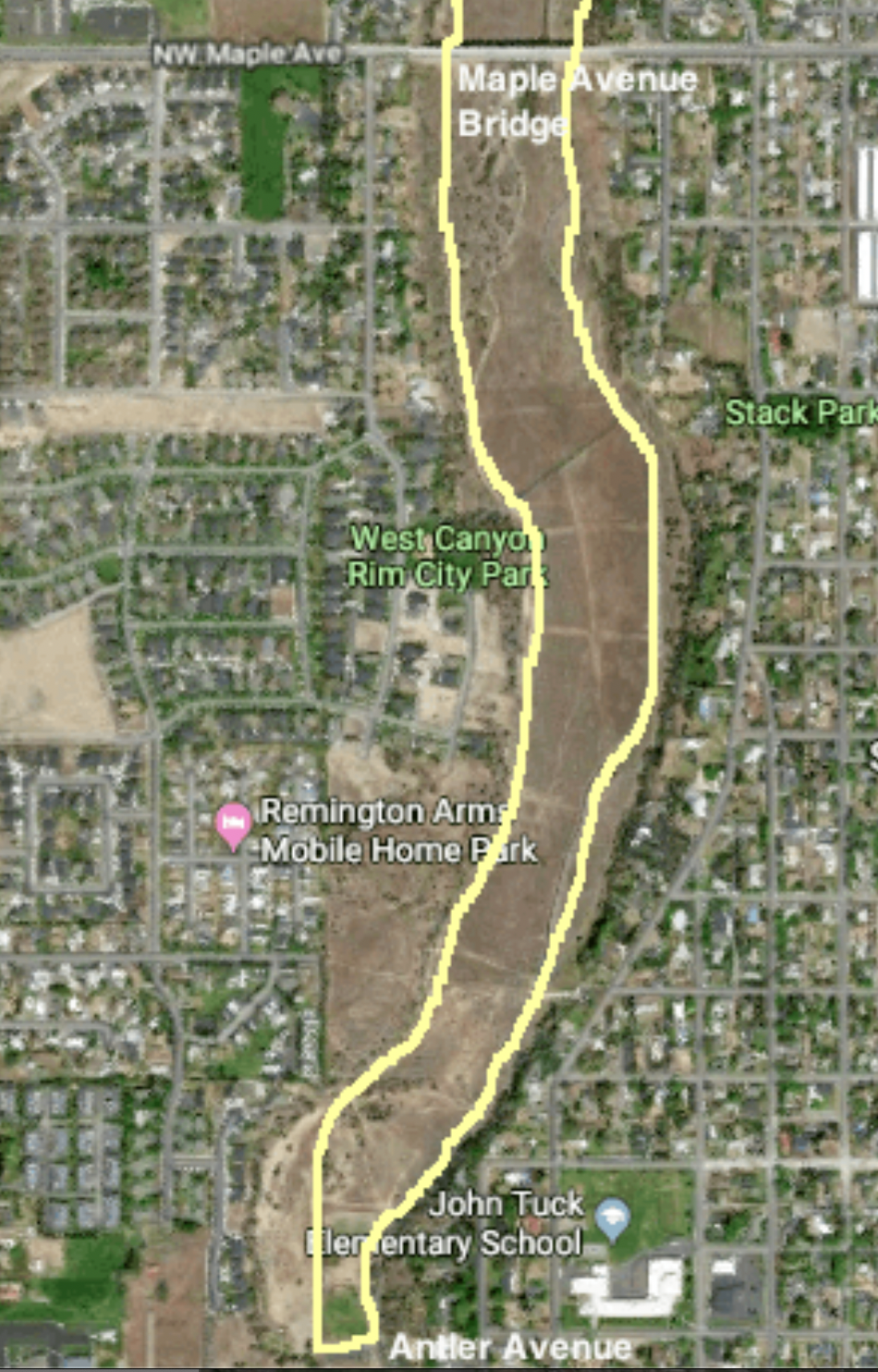
Knapweeds in Redmond’s Dry Canyon and the Pursuit of a Healthy Landscape

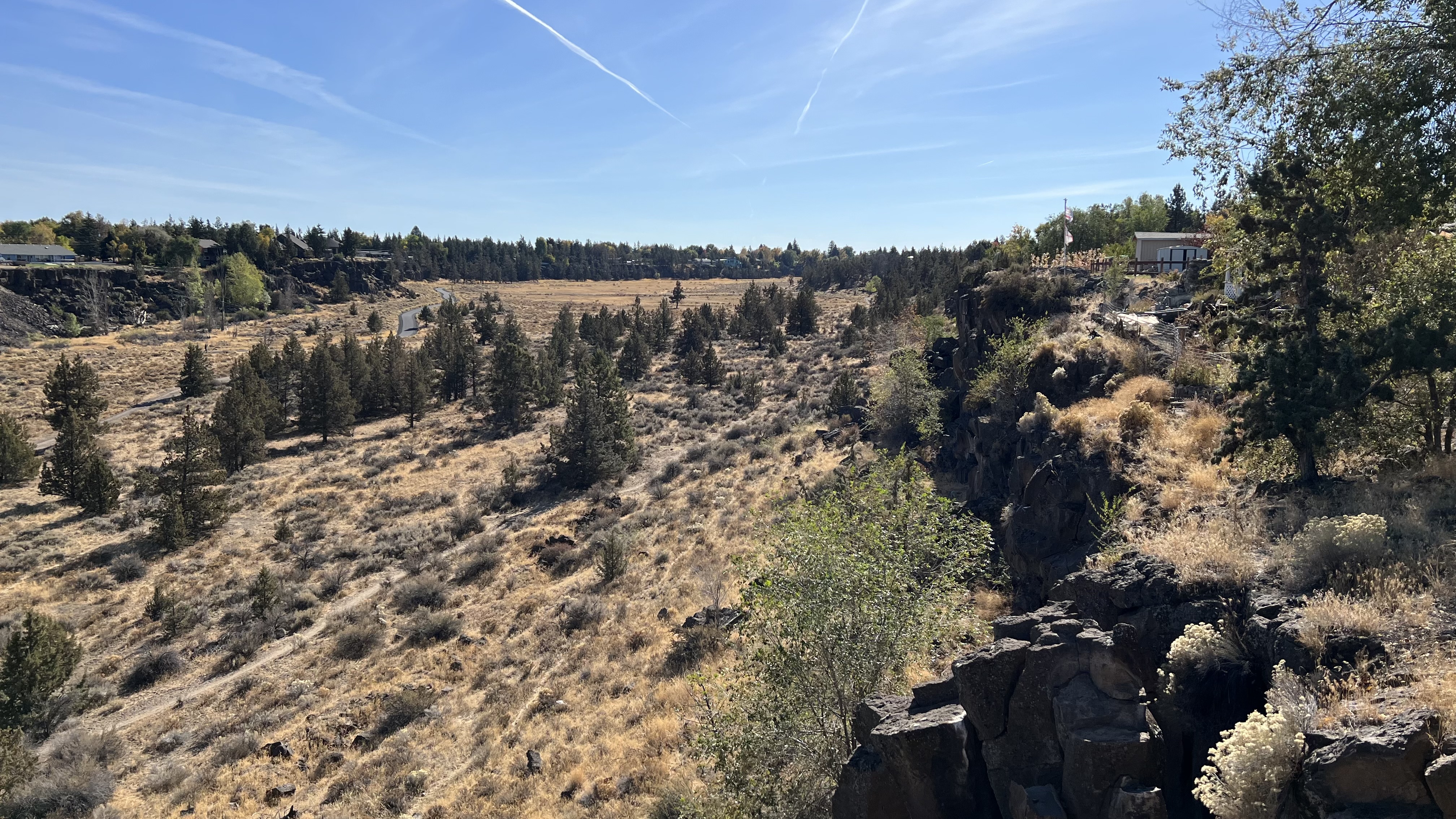
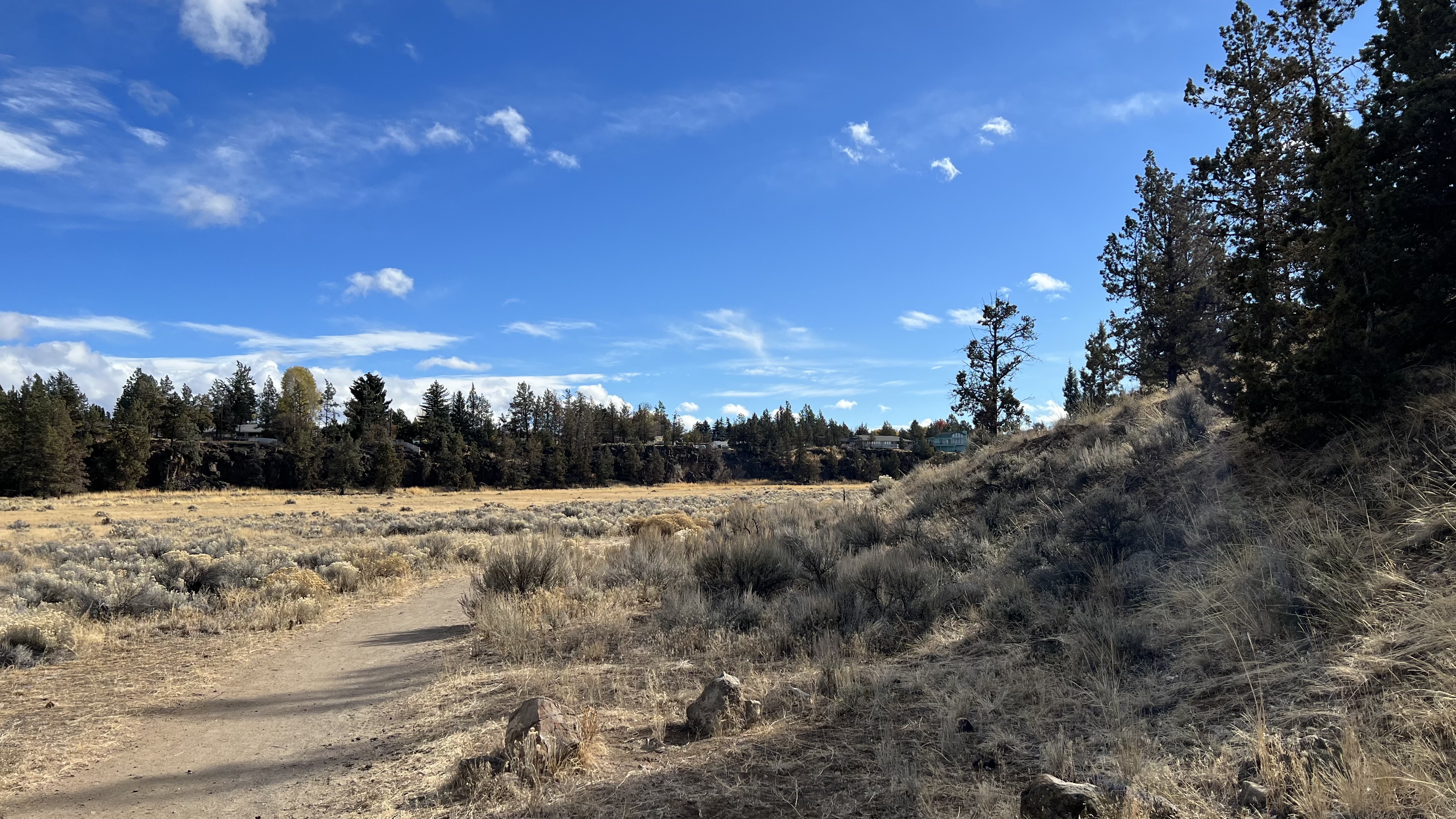
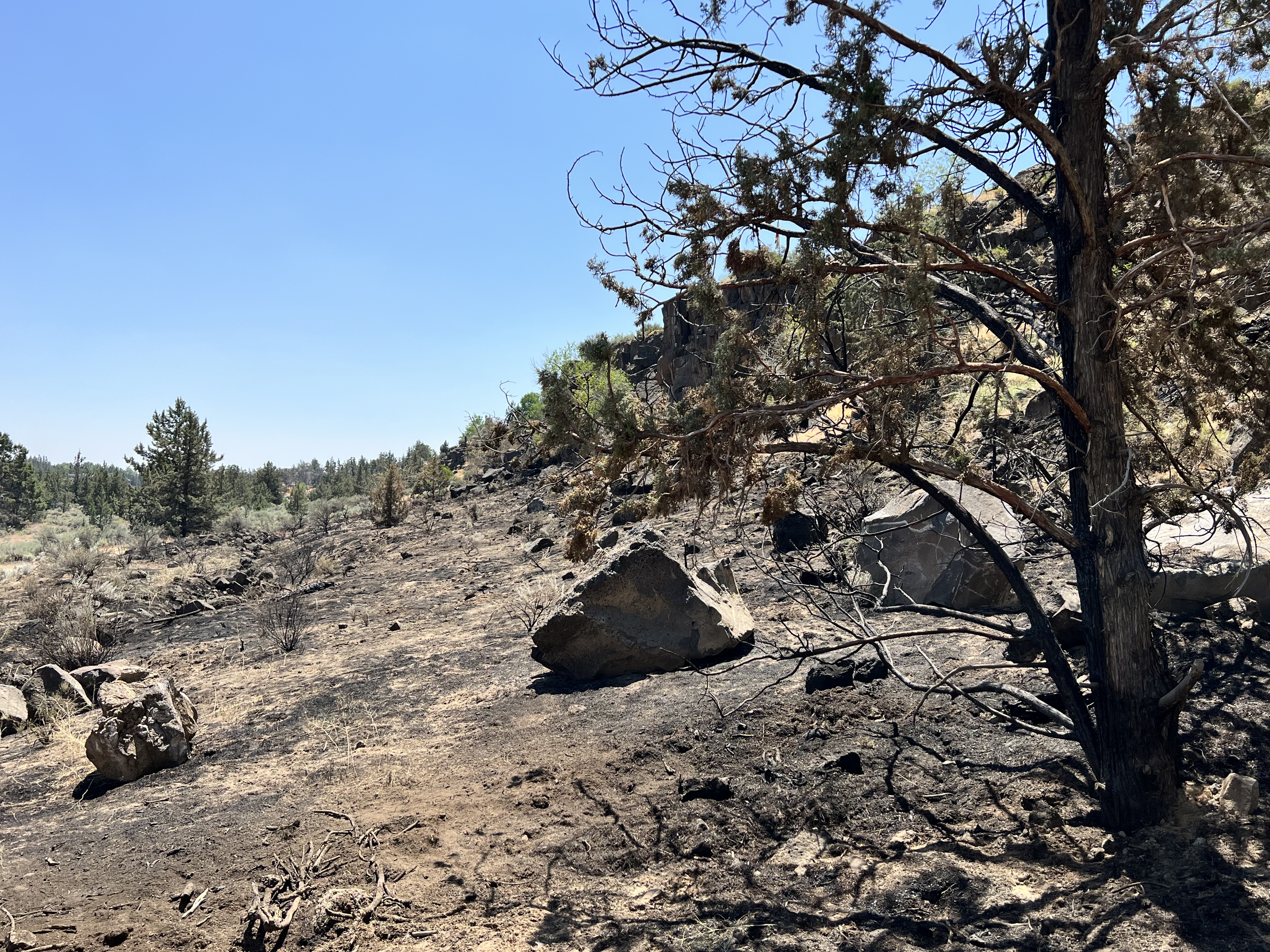
Redmond’s Dry Canyon looking south from the west rim on the Maple Street Bridge. The area in the immediate foreground burned this last summer.
If you garden, or maintain a landscape, you come to understand that not all weeds are the same. Each will have its own ‘strengths’, or perhaps you might call it ‘virulence’. Any particular weed, just like any other plant, will respond ‘positively’ to supportive growing conditions, conditions which often closely align with those which exist in its place of origin. Plant explorers and nursery growers are always looking for ‘new’ plants for landscape use. in a way, they have to walk a fine line. They must find plants, that with reasonable effort on the part of the gardener, can thrive across a range of conditions, unless they are looking for specialty plants, for narrow, niche, markets. The introduction of new plants must be somewhat measured, our enthusiasm tempered, because plants which are too adaptable, too vigorous, may possess the ability to escape our cultured gardens and find a place in the surrounding, uncultivated, landscape.
For Central Oregon, when we look beyond our regional natives, we must keep this in mind. Exotics from similar growing and climatic regions around the world offer both promise and threat. We want our plants to be successful, but not too. Sometimes through the process of trade, the movement of livestock and agricultural products, particularly aggressive species hitch a ride. A few weed seeds can be easy to miss. If they are aggressive enough and go unnoticed, a distinct possibility, it is likely that they wont be detected until a sizable local population asserts itself…and if no one is watching, that can be a fateful error. One group of plants, with many wonderful possibilities, also include species which can be exceedingly problematic here in Central Oregon, these are from regions sometimes referred to as Steppe. Continue reading
On Weeds, Disruption and the Breaking of Native Plant Communities: Toward a More Informed Working Definition of Weeds

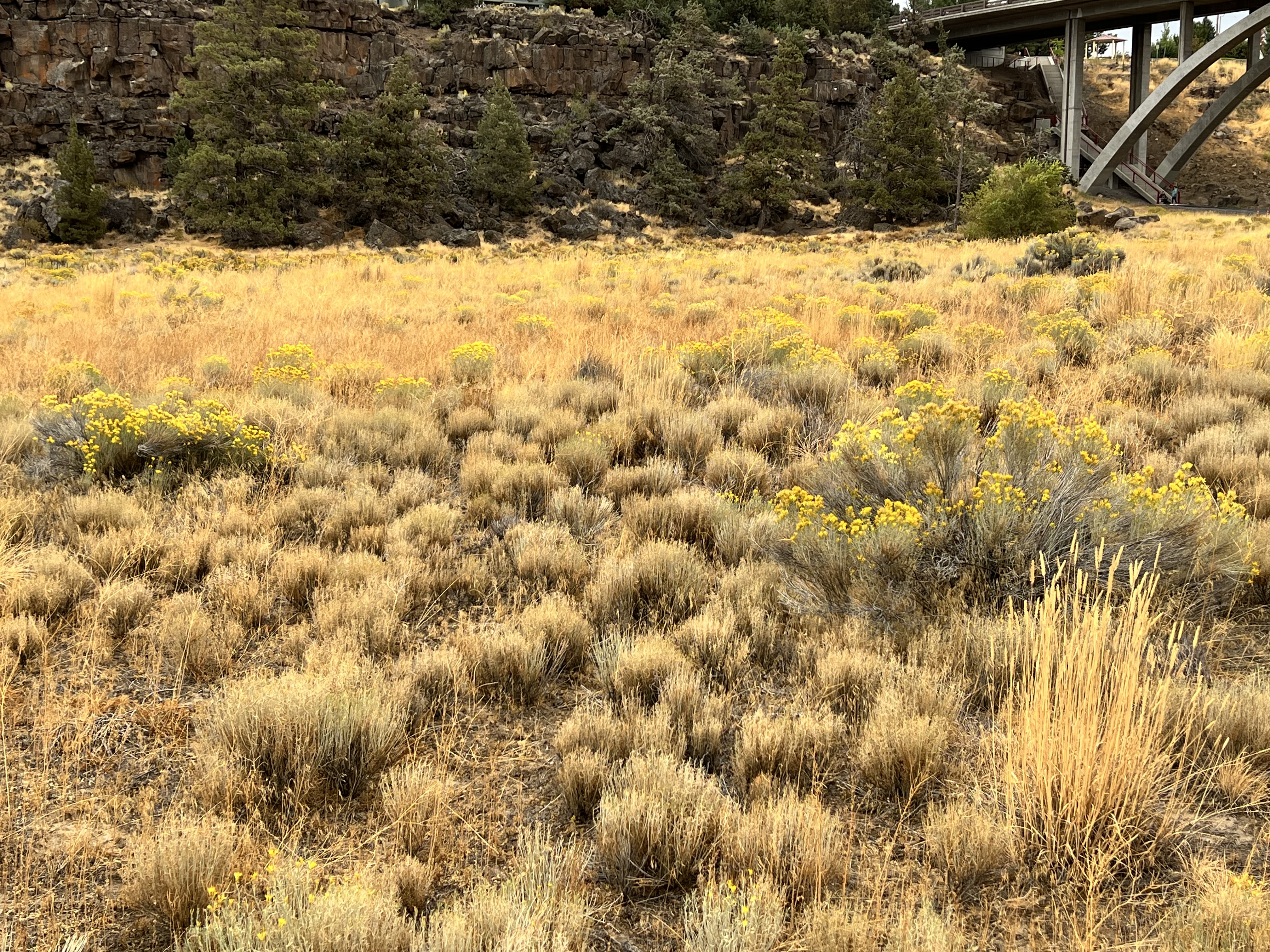
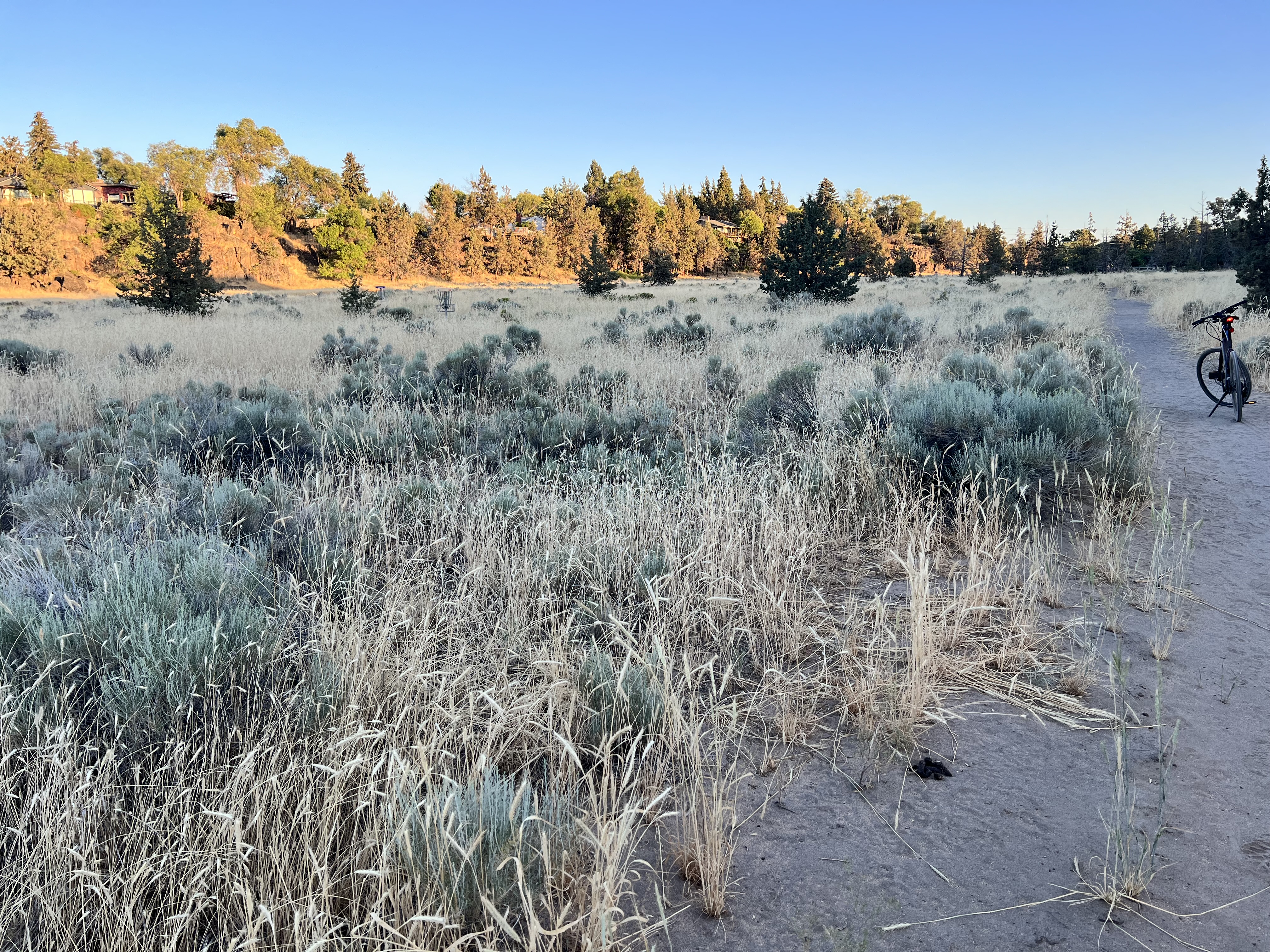
The bottom land in Redmond’s Dry Canyon was used for decades as low quality pasture, the native community pretty much obliterated. Those areas with surface rock are more likely to retain more of the original plant community, although Cheatgrass has invaded much of those areas as well. The is looking southerly over one of the larger ‘pasture’ areas near the disc golf course. There is very little Cheatgrass through this section south of West Rim Park. It includes a few native seral species which typically occupy disturbed sites as a site transitions, including Gray Rabbitbrush you see here. Found in this area too is Secale cereale, Annual Rye, a non-native, which appears to have been planted along more formal paths to limit Cheatgrass spread(?). Junipers are moving in. Sagebrush hasn’t yet.
It is commonly said that a weed is a plant out of place…and of course ‘we’ are the one’s who decide this. Some will try to argue that there are no weeds, that all plants belong and if we only left weeds alone landscapes would reach a balance on their own. If one’s time frame is long enough this may be the case, though this will take considerably longer than one of our lifetimes, and then there is our inability to actually leave landscapes on their own, or to at least consciously moderate our disturbance of them. Weeds are plants. They are not a separate classification of plants. They are plants removed from their places of origin and released into another where they have competitive advantages. Most people still simply tend to refer to plants they don’t like or want as weeds. These positions are at odds with one another. This leads to confusion and a lack of clarity, undermining any urgency to take action.
Weeds have become ‘personal’, their status a matter of ‘opinion’….A weed is a weed only if “I” agree that it is, or perhaps some ‘expert’, such as when agricultural scientist identify them as an economic threat to farms and label them as ‘noxious’. Without agreement and urgency there is a tendency to do nothing about them. Plants in general are attributed little intrinsic value. For many people they are just there. Native plants we vaguely understand as belonging to a place, but most people would be hard pressed to identify and name many at all. Quite different species are often lumped together, their relationships unnoticed. Natives are reduced to being ‘background’, their status reduced to decoration, attractive or not, a ‘space’ filler, perhaps a hinderance to what we would chose to do with a place. Continue reading
Spruce Park, Redmond’s Newest Park and Our Neighbor: a horticultural critique

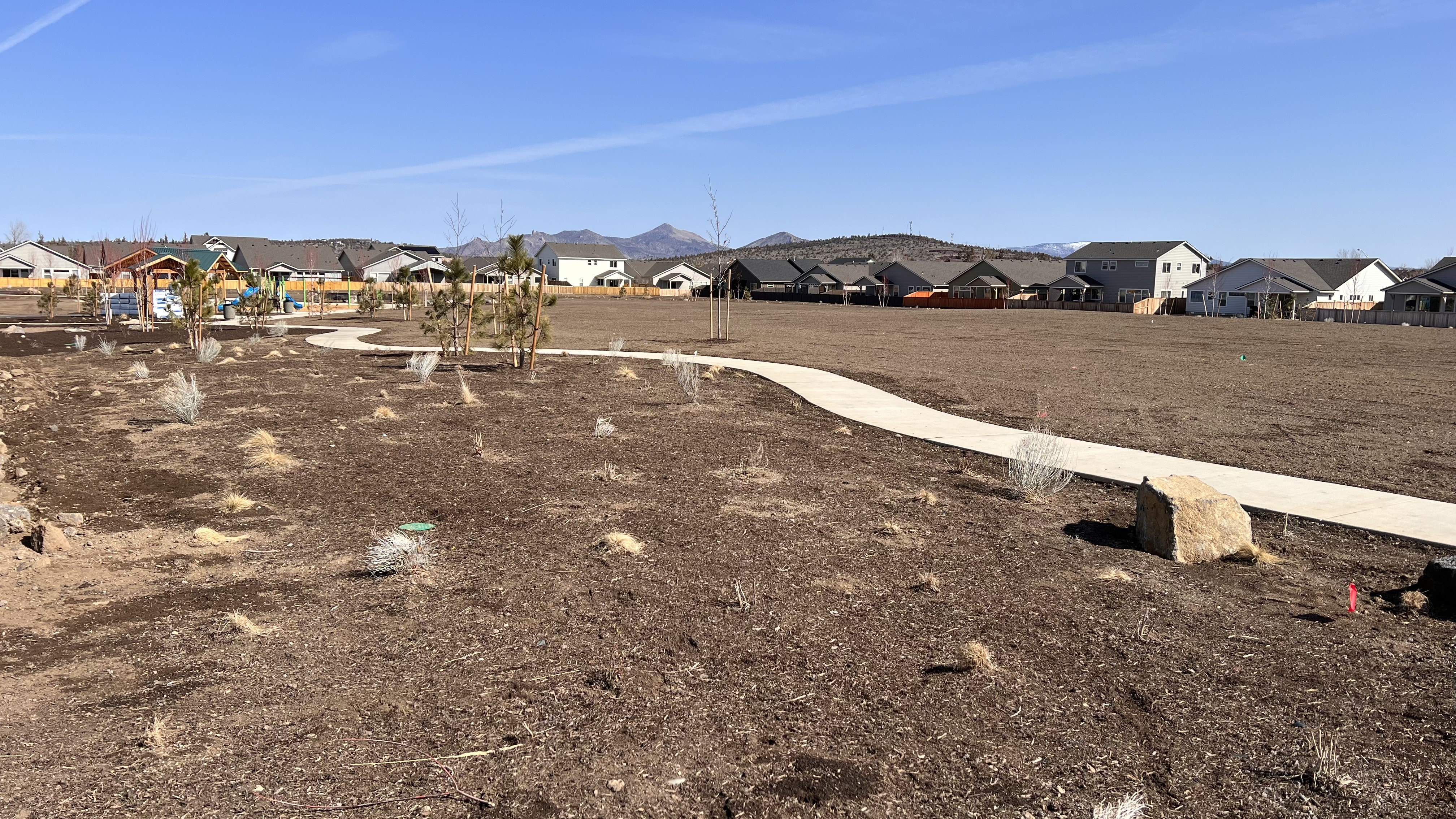
Redmond’s Spruce Park looking NNE from the SW corner toward Gray Butte and Smith Rock in the background. The border beds which follow much of the loop path are ‘native’ plantings according to the conceptual plan. It is common to claim that most of the plants are natives in designed natural areas, but native is not synonymous with ‘natural’. Although natives are used here concessions have been made including such plants as Echinacea purpurea ‘Pow Wow Wildberry’ and Rudbeckia ‘Goldsturm’. In a strict sense Ponderosa Pine aren’t native to this immediate locale either, they require more precipitation than we normally get and the Autumn Blaze Maples are a hybrid of two northeastern North American species.
A landscape, in nature, is a whole, functioning system, capable of perpetuating itself, through out the seasons and years, relying entirely on its own conditions and the cycling of energy and resources occurring on and within it. This is also the definition of a modern sustainable landscape. Ideally they require no inputs or energies supplied from offsite aside from the sun, precipitation and the normal cycling onsite of nutrients and water. A human made, contrived landscape, as all of those built by us today are, may be ‘judged’ by how well they function on ‘their own’, by how well they fit this ideal. Labor and outside inputs necessary to maintain a landscape are then indicators of how out of balance, how far from ‘ideal’ nature and genuine sustainability, a landscape is. A contrived landscape, which ignores the relationships integral to a healthy landscape community ‘demands’ more and more maintenance and support. Given its design and use, a landscape which ignores its site and relationship requirements will deteriorate from the intended design, losing to death component plants while gaining, increasingly, more unwanted available weed species. Design, conditions and use are essential to determine, in this sense, what a ‘good’ landscape is. Continue reading
Why Bad Things Happen to Good Plants?: On Root Problems, Root Washing, Nursery Practices and Customers
“To be, or not to be? That is the question—Whether ’tis nobler in the mind to suffer The slings and arrows of outrageous fortune, Or to take arms against a sea of troubles, And, by opposing, end them?” Hamlet.
Is the question we face as gardeners as simple as, To ‘root wash’ or not to ‘root wash’, before planting? To some today it has become ‘heretical’ to suggest that it might not be just a necessary corrective, but an unmitigated good…and not doing so dooms a plant to failure. The practice of ‘root washing’ in its present form, is relatively new to gardeners. Horticulture, which is a system of techniques, traditions and science, that goes back to our own species’ first intentional involvement growing and selecting plants, has not always included it. Practices develop over wide spans of time. Many are retained, others pass away. Root washing has been around as a method to assess damage to root systems, to ease and make more efficient division, to study root growth or cleanse them of particular infestations. ‘Bare-rooting’, during a plant’s winter dormancy in temperate regions, has historically been done in the field when harvesting or transplanting many deciduous trees and woody plants for shipping and ease of transport. In some circles today root washing has become an almost literal flash point, pitting proponent against opponent, ‘science’ against ‘tradition’…yet another fracture line to divide society. The road of the absolutist, as with many other human practices, tends to create conflict as evidence of correctness is lobbed back and forth. My own view is that, like so many other things today, the subject is somewhat ‘grayer’. Science can be on both ‘sides’, or neither, and reality is rarely so simplistic. Continue reading
Nature as a Model For Society and the Economy
For years now my real interest has been in plants and the life sciences. This has lead me to better understand the physics and chemistry of life, of the organism, as I attempt to understand the truly awesome and fantastical phenomenon that is life itself. I find it impossible to ignore the links between all of the sciences and it should not be too surprising that what one might learn in biology can have application for our own human species, including the social aspects of our lives, because whether we talk about art and beauty, economics or the institutions we share as humans, all are an outgrowth of our lives and the forces and cycles that govern us. Primary among these is the phenomenon of relationship whether between the various ‘nested’ and interlinked cells in our own bodies or the countless organisms we share this world with, with which we in fact evolved, in both competitive and cooperative ways. John Donne once pronounced in a poem that, ‘No man is an island’ and he meant that quite literally. Our fate and health are all bound to one another whether we like it our not, in relationships which can be mutually beneficial, or, if we choose to ignore and deny them, in mutually destructive ways.
Ecology is the study of a shared community of organisms, its description and how it all fits together, its relationships, ‘eco’ arising from the old greek word for household and logos, which speaks to order, purpose and form. Economy, begins with that same concept of ‘household’ only its suffix comes from the greek word meaning management or distribution and refers to the function of the household, its processes and how it produces, distributes or apportions its resources and products…it refers to the actions whereby the ‘household’ lives, the actions, that characterize its many relationships. In ancient Greece the economy revolved around the household. In their world economic actions were not simply those by which a society achieves material ends, the Greeks also constrained it to those activities which resulted in ‘praiseworthy’ outcomes, those which provided a larger benefit to the household. (Greek society, not perfect, was much like our own, placing women in a subservient role and was dependent upon slavery. Like American democracy, it was exclusive, but capable of being expanded to include all peoples.)
The two concepts remain closely linked though today our understanding of economy includes only those parts of the larger community’s operation, the money economy, that produces material benefit and wealth. Any harm accrued or costs imposed on others is not directly relevant if such costs have been ‘outside’ of the transaction, beyond the responsibility of the buyer and seller’s deal. Leaders have mutually decided to exclude all else. We define our economy in a limited way that serves the production of wealth and its accumulation, making profit the purpose and most relevant factor in economic decision making, placing outside it that which we choose to, that which we under value and take for granted. The two largest examples of this are our exclusion of domestic or women’s work, and the contribution of the environment. To include them would radically change our economic calculations and the very concept of profit.
Profit is what remains after costs are considered. To the degree that costs can be excluded then, profit is increased. This ‘habit’ of exclusion extends throughout society and extends to whole sectors of the human population and beyond, distorting our decision making and the broader social and political structures that govern our lives….Our understanding of economics today exists outside of ethics. Ethics and ethical behavior, if it is to factor into it, must be imposed. That is the responsibility of a society through its political processes. Such decisions lie within the realm of possibility though considerable power is aligned behind our current model and we behave as if they are fixed and unchangeable. (See this PDF to understand how far our economic ideas have strayed from the thinking and goals of the ancient Greeks.) The Greeks rightly recognized the economy as the engine of the ‘household’ and society, the system that, through nature’s largesse and human labor, creates that which sustains us. It is necessary that an economy be regulated through rational decision making. Such a system ‘freed’ of its responsibility to society to move it in a beneficial direction, is more likely to simultaneously squander its world and resources while failing to meet the needs of its people and the many species that comprise it. The Greeks understood that by not limiting the pursuit of luxury the capacity of nature to fulfill its demands would be compromised.
This last year has driven this point home for me as the pandemic and our divisive politics, both plagues on this world, work to drive us apart. These compound the ever increasing gap between the rich and poor, stranding ever more of the middle class on their own as well. We’ve conflated what we want with what we need and released individual greed to pursue its ends freely. I have been studying the topics of evolution, natural selection, random mutation and the role of energy in life, acting as a driving, creative, force behind evolution, increasing complexity and the self-organization of organisms, which in the world of physics are recognized as far out of equilibrium, dissipative structures, taking higher quality energy in, utilizing it in their growth and metabolism, before exhausting it outside of their ‘bodies’. Organisms have the ability to self-catalyze, reproduce and maintain themselves as long as energy flows through them uninterrupted. These phenomenon lend weight to our understanding that life is not a random occurrence, there is something inevitable about it, the underlying physics and chemistry of the universe pushing the process. Organisms are living, self-reinforcing, complex ‘nested’ systems, each composed of successful, dynamic patterns, that repeat in innumerable forms, between very narrow limits. Organisms exist in the ‘moment’ along the energetic cusp between life and death, that sweet spot within which our chemistry and metabolism remain, between sub-critical and supra-critical states, stasis and conflagration. There are countless lessons for us to learn from biology that we can apply to our own lives, because life is not an accident, nor is it a singular miraculous event…it is rooted within and powered by the forces of nature.
We exist within a complex network of organisms, a network of self-sustaining systems, made possible and animated by the flow of energy as it moves from low to high entropy, from order to randomness, sunlight ‘becoming’ living tissue, feeding successive trophic levels, endlessly cycling. All of life exists in this singular moment entirely dependent upon the health and vitality of the whole, the process of which each individual is a part, with a role to play, which effects every living thing and of what will follow. Through our broader economic behavior we have set ourselves outside of this essential process of nature. We cannot know ultimately where this will take life, but we do know, with some confidence, that if we interrupt or compromise it, we put everything at risk.
What Do We Do When the Whole World Feels Like its Falling to Pieces?
In this blog I focus on plants. Any gardener, botanist or horticulturist knows that plants, all living organisms, live in an incredibly complex, interwoven network of systems, each affecting the others, the health of anyone, in large part determined by the health of the ‘whole’. Life does not and cannot exist in a vacuum. We humans are also very much living organisms and subject to the same kind of limits as any species. What we build and produce, including those more abstract things like our social and economic systems upon which we are very much dependent, are subject to the same natural laws and limits, whether we recognize them or not. Very much a part of this is how we value other life collectively. Just because many may say other people and species are of less value, does not make this fact. The laws and ways of ‘man’ must remain within, and consistent with, the laws of nature. We are not at liberty to treat other life as expendable. We owe a debt and responsibility to all life. Life permits and supports us so it is incumbent upon us to do the same for it. Such is the natural law of reciprocity. Continue reading
Spreading the Wealth: Taking Advantage of Monte to Broaden a Teachable Moment
I’ve been taking advantage of people, striking when they are most sensitive, hungry for anything that is outside of their homes and families…I’ve been hanging informational signage amongst Monte’s floral neighbors as they come into bloom, not all of them. Some will remain anonymous like my Aristolochia semperivirens, an unassuming Dutchman’s Pipe, that is only noticed by the more discriminating of visitors. Others issue stronger ‘calls’ and so signage seems appropriate. Many people are taking the time to read them or take pictures of them for later consumption or to make sure they don’t forget. Many thank me for them. Who thought ‘school’ could be so cool! Anyway here is what I’ve hung out in the garden. Some will come down as their season ends, like the Pacific Coast Iris, others are waiting in the wings.
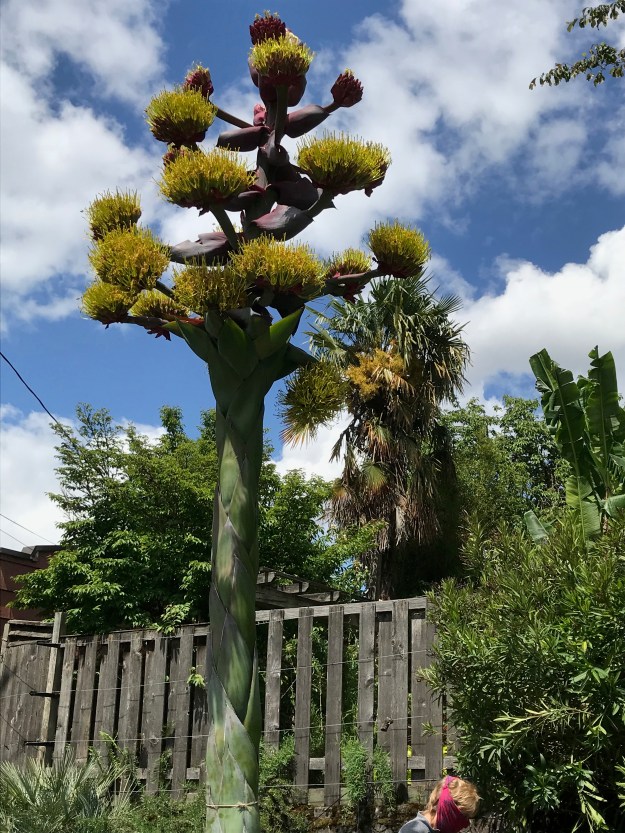
Agave montana
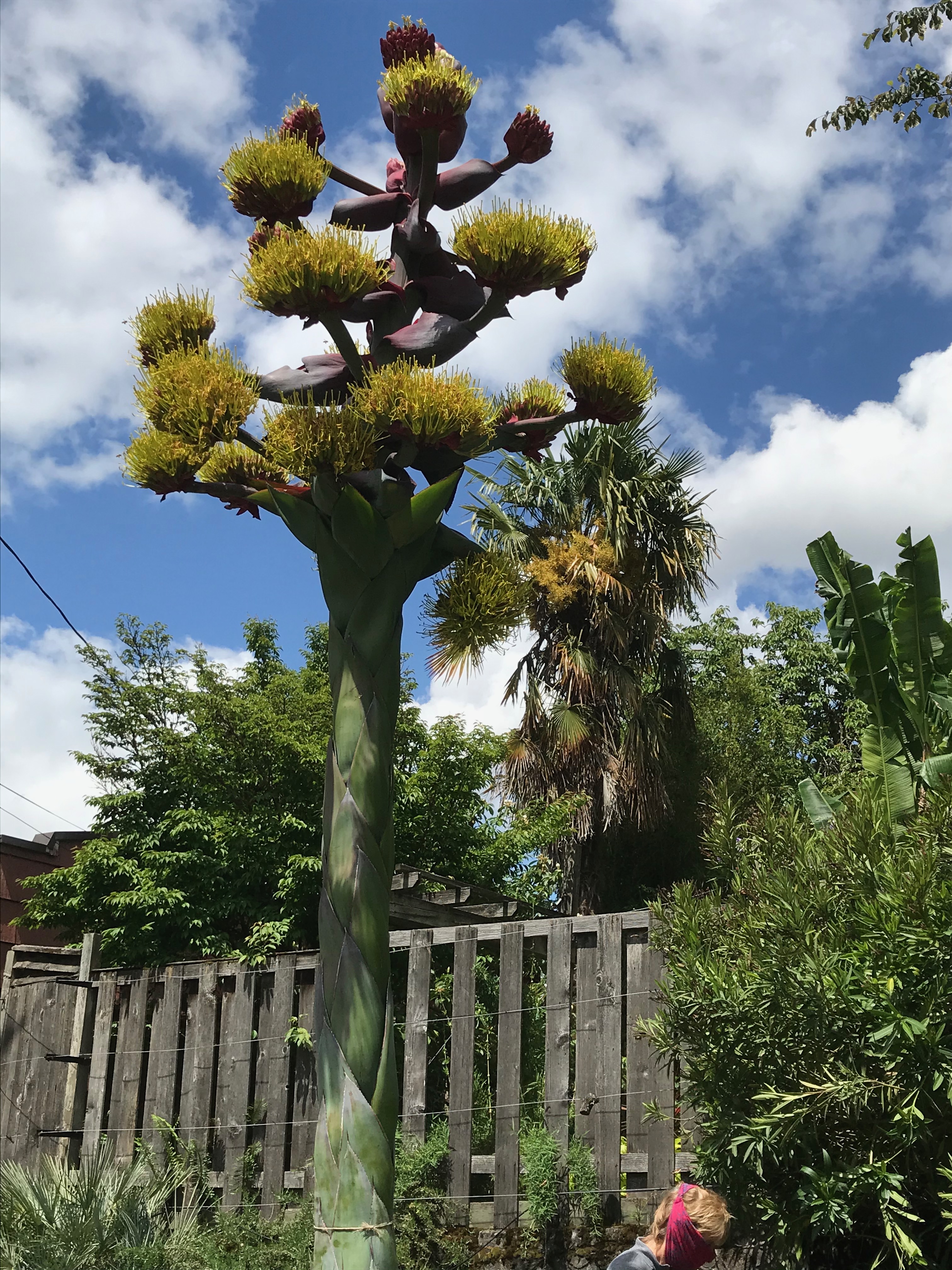
My Agave is flowering. The ‘spike’ you see growing upwards is the ‘peduncle’, the main flowering stem. As it meets its maximum height ‘branches’ will form near the top, from beneath the ‘bracts’, the tightly adpressed leaves, on which will form the yellow flowers. It will form a panicle, a ‘candelabra’ like structure. Agave are monocarpic, meaning they only flower once and then die, after it produces seed. It is 20 year old. Many Agave produce ‘offsets’ or ‘pups’ that can be grown on into mature plants…not this one!
This is a mountain species from Mexico’s Sierra Madre Orientale, where it is found between 6,000’ and 10,000’…not from the desert. This species is relatively new to the trade and was only formally described in 1996, 24 years ago. I’ve been told that this might be the first one to flower in the NW. Its native range experiences a temperate climate and receives its heaviest rains late summer-early fall during the hurricane season. It can experience freezing temperatures and even some snow there in open Oak-Pine forest. It begins its flowering process in Fall, then ‘stops’ for a period during winter, finishing the process in Spring/Summer. Most Agave are tropical/sub-tropical plants from deserts and are grown here in pots. There are 200 or so species, 3/4 of which are endemic to Mexico, found only there, none are native outside the Americas. Only 22 species are found in the US, from California into Nevada, Utah, Arizona, New Mexico and Texas. 3 are native to Florida.
Portland and the Maritime Pacific Northwest provide challenges to growing any Agave species and hybrid. Agave are native where climates tend to have most of their rainfall in summer. Here we have dry summers and wet cool/cold winters…this is the opposite of what most Agave need and will lead to rot and/or fungal foliar disease that can disfigure or kill most Agave species. Siting considerations are extremely important. They generally require full sun and excellent soil drainage. Here good air circulation helps foliage dry in winter. Sloping sites also help with soil drainage. Tilting the plant when planting is helpful as it helps the crowns stay dry. Some gardeners plant these under their eves or erect shelters over their plants to keep the crowns dry over winter. Agaves will require some summer water to grow well especially if they sit in dry soil all winter and spring….
Many Agave are becoming rare across their natural ranges in Mexico because of development and agriculture, a cause which threatens so much of our own natural flora in the US and around the world.
This species is not used to make Tequila! In its home range Agave are pollinated by hummingbirds, insects and nectarivorous bats, bats which are non-native here.
Beschorneria septentrionalis
(False Red Yucca)
There are seven species of Beschorneria, from forests of the higher mountains of Mexico down into Guatemala. This is the most northerly species occurring in NE Mexico, not far from the range of Agave montana. Unlike their cousins, the Agave, all but one of these are ‘polycarpic’, they can flower year after year. These form a substantial rhizome which spreads gradually when the plant is well sited, forming colonies. This one does so only slowly.
Another Asparagus family member, hardy through our zn8a, down to 10º for short periods, if you can keep the crown dry enough. This one struggles a bit and I have to remove a fair amount of rotting leaves every spring…I should move it and it would do better, but I haven’t…it wants better drainage. This particular site is a little wet close to our house which tends to concentrate rainfall a bit without any eave over hang to catch it.
As an open pine/oak forest dweller these are tolerant of relatively shady sites. Mine get some shade.
It’s inflorescence typically form these bright red stems with its sparse branching and hanging, narrow, bell shaped flowers. Part of their corolla is green.
At the top of my stone steps is a selection of another species, Beshorneria yuccoides ‘Flamingo Glow’, which has a buttery colored mid-rib on each leaf. from forests of the mountains of central/eastern Mexico.
Echium wildpretii
(Tower of Jewels)
There are 70 different species of Echium and several subspecies, in the same family as the commonly grown Borage. 27 species are endemic (occur no where else) to macronesia, the Canary, Madeira, and Cape Verde archipelagos lying in the eastern Atlantic close to Portugal, Morocco and west Africa. While the continental species are all herbaceous, dying to the ground over the winter, all but two of the island species are woody, with permanent stems. Echium wildpretii is one of these two.
Echium wildpretii can grow as high as 10’ in its home territory. It is generally a biennial, flowering in spring here, though sometimes, it can ‘wait’ and bloom the third spring. It is monocarpic, dying after producing seed. This plant is just under 9’ and is the tallest individual I’ve ever had in the 15 years of growing this. The plant grows in the ravines of Mount Teide, 12,198’, a volcano on Tenerife, 28ºN latitude, in the Canary Islands, so it has a very restricted range. It requires full sun and arid/dry conditions. With our much wetter winters it is best that you provide this with very good drainage as growing them in cold winter wet soil will decrease their cold hardiness and could lead to rot. Plant on south facing slopes and retaining walls with good air circulation. It is marginal, said to be hardy down to 23 °F.
The species E. pininana, the other Macronesian herbaceous grower, goes to 13’ having much the same form with blue flowers. E. candicans is a short lived woody shrub, which grows to 6’, both are grown here as well. In California these two and others are common some often escaping into the wild and crowding out native species. Here, these are marginal and survive only in protected areas killed by normal to colder winters.
Check my blog at Garden Riots. Annie’s Annuals sells several of these: https://www.anniesannuals.com/search/?q=echium
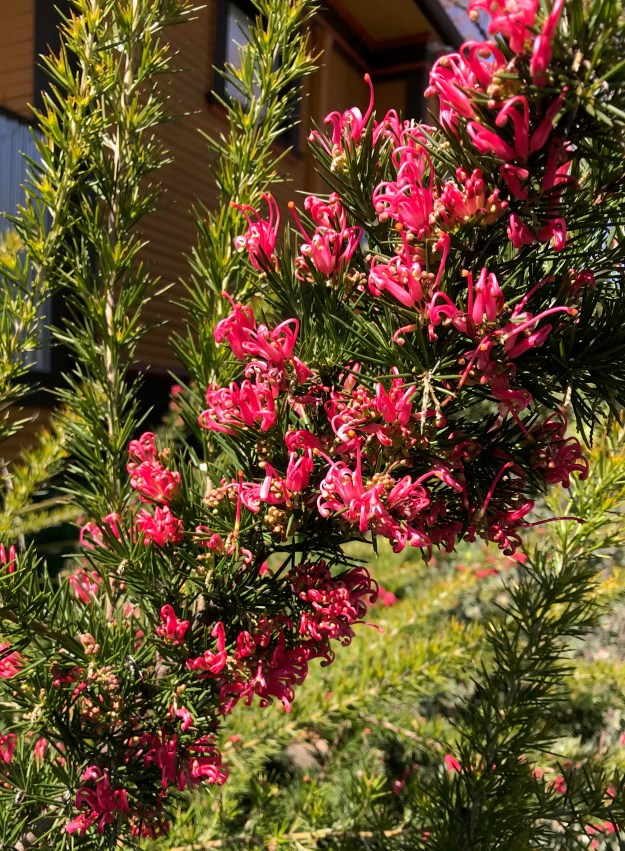
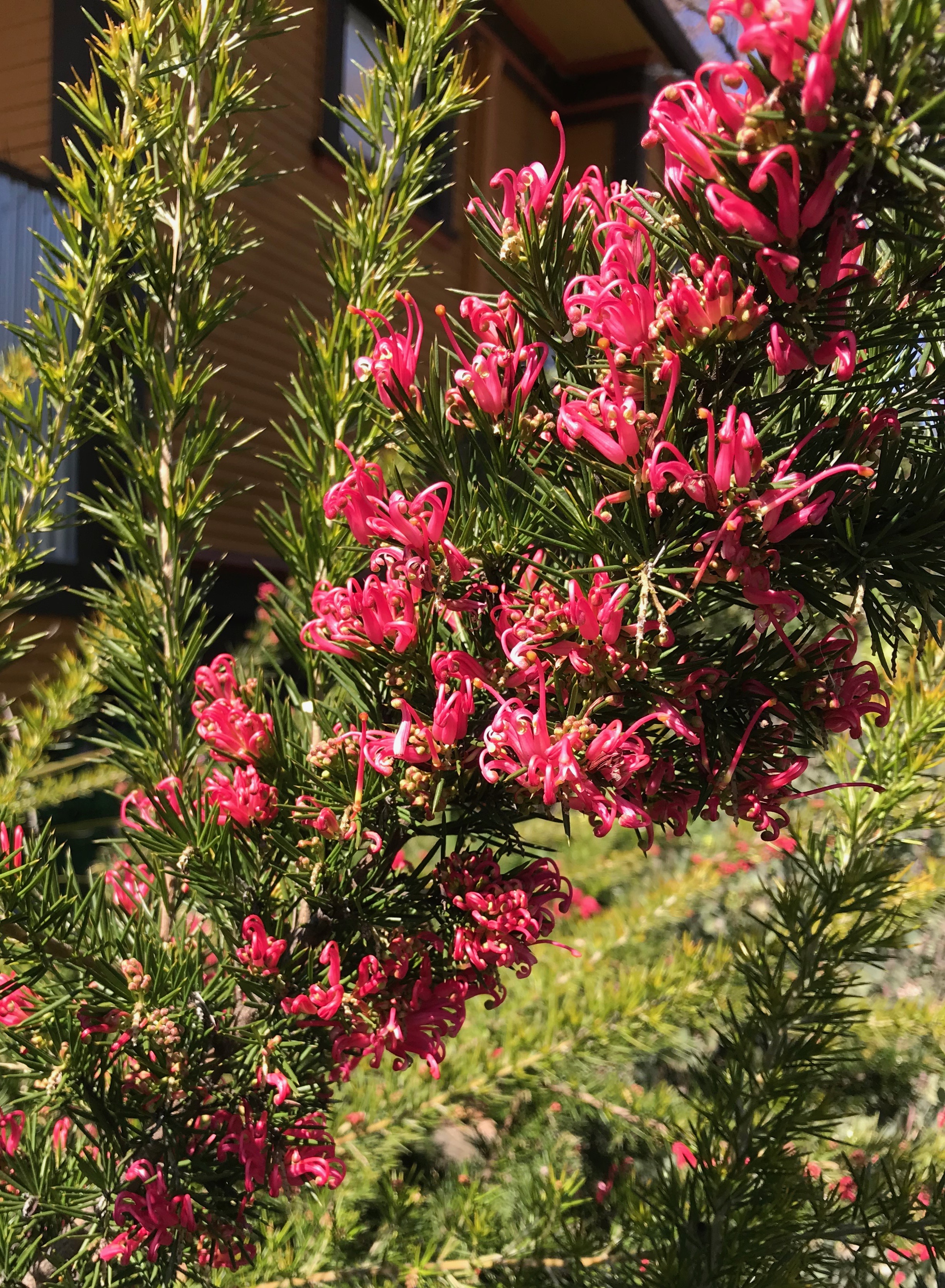
Grevillea x ‘Pink Pearl’
Grevillea is a genus of 360 species of flowering plants native to Australia and north and west to the Wallace Line. They vary from ground huggers to a tree over 100’ tall. They belong to the Protea family which includes many bizarre and large cut flowers used in the florist industry. They are pollinated by many Lepidoptera, butterflies and moths as well as by Honeyeaters, a group of nectar feeding birds native to their home range related to South African Sunbirds, but not at all to our Hummingbirds. Hummingbirds and bees visit these here.
Most Grevillea are not hardy here in the NW so choose judiciously. To find reliable plants check out the offerings of Xera Plants on SE 11th and or take the trip out Sauvie Island to Cistus Nursery, they have a section of Australian plants. There is a great review of NW hardy Grevillea at Desert Northewest’s site, https://www.desertnorthwest.com/articles/grevilleas_revisited.html
Grevillea readily hybridize. This is thought to be a hybrid of G. juniperina x G. rosmarinifolia. If you give it what it wants it is hardy down to 20ºF, maybe lower. I planted this one 6 years ago here. One winter, ’16/’17, I lost about 1/3 of the top. That was Portland’s fifth coldest winter ever in terms of number of days with freezing temperatures…so not typical. (https://weather.com/storms/winter/news/portland-oregon-worst-winter-city-2016-2017) I suspect another degree colder or with another day of sustained freezing, I would have lost the entire plant.
These are relatively fast growing and can take a hard pruning. In Australia these are often used as hedge plants causing them to grow densely with their pokey needles, quite a barrier! I prune mine regularly to limit its size while retaining its softer look with drooping branch tips.
These are sun lovers and require well drained soil here. They are drought tolerant in the Pacific NW requiring no water after establishment. It is essential that should you choose to fertilize that it include NO PHOSPHOROUS!!! Phosphorous is plentiful in our soil already and adding anymore can prove deadly to Grevillea and also to most all members of the larger plant family. These come from regions with phosphorous poor soils and are very well adapted to searching it out, so…don’t add any!
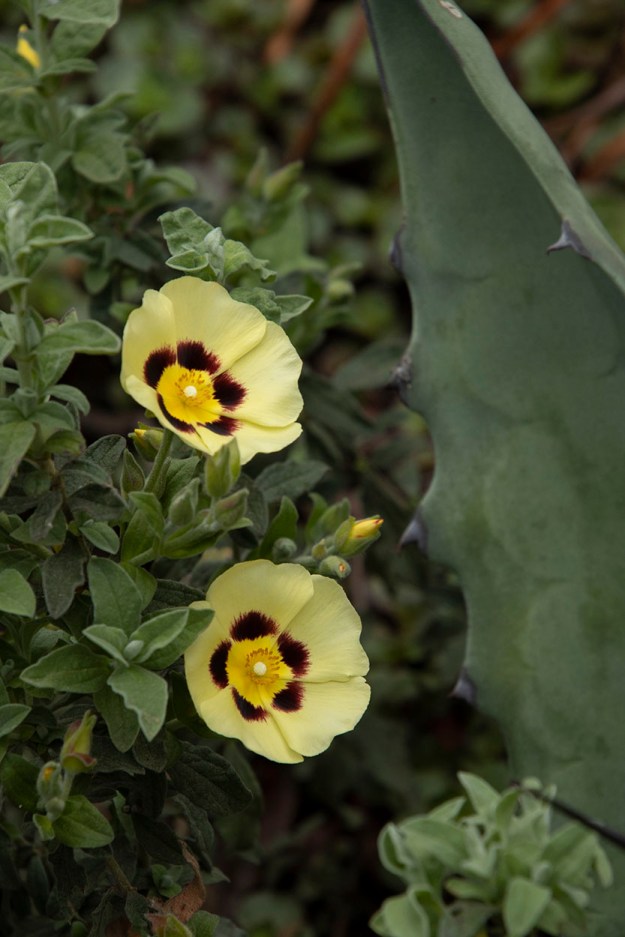
x Halimiocistus wintonensis ‘Merrist Wood Cream’
This Rock Rose is a hybrid between two different genera Halimium and Cistus, a relatively rare even as species from different genera aren’t generally capable of crossing successfully. The parents are both Mediterranean plants and this plant benefits from growing under like conditions, warm to hot, dry summers and cool/mild and relatively wet winters.
This plant has grown here for 10+ years on this south facing slope in unamended soil. It benefits from a light cutting back after flowering to help keep it compact and to keep it from falling/splaying open. All of the Rock Roses have a tendency to splay open with time here as our rich soil tends to push them to produce extensive soft growth. Don’t cut these hard, below healthy growth, if you do you are likely to end up with dead stubs unable to resprout. I’m planning to take cuttings of this, root them and replace this plant as it has gotten rather ‘leggy’ over time.
There are many fine Rock Roses available from these two genera that can be grown here.
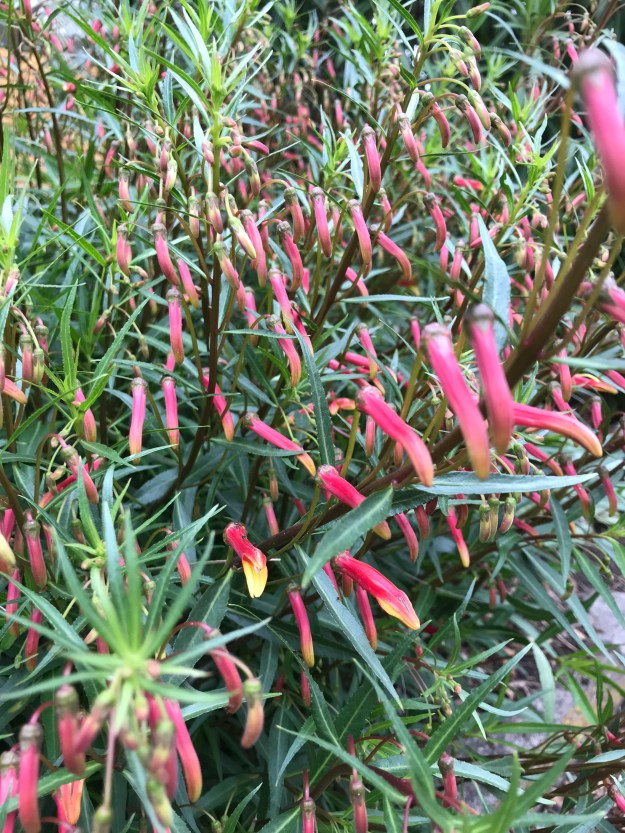
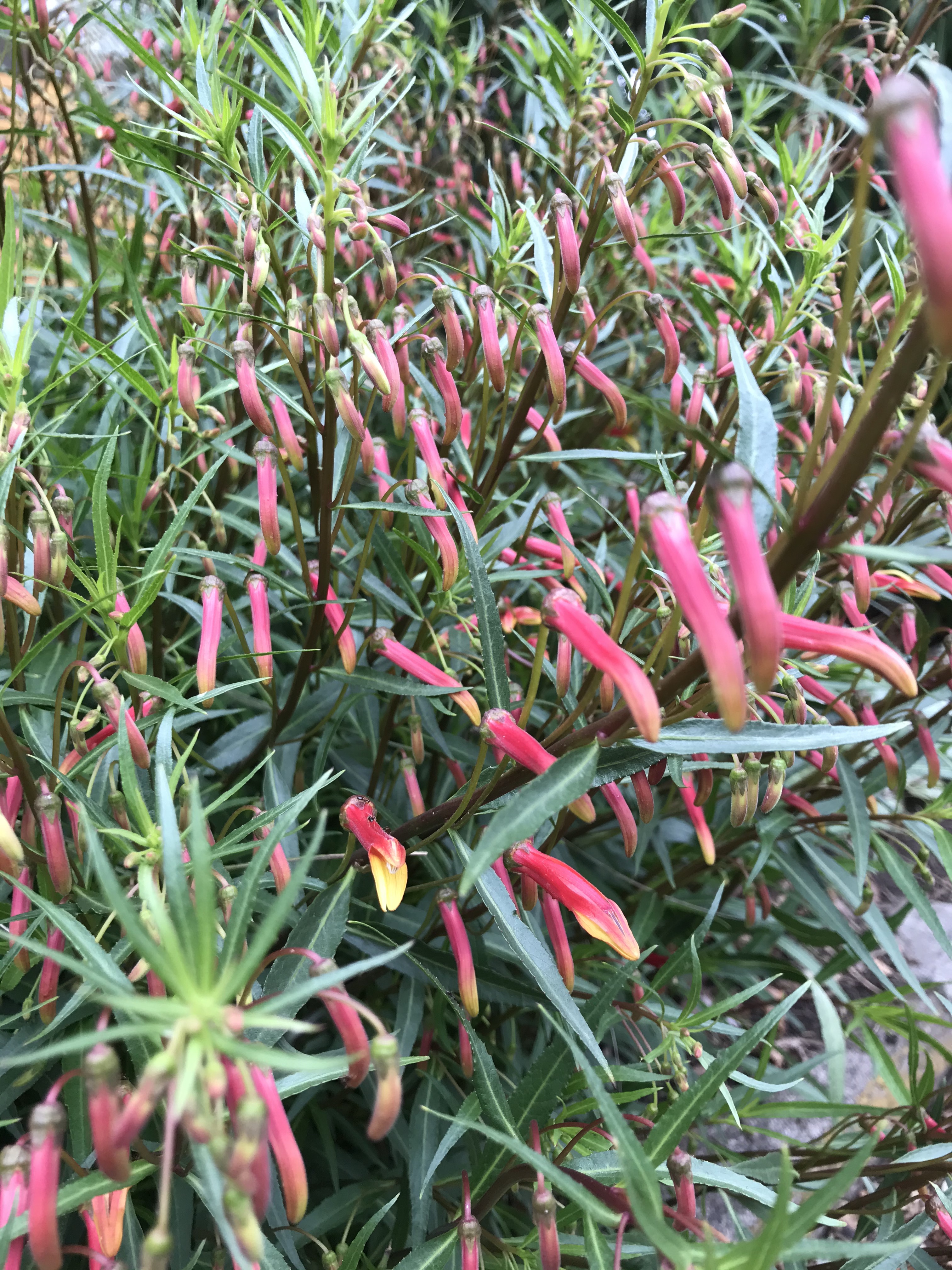
Lobelia laxiflora ssp. angustifolia Heavy with bloom this Lobelia began flowering almost a month ago.
Lobelia laxiflora ssp. angustifolia
This Lobelia, with its narrow hot red tubular flowers, from Mexico, is reliably evergreen here except over our coldest winters, which can kill it to the ground, but from which it springs back. It often blooms for 7 months or more in the year. As you might guess it is attractive to hummingbirds. This plant is rhizomatous and in too good of conditions with summer water, has a tendency to spread, though it does so compactly. It is better ‘behaved’ under drier, more spare, conditions.
Lobelia are a large and varied genus with 415 species occurring primarily in tropical to warm temperate regions. I also grow the less commonly grown species type, sometimes called ‘Candy Corn Flower’ with broader leaves which is less robust for me here, but showy in its own way.
I grow Lobelia tupa on the east side of our house. It’s a large growing Lobelia from the Andes of Chile with hooking dark red large flowers. I have others on my list including the large pink flowering species, L. bridgesii, to acquire and am somewhat enamored with the ‘Tree Lobelias’ limited to the Hawaiian Islands.
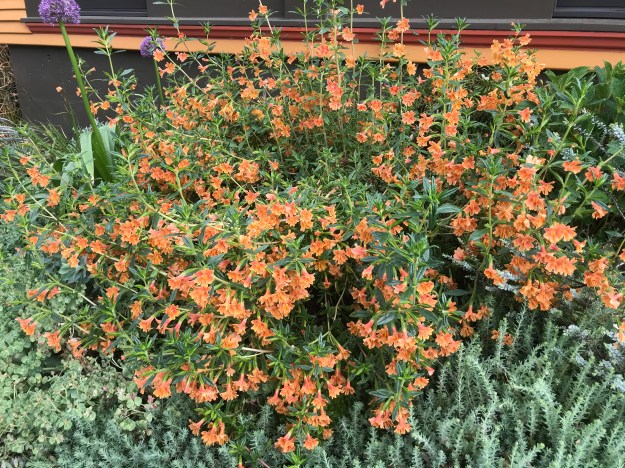
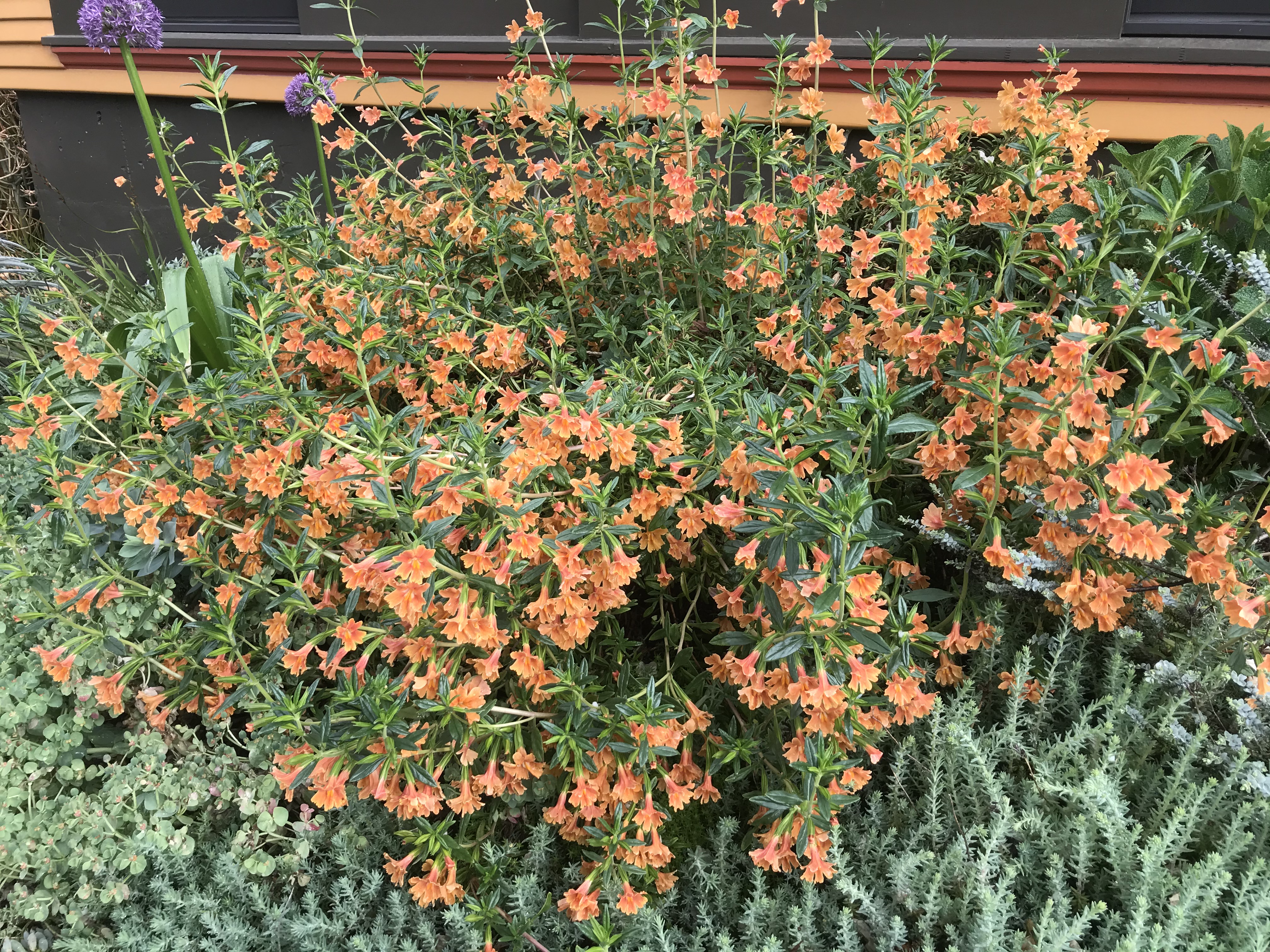
Mimulus aurantiacus ‘Jeff’s Tangerine’
Sometimes known as “Sticky” or “Bush Monkey Flower” this plant is native from SW Oregon down through most of California into Baja. A ‘sub-shrub’ this has a somewhat woody base from which sprouts softer herbaceous stems that carry the leaves and flowers. Found from coastal bluffs east into the Siskiyou and Sierra Nevada mountains, these are ideally suited to our mediterranean climate with its summer dry/winter wet precipitation pattern.
Typically, where I’ve seen it growing in situ it is taller than my plant with a much more substantial woody base. At Point Lobos, on the central California coast, these can be over 4’ tall and form impenetrable thickets. Here with our rich soil it grows more lushly and flops. My plant is ten years old and will bloom all May through September in waves, almost never completely out of flower.
Place it in full sun. Mine receives only sporadic summer water. It grows in unamended soil on a south slope so it has good surface drainage. It benefits from free air movement and good soil drainage. There are several color forms available from specialty nurseries.
Pacific Coast Iris
(aka. pacifica)
There are 12 Iris species in the group native to our region stretching from southern California northward into Washington state, in a narrow band between the ocean and the Cascades and into California’s western Sierra Nevada. Most of these are limited to California and southern Oregon to areas that receive enough rain and are often limited to places closer to the coast. The Willamette Valley and Washington is mostly limited to one species, the deciduous, woodland edger, Iris tenax.
Hybridizers have taken advantage of their tendency to cross and are found in a wide range of jewel like colors, white, to yellow, red, russet, blue and purple. The hybrids are evergreen. These must generally be searched out as their production is relatively low because these Irises are difficult or impossible to grow anywhere else in the country because of soil and climate differences too far out of their ability to adapt.
The hybrids are drought tolerant in our western gardens. Plant them with plenty of sun, then water to establish. Don’t plant them anywhere where the soil remains soggy into the summer, they need to dry out. It is important to leave them undisturbed after planting. If you choose to move or divide them, wait until the fail rains, when they are producing new roots. They will likely die if messed with during the summer. See my blog: gardenriots.com.
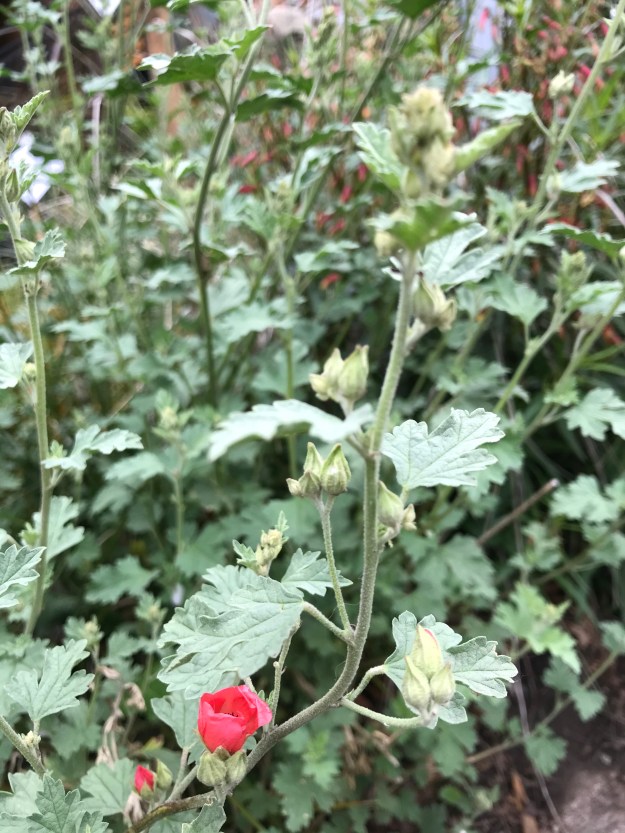
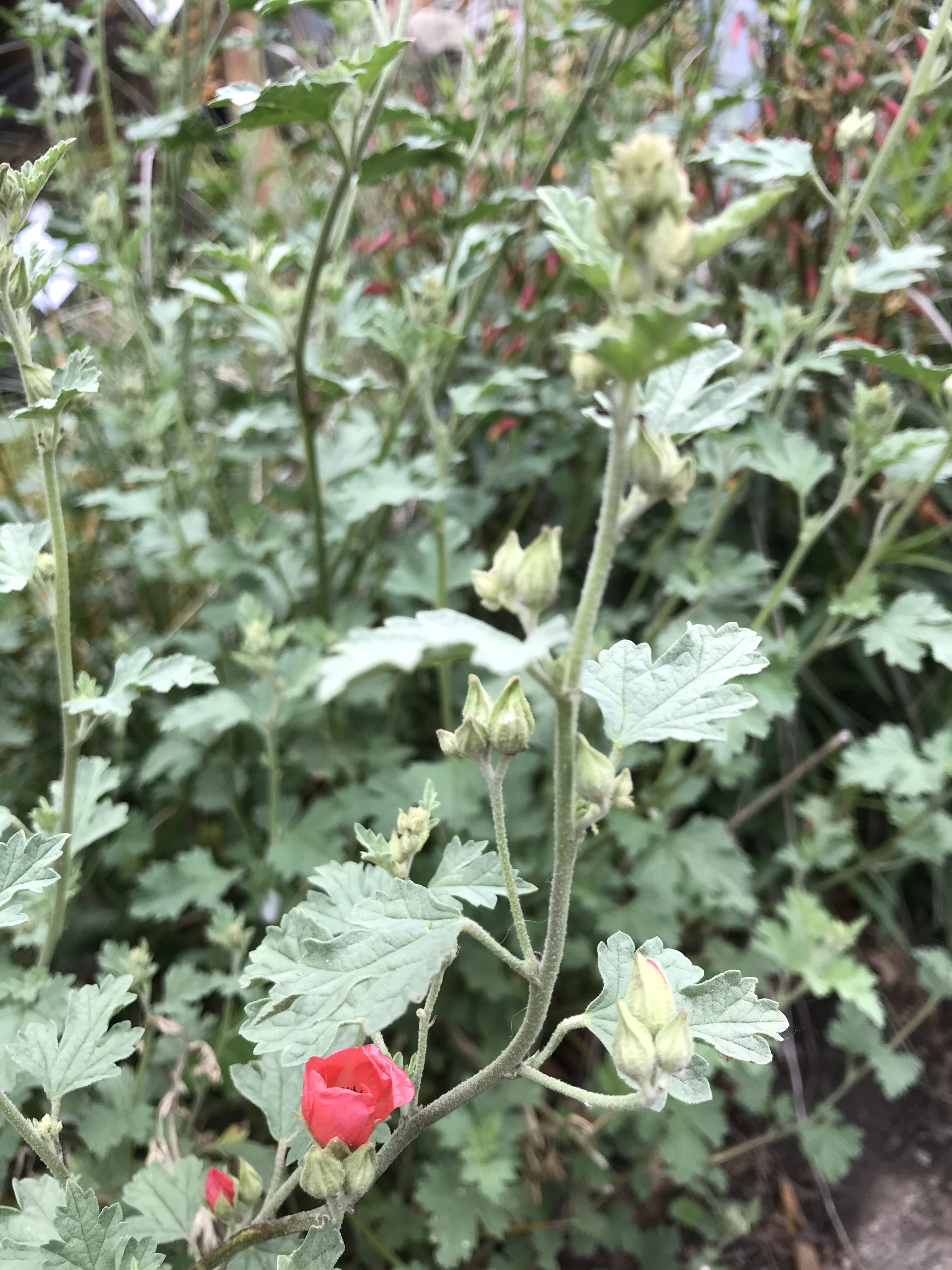
Sphaeralcea x ‘Newleaze Coral’
(Glog
The genus Sphaeralcea is native/endemic to the intermountain west of North America, occurring between the Rocky Mountains and the Cascades and east of the Coastal mountains of California. Some can be found in eastern Washington, Oregon and Idaho on south into northern Mexico. They like sun, heat and thrive in poorer mineral soils and are drought tolerant here once established.
‘Newleaze Coral’ earned its garden pedigree in the UK and is a stellar performer here in xeric beds. Sphaeralcea is a member of the large Mallow family which contains 244 genera with 4,225 known species. Well-known members of economic importance include okra, cotton, cacao and durian. There are also some genera containing familiar ornamentals, such as Alcea, Hibiscus, Malva and Lavatera, as well as the genus of trees, Tilia. Commonly called Globe Mallows, this Sphaeralcea will easily bloom for 5 months bookending the summer months.
Toward a Redefinition of Work

Several different Panicum, Miscanthus and Pennisetum cultivars were planted in large sweeps across more than an acre of bank above the Willamette River here. For several years, late each winter, we gathered in mass for the ‘Harvest’ cutting them down and removing the debris as we were unable to get permits to burn them. Maintenance on this site was always labor intensive given the manner in which it was planted, large sweeps of clumping grasses with nothing in between as per the design. Over time irrigation was discontinued and a more xeric, complex of other plants were added, changing how the work is done. Anyone working in the plant world knows how undervalued the work is and the compensation those doing it receive. No one doing the work is getting rich. Those who do it are either sustained in part by their passion for plants, their desire to work outside and/or at least some degree of desperation…and Portland is becoming an even more expensive place to live as are all West Coast cities.
In this time of political chaos and environmental threats it is difficult to keep my mind only on plants….Nothing in the living world is easily separable from the whole, its context. The following is reflective of my interest in people. My first degree was in sociology.
Work is what we do with our lives. It is what we ‘spend’ our lives doing, whether we are paid or compensated well or not, whether it is a joy or drudgery. Through our ‘work’ we give our lives purpose and meaning, or we don’t. When we speak of it, it is as an expression of our lives…one’s ‘life’ work.
Work is a reflection of our place in our community and society, our role. It is through ‘work’ that the needs of the community are met. What compensation we receive is in proportion to how our community and society values us as individuals as well as the work that we do. When work is not this, when our work itself is demeaned, so are we who do it. When this happens to us we search for other ways to find value in our own lives…or for distraction. When we receive only monetary remuneration for our work, when even we ourselves, fail to recognize the value of the work that we do, when it isn’t ‘fulfilling’, we have a huge hole to fill in our lives.
It is difficult, but doable, to retain one’s dignity in one’s work when those around us recognize neither the value of our work nor our lives. Sadly, we have fallen into the trap set by the larger economy and owners for us, measuring value by the dollars that they are willing to pay. We are raising a generation who sees little value in the necessity of manual work, of hand labor…even the construction trades, historically valued and well compensated, is attracting fewer of our young people. We are learning not to seek satisfaction in paid work, that pay should be enough and that fulfillment, satisfaction, should be found in our shrinking free time, in recreational pursuits, which are defined very narrowly and separately from work.
Work today is, by and large, not creative. It has been reduced to a narrow Protestant, even Calvinistic definition, as a kind of servitude, even a punishment, something we must do to attain our reward and salvation. We have demeaned not only work, but our own value as human beings in the process. Because we spend so much of our lives doing it, work should be creative, fulfilling and satisfying, in multiple ways. We should pursue it because it is satisfying allowing us to contribute to our communities and the support of our families. We are not interchangeable cogs.
There is nothing ‘fair’ about the vast range of pay, the chasm, between those who ‘labor’ and create the product or service and those who own it and decide who gets what. We are all taught that life is not fair, though we have a base understanding that it should be. We have learned that those in positions of power will take what they can and that we will be left with what remains…and, many of us, were our positions switched, would do the same…and very few of us see how simple and just the solution is. We have been taught that money and wealth is adequate compensation for unfulfilling work and we play and recreate very hard to make up for what we’ve given up. We do not live our lives as we do because we must, we do it out of choice, informed or not. Right or wrong.
How we value work reflects how we value our own lives and those of others, how we structure jobs, our relationship with work, our relationships with one another. We need to redefine our idea of work, set it in proper relationship with our lives, make it mean more than a paycheck. All work, if worth doing, should afford those who do it adequate and just compensation so that they can live healthy and secure lives. Work should be important in and of itself. Work should add value to our own lives while it does the same for the world around us…instead of a disconnected opportunity to take for ourselves. It should emphasize and build the relationships between us instead of set us against one another as it does in today’s world in which we literally consume the Earth while diminishing the lives of others at the same time. Ultimately, the result of our work must make the world a better place, because to set the standard lower is to compromise our lives and the Earth. Our work, in this sense, is our ‘contribution’ to the planet and as is true in all things, our impacts are both individual and accumulative. We build or destroy through our combined efforts. This is something we must understand if the human ‘experiment’ is to continue.
On Ecology, Politics and Climate Change: the Links that Tear us Asunder
Warning!!! This is a rant! It’s political, economic, ecological and, most definitely, covers all of the connections between with climate change, these things and our future as a species. I hope you choose to read it, but be forewarned!!
I woke up yesterday at 4:30am, unable to go back to sleep, so I got up and began writing this. The state of the world, the absolute idiocy, meanness and short sightedness of politics today, the undeniable enormity of climate change and its inevitable impacts for every organism on the planet, drives me from paralyzing frustration, to near rage, to profound sadness and despair. Most days all I can do is seek escape and I do this through gardening, reading eclectically, trying to follow some kind of routine, going for walks, a swim or a hike, sharing time with friends or delving into research on plants and the everyday miracles within them and their wondrously choreographed lives here on this planet….I spent my entire morning writing and rewriting this (and returned to it the following day, now today). It is me ‘sharing’. Yes, it’s a rant, it’s a bit of analysis, it’s a window into the world as I see it and it contains a hope I have…that I have to cling to most days, for this world and all that lives upon it, because what we have done, what we continue to do, is so profoundly destructive and disheartening to me. Continue reading