
-
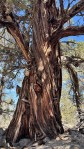
- This old Western Juniper (Juniperus occidentalis) resides in north Dry Canyon and is around 8 1/2′ in circumference making it several hundred years old. Recently ‘brushed’ up in an attempt to reduce the likelihood of its catching fire, a cause that would be greatly improved by the removal of nearby overly dense younger trees, once trails are better established and off trail activity is curbed.
-
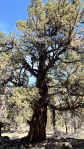
- This pic better shows its overall form, squat, which is indicative of harsh conditions and very slow overall growth, which makes sense as its growing on top of a narrow, raised, portion of one of the Canyon’s later lava flows that partially filled it some 75.000 years ago.
Paleontoiogists say that we first evolved as a species on the African savanna, that mixed landscape of grassland and scattered trees. Some argue that we were first a tree associated species. Be that as it may, most people have an affinity for trees today. We have our favorites. We plant them for food, as a source of material to meet various needs, for shade, for that inexplicable feeling we have when amongst them, in support of the life that came before, those dynamic communities, their complexity and the vitality, that define these places we now occupy, for their beauty. In Central Oregon with our arid to semi-arid climates, those with annual precipitation as high as 15”-20”, xeric referring to our dry summer growing season, our native trees serve as an indicator of the possible. Our local landscapes have curvilinear boundaries, that delineate areas with like moisture regimes. These go a long way in determining the native landscape (But not all of the way!).
14” of precipitation locally is roughly the bottom limit for Ponderosa Pine. You can see this as you observe grouping and the massing of tree species, forming a line from south of Bend, west and north to Sisters, then along Green Ridge and north to the Columbia. There is an in-between landscape, an ecotone, where the Ponderosa intermingle with the Western Juniper, which dominate easterly, until the average drops below what even that reduced amount can support. The ecotone roughly bisects Bend. Continue reading

