
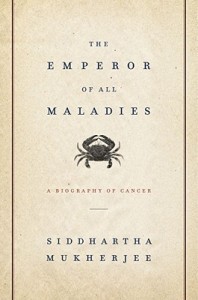
 Siddartha Mukherjee’s first book, “The Emperor of All Maladies: A Biography of Cancer”, is the third of his I’ve read. My interest earlier, and still, remains in understanding the biology of the organism, so I read his books on genetics and the cell first, trying to improve my understanding of the complex actions and structures of life before attempting to understand a disease that ravages and destroys so many lives. His effort to write this book led to Mukherjee receiving the Pulitzer Prize. It is a gargantuan endeavor, artfully constructed. It contains several stories in an overlapping, although, natural style beginning with man’s earliest recorded conception of the disease(s). It becomes clearer and clearer as you read through it that cancer is more a ‘family’ of diseases, linked by their pattens and effects as they progress within the cell and from there, into the collective structures of our body, than it is a singular disease. But that gets way ahead.
Cancer is not a ‘new’. The ancient Greeks wrote of it and there are scattered records of it much earlier from other civilizations. Galen, wrote of it almost 2,000 years ago, attributing it to an imbalance in ‘black bile’, one of the four humors, which when out of balance, he claimed, lead to various diseases (This was the justification for the practice of ‘bleeding’ a patient that continued on into 18th and early 19th centuries, not that long ago). Such ‘humors’ were thought for centuries to be at the root of many diseases and infections across Europe until scientists, through the use of microscopes, began to understand that the cell was the basic building block of all life, and that there was a microbial world beneath and within the world readily observable to us. Galen’s views continued to hold sway until anatomists, through their careful dissections, realized that ‘black bile’ was a fabrication, an attempted explanation for something unseen at work within the body. Cancer then, along with our understanding of the body and disease, began its slow, lurching, advancement through the practice of science. What actually is cancer? Continue reading





 GardenRiots