Category Archives: Landscapes

Weeding in a Dynamic Landscape: A Goal Oriented Strategy

The Over Thinking Series, part two

Weeding seems simple enough, but that’s the problem with simple things…they often aren’t.

Ugh! Gronk see weed??? !!!Gronk pull weed!!!

It isn’t rocket science, but we’re not stamping out widgets on a production line either…the first one the same as the 13,649th one. Landscapes are living systems containing many complex relationships and feedback loops. Just because most people don’t pay attention doesn’t mean that it’s simple. Continue reading →

Tool’s of the Trade: Shovels, Implements of Construction…and Maintenance

(I wrote this piece a few years ago. It was last printed in the Fall 2012 HPSO Bulletin.  It is updated here for my Blog.)

Cut from a piece of sheet metal the failure point is at the bottom of the 'arrow'

Cut from a piece of sheet metal the failure point is at the bottom of the ‘arrow’. Yes, I know this is a square point, but the are built using the same process.

I broke my shovel at home last week digging out a smaller-growing bamboo, Semiarundinaria yashadake ‘Kimmei’. It was at least ten years old, the shovel that is, and I broke it the way most people do, prying with it. I’m not nearly as hard on shovels as I used to be; I know their limits, but I was tired of this shovel. It was one of those thin-gauge “stamped” shovels that hardware stores sell these days to consumers, inexpensive and cheaply made; the kind of tool a person could buy many times over the course of their gardening life. I have broken several in the past jumping on them, with two booted feet, while trying to cut through heavy soil and roots, or like I did here, levering to hard before the object of my attention was adequately cut free of its earthly ties. Stamped shovels flex due to their thinness. Any flexion causes an inefficient transfer of energy when attempting to drive the blade against resistance. Think wasted energy and more effort. Stamped shovels have a soft fold where the smooth curve of its bowl bends into the vee that becomes the sleeve that then wraps around the shovel handle. This shaping of the blade adds some rigidity that the same material flat doesn’t possess. Any such bend in a piece of metal, however, becomes the weak point. This is where the metal breaks. Finding a quality replacement requires special ordering or buying through someone who serves the nursery or landscape trades.

Continue reading →

Gardening as a Political Act: Growing a Better Public Landscape – The Ross Island Bridge West Approach

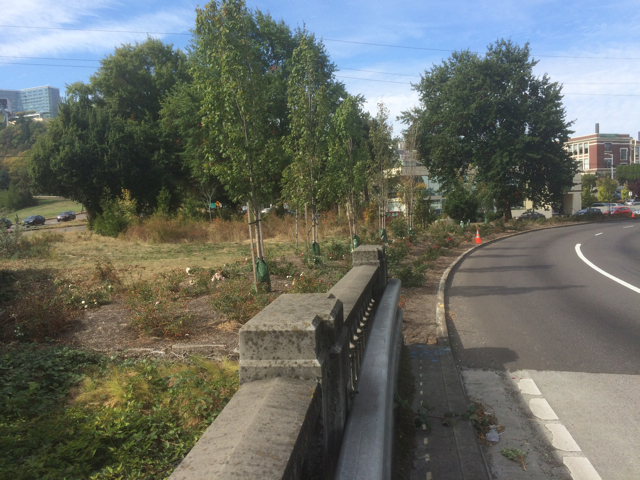
Peeling off towards downtown from the bridge westbound

Peeling off towards downtown from the bridge westbound.  The little landscape Roses and new trees…one mown down by a car further down.

I’ve said it before that everything we choose to do is a political act. Politics is not something practiced by ‘politicians’ exclusively. We are social animals. What we choose to do effects those around us…gardening is political. We have chosen to invest our time and energies into growing plants and maintaining our gardens. We do this as individuals. They feed our spirits and those of our friends and families. Beyond this are our neighbors and, to some degree, commuters passing by. I’ve had people I don’t know stop by and tell me, “I’ve been walking/riding/driving by your house for years and I just wanted to tell you how much I’ve enjoyed it.” There’s the bus driver who used to stop in his turn at our corner, open the doors and tell me how much he loved my Wisteria (now gone…Sad for him, good for me), the guy from BES who stopped one day to quiz me about a Grevillea and many others. People, gardeners or not, may be buoyed by your gardens. We change the world for the better. Politics need not be limited to the big divisive social, economic and environmental issues of the day. In fact, if we want to make a positive difference we better start on the little things that we can.

Continue reading →

Choosing a Tree: Issues of Structure and Growth

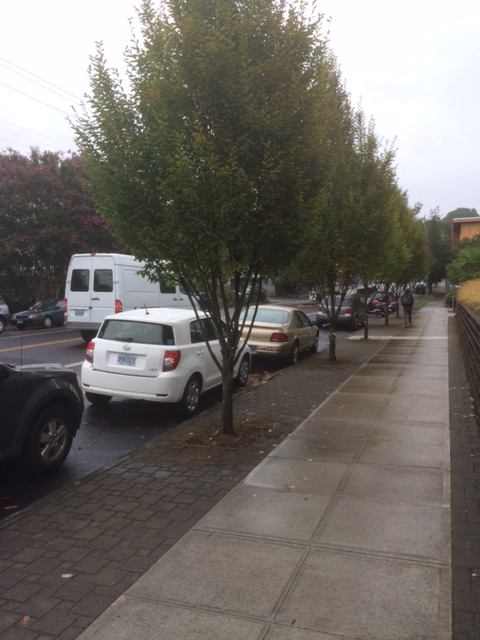
Right Plant Right Place covers a lot. Usually when you hear it used the speaker is referring to matching the plant with the growing conditions: soil, sun, climatic conditions, size, etc. Here, I’m going to address the physical structure and growth of a tree as it relates to place, Carpinus betulus ‘Fastigiata’, in this case, as it is often used as a ‘street tree’. The Upright European Hornbeam has proven its value as a street tree. It is very adaptable to conditions in our region that exist at the curb. That being said there are questions of structure and growth that need to be asked if such a planting is going to be aesthetically successful over the longer term.

Hornbeams across the street from my house after pruning

Hornbeams across the street from my house after pruning

Continue reading →

Desirable Plants, Thugs and Weeds: The Fine Line Between Good and Bad

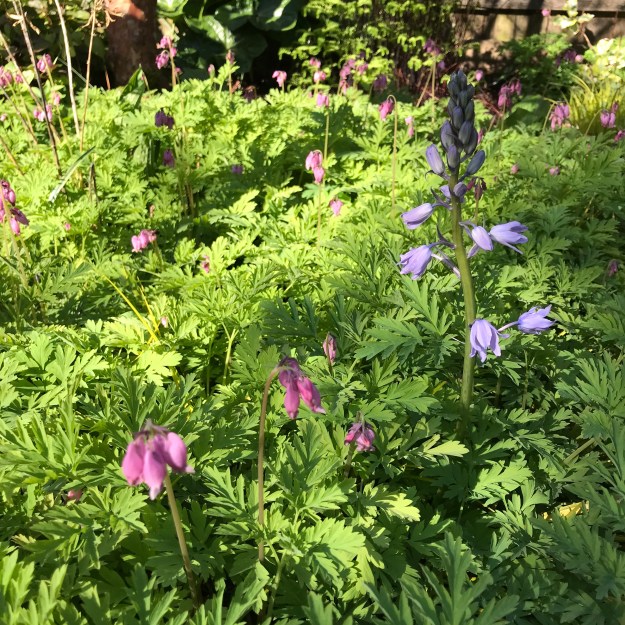
Our native Bleeding Heart, Dicentra formosa with Siberian Squill, Scilla siberica…both of these are ‘weedy’ in my garden, the Dicentra spreading quickly from its brittle rhizome while the Squill, an extremely ‘successful’ old fashioned garden plant, persists and increases even in long neglected gardens and homesteads. While neither of these are technically ‘weeds’ they both possess degrees of vigor and adaptability that have allowed them to persist, often in spite of our efforts to limit or eliminate them.

The first in the critically acclaimed ‘Over-Thinking Series’

What is a weed? What differentiates it from any other plant? What about plants like Golden Creeping Jenny? I know those who call it a weed. Is it a matter of generally accepted horticultural opinion? One is on the list and the other isn’t? Is it more than simply a plant we did not plant? We all have those fortuitous seedling volunteers that appear bringing with them a little garden magic. Some of these prove themselves to be quite remarkable and, if found by the right person, if they retain their desirable characteristics when propagated and are stable over time, may become the next rage among the garden fashionistas. They aren’t weeds are they? While not planned for we may choose to welcome certain such plants. To just define weeds as plants out of place, is to render the word almost useless as an aid to understanding our problem.

There is no conspiracy going on in the garden. No malignant intelligence plots and schemes to upset our plans. Not every seed germinates. Not every bit of rhizome or tuber will take over the garden/world without our intervention. Weeds are plants and within the limits of their own genetics they either grow or die. If a seed of Calypso bulbosa finds itself on the ground in the desert. It will not germinate. Eventually it will lose its viability. No one will notice its absence because it never belonged there. All plants possess a degree of vigor. All plants have within themselves a range of conditions they can grow and prosper in. Weeds, are plants that possess the vigor and adaptability to be successful under the range of conditions that we as humans typically occupy. Because we occupy these places, disturb them, because we move about and conduct trade with those elsewhere, we have ‘weeds’. These are merely the plants that do well in the places that we habitually have created. What we should be talking about instead is the quality of ‘weediness’, that blend of adaptability and vigor, that these plants possess.

(Readers should be aware that there are no pretty pictures to either break up the following text or to graphically ‘hammer the lesson home’. Continue reading →

Arctostaphylos patula: Greenleaf Manzanita – Seeing a Plant in Context

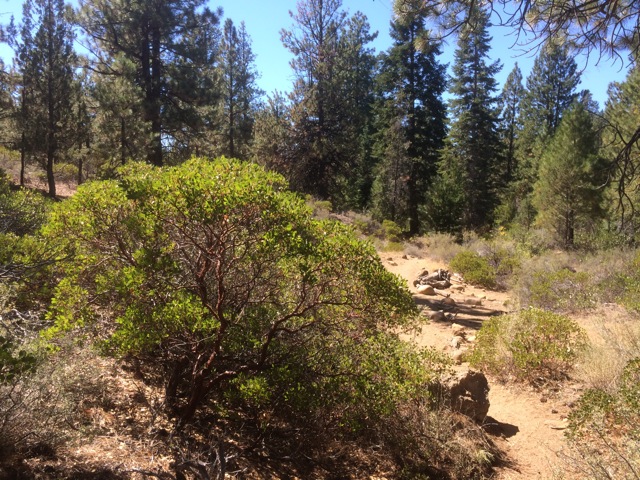
Arctostaphylos patula growing on site near Whychus Creek south of Sisters, OR.  Here it is 5' tall growing in a mixed condifer forest along with Doug Fir, Grand Fir, Noble Fir, Ponderosa Pine and Western Juniper.

Arctostaphylos patula growing on site near Whychus Creek south of Sisters, OR. Here it is 5′ tall growing in a mixed condifer forest along with Doug Fir, Grand Fir, Noble Fir, Ponderosa Pine and Western Juniper.

Outside our breakfast window, when I was a kid, was an Arctostaphylos patula. I never thought that much of it at the time, and how unusual it was, that sometime, probably by the late ‘40’s or early ‘50’s, somebody had dug one up and transplanted it to our yard in Redmond. They are denizens of the eastside Ponderosa Pine forest ecotone not the Sagebrush ecotone where I grew up. We averaged less then 10” of precipitation a year, too dry (For those who don’t know Redmond, OR, lies wholly within Oregon’s High Desert country that puts it in USDA zone 6b, -5 to 0 F). It grew in this little jog of the house facing northwest. I’m sure it got overspray from when we dragged hoses and sprinklers around to keep the lawn green, which is probably why it had grown with some vigor, having a form that you wouldn’t see in the Ponderosa – Juniper transition band sixteen to twenty miles away. In my memory it was always clean, with bright green foliage, part of which can be attributed to the low desert humidity and our sandy soil. I wish it was still there to take a picture, but the house has sold several times and had ‘improvements’ to the structure and the landscape including an irrigation system. I don’t know whether it rotted out or they removed it for one of their remodel projects. In its day it was 6’ high x 7’-8’ across with the characteristic sinewy branches and smooth peeling red bark.

Continue reading →

Whychus Canyon Preserve

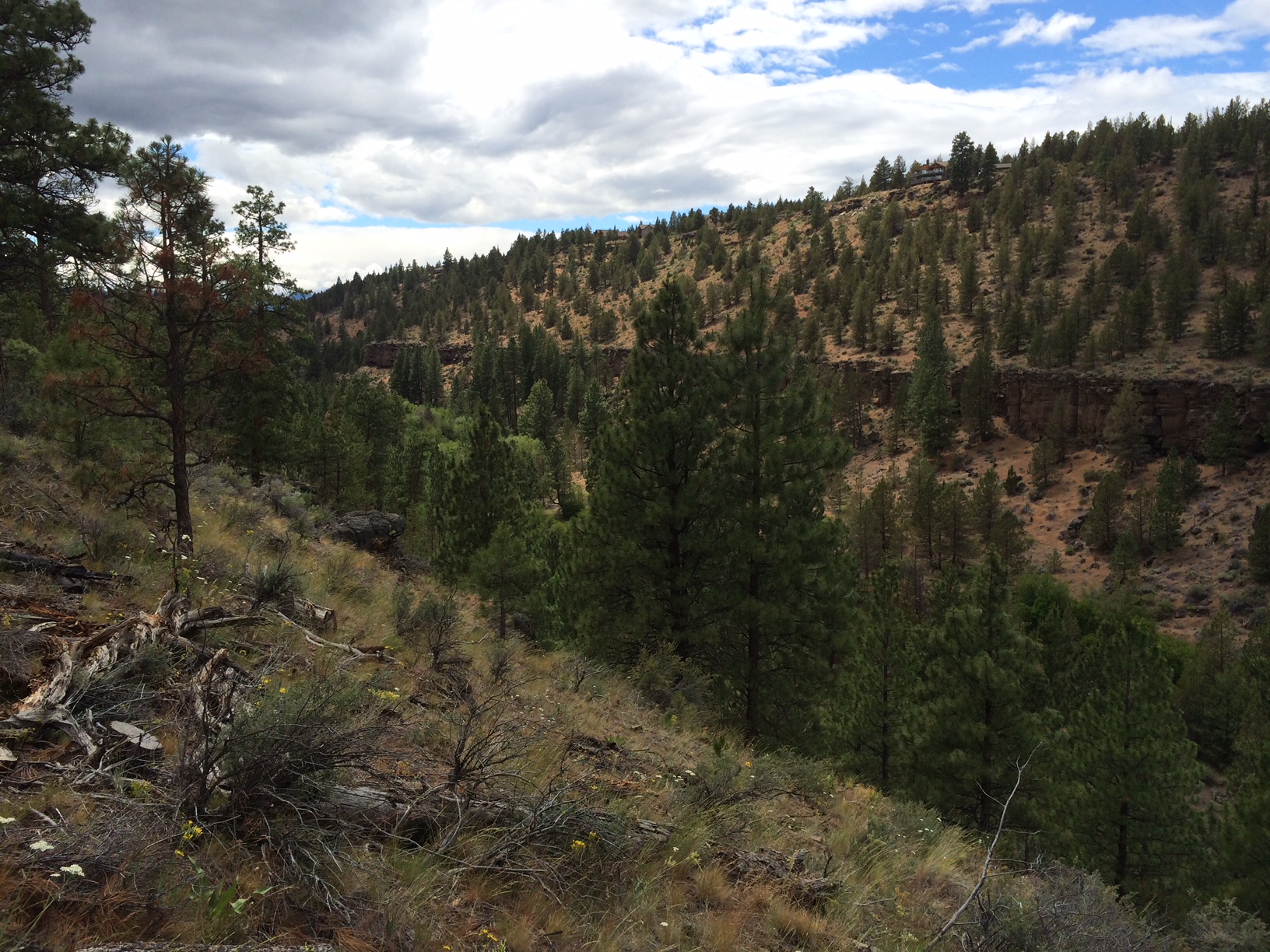
IMG_0062Whychus Creek starts up in the Three Creeks area south of Sisters, OR, below Broken Top and the Three Sisters, and runs north-easterly to where it joins the Deschutes River winding much of the way through a canyon carved through basalt.  It’s a beautiful band of green cutting its way through the Juniper – Sagebrush Scrub country where I grew up.  I’d never been to the Preserve before and was happy to see it mostly intact.  Though development has been creeping up along some of its edges the Preserve is being actively managed by the Deschutes Land Trust these days.  We hiked it on June 26 and many plants  were still in bloom.  Many people from the wet side of the Cascades have never developed an appreciation for the starkness of Oregon’s High Desert country.  Julie and I both grew up over here and where some people see barreness we see country defined by its sky, its geology and the spaces in between that set off the unique character of everything that lives here.  We took this hike with long time friends, Robert and Elayne, who stayed in Bend when we and others left.

Continue reading →

Landscape and Culture: Redefining the Urban Landscape – Single Use Corridors – Railroads

R x R below Division St. and 9th

R x R below Division St. and 7th

Landscape, is a human concept. It is more than simply a place, or the land that we occupy. Land becomes landscape when it passes through the lens of our eyes and we ascribe to it not only our own values and emotions, but also the value and emotions of the culture we share as members of this society. Just as we are shaped by the laws and culture of our society so to is the landscape. Without, sometimes, considerable conscious effort we cannot see the landscape free of this ‘cultural looking-glass’. As individuals I don’t think it’s ever possible to look at the landscape neutrally, though over time, our experiences can change us, and so, also, how we value and view the landscape. This is important if we ever want to change our relationship with the landscape we live in, if our role as an actor in the landscape is to change, if we are to, individually and collectively, become responsible stewards of the places within which we live…because it is one thing to say we are good stewards and something else entirely to actually be one.

People continue to be drawn here to the landscape of the Pacific Northwest. We all have our favorite places that hold us, and, unfortunately, over time, can come to sadden us as we see them degraded and homogenized by the momentum of our culture, the economic engine we all depend on, that is still systematically converting our landscape into one that can be found almost anywhere with the exception sometimes of a geography too expensive to alter. Even climate, we are beginning to realize, is within our ability to change, though we are finding, such changes are likely beyond our control. Continue reading →

Crassulacean Miracles

Some of my CAM plants: back, Agave colorata, A. americana Medio-Picta; middle, Hechtia 'Texas Red' w/ Sedum 'Anglina', Agave gentryi 'Jaws', Puya venusta, Aloe (?); front, Puya chiliense, Dyckia 'Big Red', Senecio mandraliscae and Agave parryi 'Cream Sickle'

Some of my CAM plants: back, Agave colorata, A. americana Medio-Picta; middle, Hechtia texensis’ Big Red’ w/ Sedum ‘Angelina’, Agave gentryi ‘Jaws’, Puya venusta, Aloe (?); front, Puya chiliensis, Dyckia ‘Red Devil’, Senecio mandraliscae and Agave parryi ‘Cream Spike’

Plants for me are little windows into the working of the world. Beautiful, exotic, grand or seemingly simplistic, perfectly attuned to their place. We are simple animals ourselves our attentions grabbed and later lost by what shimmers and glitters in our minds for a moment. We look, but only partially see. Each plant is an opportunity, maybe a lesson and later forgotten by most of us, unaware that there is anything there to learn beyond our initial attraction to the physical plant itself. The unrolling of a leaf of Liriodendron, like a flag, happening 10 thousand times on one tree, each year across the span of its years, for generations for millions of years. The perfectly memorized pattern of the single enormous leaf of an Amorphophallus as it stretches up out of its corm, fully formed, each leaflet revealed as a piece, entire, not expanding through a growing tip, adding tissue, but revealing itself wholly if we watch. Each plant a miracle to all but the blind.

I was reading an article on UBC’s botany photo of the day site, on Crassula ovata (Jade Plant). It is one of the most common of the Crassula species in South Africa growing on sandy loam soils, with around 12”-18” of rain as part of what some call the ‘Albany Thicket’. Continue reading →

Dispatches from Bend, OR

I’m over here in Bend for the Labor Day weekend doing family stuff, visiting my dad and Julie’s parents…dealing.  I worked my way through the first draft of an article/posting on everyone’s favorite Manzanita, isn’t it, Arctostaphylos patula, with a sustainable landscape spin.  I met two old friends at the 6th Annual Little Woody, a celebration of beers aged in barrels, mostly bourbon or wine, 24 breweries with 40 decisions to make.  Needless to say they got easier as we worked our way around.  If you’re a beer snob and like to wow your friends with talk of original and final gravity, A.B.V. and what the right balance of I.B.U.s might be, this is for you.  It’s still a modest sized crowd that attends.  Don’t expect pints, just good beer, with a twist and extra ooomph!

Today, though I’m between things and went for a walk with plants in mind, Arctostaphylos foremost, and set out to look a little closer at some of Bend’s more public ‘scapes, in their roadways not their Parks.  Bend is known for its ubiquitous and proliferating traffic circles so I checked this one out on SW 14th, on Bend’s westside.  They are all planted from a native palette.  A couple of bronze deer were curious what I was doing.  The light was glaring and my pictures less than I had hoped.

After that I was cutting through some commercial spaces on my way to check out Bend’s newest booze joint, Back Drop Distilling, it’s sharing space with Good Life Brewing, but the sign says they won’t be open until sometime later this fall, when I saw these Rhamnus frangula ‘Asplenifolia’ at a little US Bank branch office.   Continue reading →