Category Archives: Plant Selection

On Ornamental Trees and the Remaking/Unmaking of Place: Revising the City of Redmond’s Tree List, part 2

How Much to Water?

Recommending trees from climates with significantly wetter growing seasons needs to stop if we are to continue growing our population. Landscapes as designed, and managed, are the single largest user of residential water. Recommending trees which ignore this problem is irresponsible. Lower water use residential landscapes are possible. Local codes and recommendations must, however, reflect this priority.

Additionally, how much to water is a bit of a mystery to all of us and especially so to non-gardeners. How much? How often? Our watering practices should be determined by the local precipitation and the tree’s needs. What is commonly done, however, is that we water for our lawns and that largely determines what our trees receive, unless we have separate drip systems. A tree’s root system doesn’t stay neatly between the lines. They quickly extend out well beyond the span of the tree’s leafy canopy. In many cases even 2-3 times as far, taking up water and nutrients. A roots of a tree, planted in a small bed, adjacent to an irrigated lawn area, will move out into the lawn. A tree isolated in a xeric bed with only a few drip emitters, will quickly demand more than such a meager system affords it and such a tree, if it requires summer moisture, will struggle while competing with its nearby  ground level growing neighbors. Again ‘neighbors’ should share compatible requirements so all can thrive on the same ‘diet’ and moisture regime. Continue reading

On Ornamental Trees and the Remaking/Unmaking of Place: Revising the City of Redmond’s Tree List, Part 1

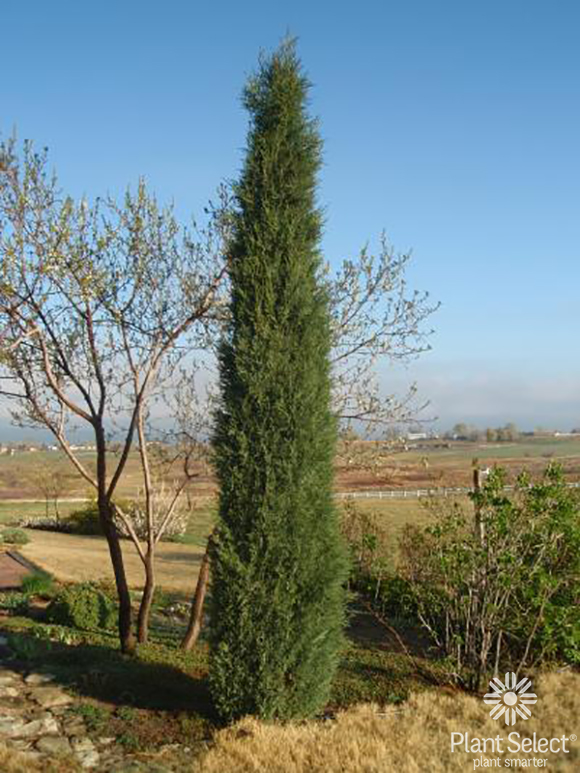
Perhaps an odd tree to start this with, Juniperus scopulorum ‘Woodward’, is not a ‘shade tree’. It is not deciduous. It is a narrow, fastigiate form of Rocky Mtn. Juniper that, growing to a height of 20′ with a 2′-3′ spread can serve as a formal accent in colder climates like ours as a ‘replacement’ for the more tender Italian Cyperss, and it can do quite well here with very little supplemental water.

Trees, specifically ornamental shade trees, have become an expected and desired part of our urban lives, at least util their leaves fall and await our cleanup. Many associate long tree lined streets and avenues with urban living. Broad Maples. Lofty Elms. Plane Trees and, in tighter spaces, perhaps Cherrys, Crabapples and flowering Plums. Urban trees provide several notable ‘environmental services’ increasing our comfort level with their cooling shade, their capacity to remove pollutants from the air, cover and nesting places for birds and the sequestration of carbon. Trees are generally viewed as a public good, necessary even for our lives. We can get quite emotional about them. So it seems a bit ‘wrong’ to suggest that this ‘ideal’ may not always be ‘best’ or even desirable.

Broadleaved deciduous shade trees are ‘naturally’ members of mesic, temperate to cold-temperate regions of the world. That is where they evolved and where when we plant them out, where they do best. When we begin planting them outside of their historic natural ranges, especially when we ignore the conditions, the disparities and the extremes between their natural ranges and those where we choose to plant them, then we can have some serious problems. The trees may struggle along, or if we remain committed to making up for our local area’s lacking, usually in the form of supplying more water, they can do reasonably well. But this suggests possible real problems as one moves further away from the conditions of a tree’s natural limits and increase the numbers planted out. Where is this water coming from and what are the impacts of removing this water from its normal and healthy cycling of which it is a part? What will be going without? And, is that cost worth the losses it creates? Our selection and planting decisions depend on how we value that which is lost! In short, the typical deciduous shade tree of our imaginings does not belong here in a desert. Continue reading

Weeds: What We Need to Do at DCVS

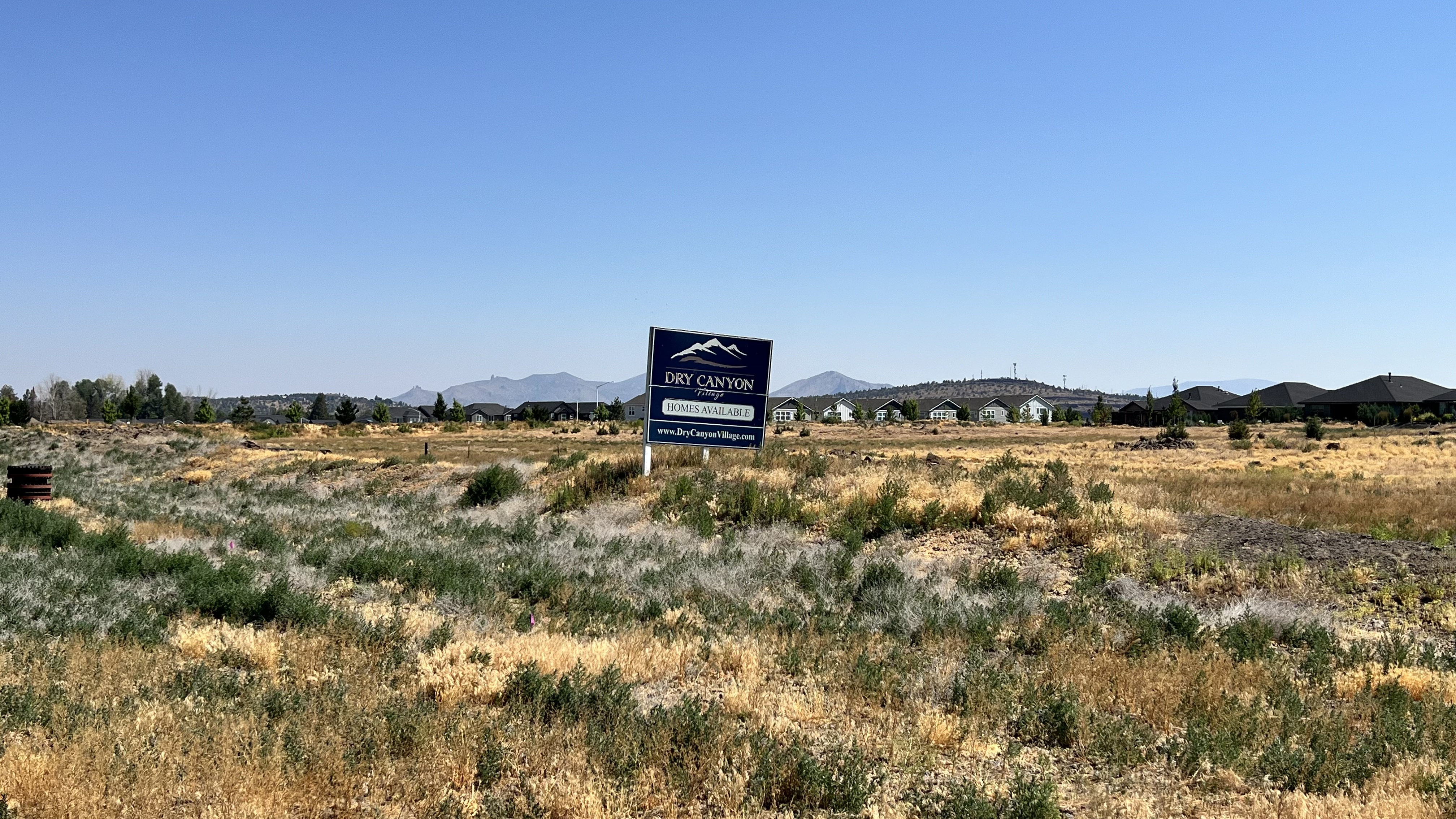
Looking NE from the gate at Northwest Way, other than a handful of juvenile Juniper there is literally nothing native of value across this roughly 9 acre spread. The other two undeveloped phases are equally bad, having a similar mix of weeds.

The question I keep hearing is, ‘What do we do?’ Many, if not most people living here now, have expressed frustration and more about the Dry Canyon Village South, DCVS’s, landscapes, specifically the berm, the mini-parks,  the Circle and the 25+ acres of undeveloped, uncared, for property we share space with. They ask me because they know I cared for Park landscapes, as a field horticulturist, for almost 30 years, Parks which often included natural areas of over 100 acres, to little neighborhood parks and intensively developed and used urban parks in the downtown core. I also haven’t been shy about my criticism of the lack of care, or of even a plan, for the neglected property we are saddled with. Anyone who has cared for a landscape can see the problem here. Leaving disturbed and neglected properties on their own is not a plan and can lead only to their further deterioration and continuing, worsening, ‘weed pressure on the adjacent developed landscapes. Continue reading

Agapanthus for the Maritime Pacific Northwest: Not all of these are well suited for us…or are they?

A fellow gardener asked the question about whether there were a list of sure thing Agapanthus, plants that a beginner could confidently choose and have success with in most of the maritime PNW.  I’m going to say no.  All of these are South African natives and while many of us can grow these in our gardens, because our conditions overall are marginal, a gardener is going to have to possess a good understanding of their site in particular and some knowledge of the cultivars that they are choosing.  I’m going to borrow here from Manning and Goldblatt’s book, “The Color Encyclopedia of Cape Bulbs”, which discusses the bulbs of the Cape Floristic region and those adjacent areas spilling over into other parts of South Africa. Agapanthus species are native there, endemic in fact, occurring naturally no where else in the world.  I’m also relying here on the SANBI website, the South African Natural Biodiversity Institute which has put together an incredible national program, which all countries should be building for their own countries.  Being a South African plant aficionado I visit it frequently. To this I add my own observations and speculations, having grown several Agapanthus over the last 25+ years in Portland: These come from warm temperate and subtropical areas in South Africa, 10 species total, 3 limited to the Cape itself, all of which tend to occur in rocky grasslands.  Other botanists have downgraded 3 of Manning and Goldblatt’s species and given them subspecies status recognizing only 7 species. Continue reading

Gardening in Public, Charismatic Mega Flora and the Need for a Public Horticultural Intervention

We ‘need’ charismatic mega-flora today, plants that scream out to even the most plant blind of us to take notice, those that create such a sudden and uncontrollable ‘stir’ within us that our simple glimpse of them breaks our momentum, our chains of thought, interrupting whatever we’re doing in that moment bringing about a reflexive interjection, cause us to take notice, create an uncontrollable urge to stop what we’re doing and come back for a closer look!  To tell our parents, partners or friends, to drag them back, for a repeat performance or to see if what we saw is really there or merely a mistake of perception.  And they do come back.  I see them every day, sometimes dragging disinterested friends to see this unimaginable impossibility.  I hear them when I’m out working in the private part of the garden with excited voices, sometimes expletives, “Look at this ‘F@#$ing’ thing! Can you believe it?”  I love this. They’ve come for ‘Monte’!

Continue reading

Puya: Growing These Well Armed South Americans in the Pacific Northwest

[I wrote this originally about 2 years ago as part of what turned out to be a too long look into the Bromeliad Family.  Here I present only the genus Puya spp. in an edited form with the addition of the species Puya berteroniana.  Go to the original article to read about the shared evolution of the several genera and families that comprise the family, why these are not considered succulents and a look at the armed defenses of many plants.  My plan is to breakout at least some of the other genera as well as I think the length of the original post may have put some readers off.]

Puya: one of the Xeric Genera of Terrestrial Bromeliaceae

The name “Puya” comes from the Mapuche Indian word meaning “point” (The Mapuche people are indigenous to Chile and Argentina.  They constitute approximately 10% (more than 1.000.000 people) of the Chilean population. Half of them live in the south of Chile from the river Bío Bío to Chiloé Island. The other half is found in and around the capital, Santiago and were mostly forced to the city after Pinochet privatized their lands giving them to the wealthy.)…the assignation is clear and the pointed, spiky, nature of this genus is immediately obvious to anyone.  But there is something easy and comfortable about the sound of the word in your mouth when you speak it…poo-‘yah.  Puya are native to the arid portions of the Andes and South American western coastal mountains.  (Oddly, two species are found in dry areas of Costa Rica.)

Puya spp., populate arid western regions of the Andes Mountains up into southern Central America.  These are terrestrial plants, relying on their roots to find the moisture that they need.  They possess the same basic rosette structure common to all members of the Bromeliad family to which they belong, including their petiole-less leaves, which clasp directly to a compact stem structure, funnelling the infrequent, and seasonal, precipitation they get into their crowns and root structures where they can take it up, a strategy very similar to Agave and Aloe which grow under similar conditions. Continue reading

Winter 0f ’18 -’19: Cloudy, Mild With a Chance of….On Weather, Zones & Plants

It’s 41ºF at 5:30am on Mar. 12 as I begin to write this.  We appear to have come out of the longest sustained ‘cold’ period of the winter of ’18-’19 which began on February 4 and continued through Mar. 11, a period of 36 days.  Over those days we had freezing minimum temps at PDX, the official NOAA reporting station for the Portland area, on 26 of them.  On two of those days, Feb. 6 and 7, PDX recorded the winter’s lowest temp, 23ºF, making it a zn 9a winter, mild for us historically and especially so for the temperate US as a whole, much of which was experiencing its own much colder temps.  It’s mid-March and our high temps have climbed well above what they were and our forecasts call for milder, more ‘normal’ highs and lows now locally.  It looks likely that not only are we going to be on the ‘warm side’ of normal, but that our lows have shifted into a pattern well out of the freezing range.  (State ODF meteorologist, Pete Parsons, calls for a pattern of slightly warmer and drier weather than normal over March, April and May with the highest chance of this during May.) 

While weather consists of moments, recorded data points, we attempt to make sense of it in its patterns over time…our experience of it.  In this we are much like our plants.  Plants too have their ‘expectations’ of the weather and those conditions that take them outside of them, outside their familiar patterns, the relatively quick changes and perturbations, as well as the longer sustained patterns, and extremes, are ‘noticed’ and make a difference.  How does this winter compare? Continue reading

Fabiana imbricata: the Andean Un-Tomato, a Non-Heath That Looks a lot Like its Cousin Cestrum

800px-Fabiana_imbricata_HRM2

Fabiana imbricata has an appearance much like the upright and shrubby Erica arborea…maybe mixed with an upright form of Rosemary…providing a remarkable texture in the garden.

In gardening and botany one of the first things we learn is that not everything looks as we might expect that it should!  Fabiana imbricata, is a member of the Tomato Family, the Solanaceae, yet, if you don’t look too close, it looks like it might belong to the Ericaceae.  At one time I was planning to take advantage of this similarity as I was attempting evoke a South African feel in part of my garden substituting this for one of the many tender South African heaths as the correct Erica species are either too tender, of borderline hardiness for my conditions or are simply difficult to come by.  It was sharing an area in the garden with Restio capensis, Eucomis spp., Melianthus spp. and others to give an impression of South Africa, not a strict species for species duplication of a community.  I didn’t quite pull it off….I’ve done much the same thing when substituting tropical looking temperate plants for the real thing when evoking a tropical feel.  It’s a matter of manipulation…a sleight of the garden hand.

Its Chilean Home and Garden Merit

Fabiana imbricata is not from South Africa, though it shares Gondwanan roots, and is endemic in Chile, occurring very frequently throughout much of its Andean range.  It is in fact identified as a ‘keystone’ species strongly effecting the composition of its local plant communities.  It can be found growing from well into the dry region of Coquimbo in the north, just south of the huge Atacama Desert, south into the wet Aysen region with its many islands and inlets south of the Lake District or Zona Sur.  The vast area stretches along much of Chile’s length which can be driven, on often tortuous mountain roads, for over 1,700 mi., stretching from the arid city La Serena to the small, rainforest town of Tortel, in the south, a distance almost 500 miles further than the drive from Vancouver, BC to Los Angeles, CA….There are not that many plant species in the world that span a similar latitudinal range with its accompanying climate differences.  As you look for this plant moving from north to south through Chile, the soils and its particular niches change along with the temperature and rainfall.  You are more likely to find this growing exposed in rocky scree in wetter regions to the south, while it tends to be more commonly found on sites more protected from the sun’s intensity and into better soils as you move into the arid and hotter north, more protected from the sun’s tropical intensity.  No surprise there, but overall this is an adaptable plant succeeding in cool rainforest to arid, desert like, conditions.  As would be expected across the more arid portion of its range fire is an important factor in maintaining the plant communities balance, riding it of other competing woody plants  and even aiding it in germination, when followed by ample winter/spring rainfall, though this is obviously not essential for its continuing survival in rainforest areas where fire is much less frequent.   This is a very adaptable species and as we live near the Pacific Coast in the northern hemisphere, which mirrors much of the range of conditions, we should be able to have success with it, if we pay attention to its cold limits.  Those away from the Pacific Coast, especially those with ‘continental’ climates or strong influences from them, will have to pay closer attention. Continue reading

The Fascicularia and Ochagavia Question: Two Worthy and Relatively Hardy Bromeliads


The inflorescence of Fascicularia bicolor with its blue flowers. The center of the foliage on a blooming rosette, turns red when the flowers appear and then, like many Bromeliad, that rosette dies replaced be previously formed offsets. My blooming plant had multiple rosettes at the time, three of which bloomed. Taken in my garden, Sept. of ’17.

If you’re not into blood and guts, consider this genus, as on my scale of one to ten as described above with ten warning of near complete evisceration if one is fool hardy or reckless, this one’s a solid 4, dangerous enough but not stupidly so.  Fascicularia pitcairniifolia.  You would think that in a genus composed of one or two species things would be pretty well settled taxonomically, guess again. Originally described as F. bicolor it was reclassified as F. pitcairnifolia and later changed back to F. bicolor.  Subspecies were proposed.  Changes retracted.  There are significant differences in the sampled populations, but were they sufficient to constitute separate species??? Adding confusion at a different level are those who say the species name indicates that it is from Pitcairn Island.  It is not.  The specific epithet simply recognizes a similarity to the foliage in genus, Pitcairnia, another Bromeliad member.  This Fascicularia is from the lower Chilean Andes, allegedly north of the other Fascicuaria species, F. bicolor which is suppose to be slightly hardier and occurs at least occasionally as an epiphyte!  Some botanists have argued that F. pitcairnifolia possesses thicker, slightly wider leaves. and some minor differences in the timing of flowering and is reputedly slightly less hardy.  The ranges of both overlap  Good luck sorting this out. Continue reading

Our Gardens as Teachers


Of all the things our gardens do for us, arguably the most important is their role as our teachers, even in winter when a temperate garden ‘rests’, its surface crust or top few feet, frozen, maybe sheltered beneath the cover of snow, or, as ours so often are, simply too cold for active plant growth, the soil wet, the rain too heavy to percolate fast enough down through its layers, without the active aid of either the direct heating of the sun or its effect on plants, through evapotranspiration, pumping water back into the air as the plants grow.  Gardens teach patience.  They encourage us to become more careful observers…to think and plan, to anticipate and prepare, to understand that there is more going on here than we can readily see…and they teach us about faith and trust in the natural world, that there is always more going on than we can see. Continue reading