Category Archives: Sustainable Landscapes

Portland Sustainable Landscapes: Toward Health and Diversity – Creating an Organizational Structure for Implementation


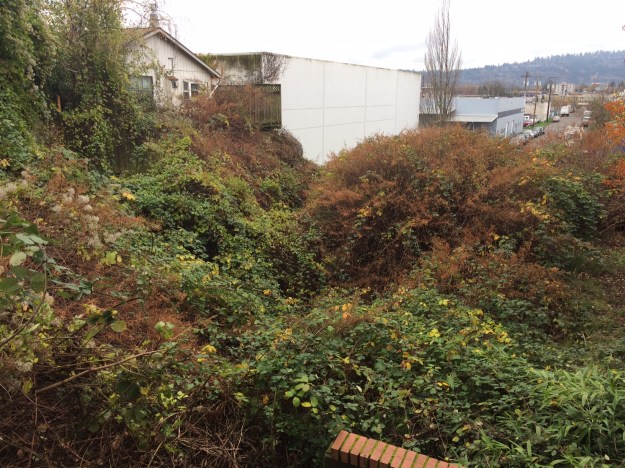
img_5221

Urban landscapes can and must vary across a wide spectrum of types from natural to highly contrived display and educational beds. All will require their own maintenance regime that should minimize impacts while supporting the expression of the particular landscape. Good horticultural practice will minimize negative impacts and costs and is largely ‘determined’ by the design.

Introduction

An Office of Sustainable Landscapes that oversees all landscapes within the City and provides active leadership to both private and commercial property owners through the following:

Public Landscapes (active urban contrived) Horticultural Management

Public Landscapes (urban plant communities)

Corridor Management: Transportation and Riverine

Division of State Lands

Tri-Met

P-BoT

O-DoT

Multnomah County Bridges

Outreach and Education

‘Regulatory’

Introduction

Landscape is the setting, matrix and backdrop for everything that we do as humans.  It is where we live, work and play, the places, on which the infrastructure that enables our modern day life, exists.  It is both essential and peripheral, always present and, too often, taken for granted, so much so that we often view it incidentally.  Like many other things in our lives it may go unnoticed until it is so degraded that we can no longer ignore it.  Overall, our care of it, reflects a similar low priority.  It becomes largely ‘invisible’, behind the more recognized needs of a modern City.  Individual mobility, food, water, shelter, energy, economic opportunity and growth, the transportation infrastructure that keep us supplied with these things, all and more take precedence, the landscape subsumed and secondary, inferior and problematic.  Overall, it is not generally viewed today as having inherent value.  Its value, as a living system that allows and enriches biological life, seems almost irrelevant as we are able to satisfy our needs and desires via the economic engine that propels us along.  The landscape, nature, seems relevant only in so far as it can meet our recreational needs providing us a base on which to build and resources that we can manipulate/convert to satisfy our ‘needs’.  Lost in all of this is our relationship with nature, with the landscape, its essential role in the creation and sustenance of all of the resources upon which we and the rest of life depends, and so, it has suffered.  We have lost the ability, or willingness, to use nature as a gauge that shapes all of the other decisions we routinely make in order to meet our ‘economic’ needs.  As both a society and as individuals we have learned to see these as separate and unrelated, so we routinely neglect the landscape.  The problem is pervasive and integrated with how we live our lives.  To correct this we must first acknowledge this and address it on many fronts. Continue reading

What Really is a Sustainable Landscape & Why it Matters

IMG_2603

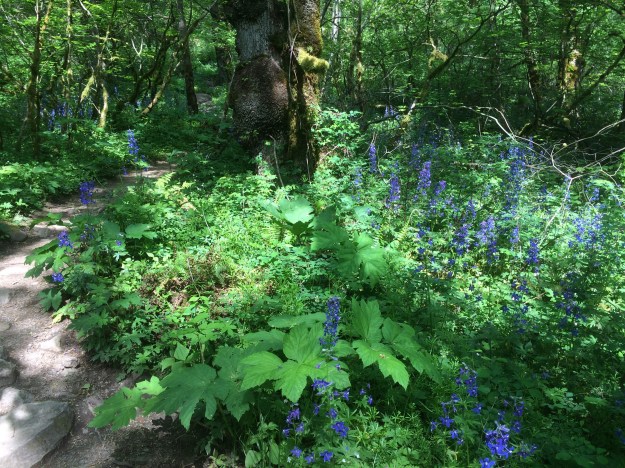
I took this at Cape Horn in early May ’15 in one of the ‘wet’ woodland ‘terraces’. The native Delphinium gives it a fantastical appearance. If we could create this landscape anywhere in the City I can’t imagine that it would withstand the level of use and inevitable abuse it would receive let alone the ‘weed pressure’ it would suffer. Perhaps there are a few places that such a landscape could work but it would require that we have all of the surrounding landscapes ‘under control’ and that we educate the public so that they would understand and respect it enough to stay away. Our numbers alone even if most behaved themselves would make its survival difficult.  Ultimately, this is just what is necessary, re-establishing the public’s relationship with nature and the wild world.

(I’ve made earlier postings on this topic, but this piece actually predates those.  I wrote this in 2013 while still working as a horticulturist for the City of Portland Parks and Recreation as a member of a Bureau committee that was working to define ‘sustainable landscapes’ so that we could begin to make our policies and practices more consistent with our ‘desire’ to create sustainable landscapes and protect the relatively intact ones that remain.  This was a difficult process.  We spent a lot of time discussing/arguing about what constitutes a sustainable landscape and ultimately the direction that Parks should be headed.

There was a large divide between those of us who saw ultimately, that the only truly sustainable landscape was one that recreated those native landscapes that preceded the massive changes that European Americans brought with them, so that our efforts should be on these, and those of us who, having spent much of our professional lives in the field doing maintenance in created/urban landscapes, arguing that these new landscapes played a necessary role in the modern world and that our designs and maintenance of them could be moved in a more ‘sustainable’ direction.  These urban/functional landscapes, whether for active sports, community gardens or even many passive uses, provide places and venues for activities that native landscapes cannot.

IMG_0408

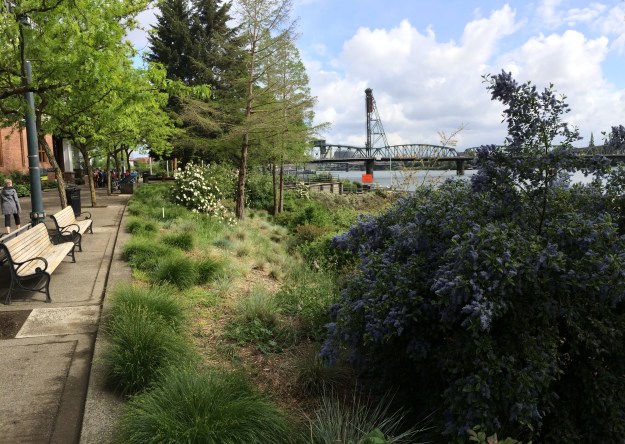
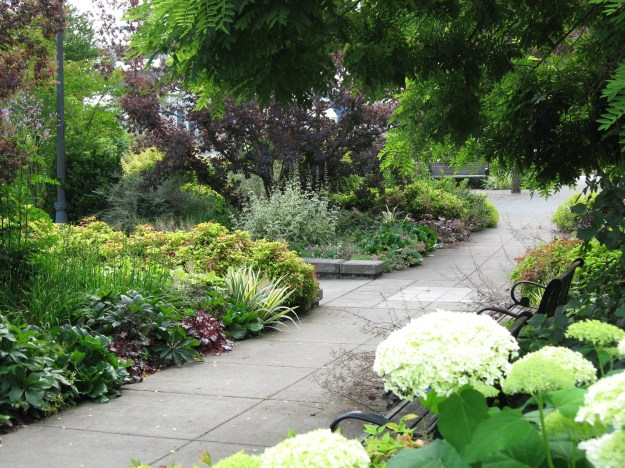
There is space and need for many different landscapes in an urban area. This is in the garden at South Waterfront Park along the Willamette River and is intended to be a contemplative refuge from the business of the city. It is layered and carefully orchestrated though its goal is more aesthetic than to be a ‘natural’ plant community. It requires considerable regular ‘grooming’ and editing to maintain in order to show off the plants to their best advantage. This garden was designed for multi-season interest especially through the summer when our native Willamette prairie landscape slides into dormancy.

The organizational structure of the Bureau has been built around three primary landscape ‘types’: ‘natural landscapes’ which tend to be larger and border more densely populated sectors of the City, ‘contrived landscapes’ that are dispersed throughout the City and serve the more traditional Park functions for sports and more casual social use and the ‘enterprise landscapes’ of Golf and PIR that serve very narrow functions and depend on those uses for much of the revenue that supports them.  These are operated and maintained by discrete groups within the Bureau, have different cultures and priorities and view sustainability very differently.   Because these are all in a highly urbanized area the degree of historical disturbance and the continuous pressures that a concentrated population apply to them, they can never by truly ‘sustainable’ in that they will always require our active stewardship to counterbalance these pressures.  This is not to say that we give up on the idea of balanced/dynamic landscapes of appropriately chosen plant communities.  We just need to remember that these are urban areas and be good stewards of the land.  We can even move ‘high use’ landscapes in a more sustainable direction, both in their design and in their maintenance.  It is incumbent upon us to do this to ultimately minimize the pressures put upon them and natural areas by weeds, invasives and human use.) Continue reading

Losing Our Urban Landscapes: Sustainable Goals and Our Crisis in Leadership

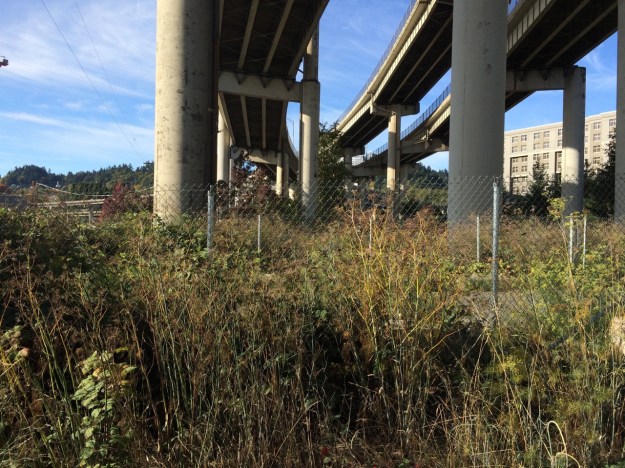
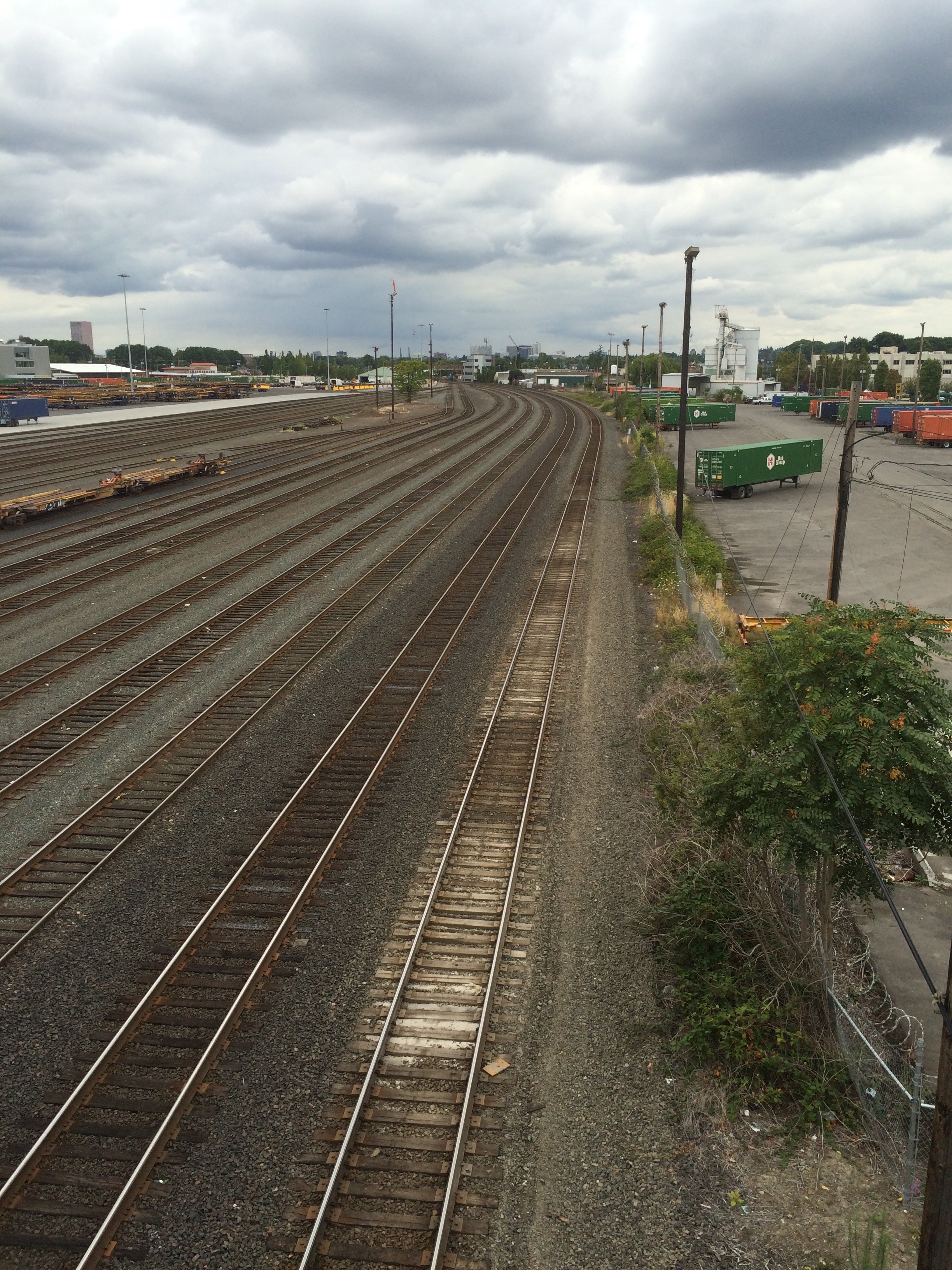
The Brooklyn switching yard. These areas must be kept clear. The fence line to the right, next to the container yard, is typical, here filled with common weeds, aggressive invasives and Tree of Heaven.

The Brooklyn switching yard. This ‘landscape’, in a modern utilitarian sense, is ideal.  These areas must be kept clear. The fence line to the right, next to the container yard, is typical, here filled with common weeds, aggressive invasives and Tree of Heaven…and it doesn’t matter.  It works and that is the priority.  Whatever results elsewhere…is not.

The following is intended as a template for action or a beginning point for a discussion that is long overdue.

Landscapes are more complex than most people realize.  They can go seriously awry in a very short time.  Undisturbed native plant communities are relatively stable and are able to respond on their own, as they have for millions of years…if the disturbances they suffer are relatively small.  Unfortunately these plant communities have been decimated in urban and most rural agricultural areas severely compromising their abilities to respond in a positive and effective manner.  The addition of invasive species to the region puts even stable, undisturbed plant communities at risk.  Because we are not all ecologists, or even gardeners, what can we realistically do to stop or reverse this process of landscape degradation?  The decline of our landscapes is linked to a long history of practices that have ignored the value of both our native and contrived landscapes, a belief in a right to ‘dispose’ of the land in whatever way we so choose and our denial that this destruction matters.  We have done this through our land management practices, our designs and the uses of the land itself even those that may seem unrelated, many that have become automatic in our society and are directly related to how we live, work and play today in the modern world.  Our active threat is inherent in the way that we do business.  Our attempts at correction are, too often, limited to only slight modifications that do not put any undue ‘pressure’ on our local economy, business or the privileges that we have come to see as ours.  We are a society that has, in short, become disconnected from the realities of life at the local level and what is required to support it.  We see a limitless nature that is there for our use.  Whatever we may need, we believe that we may merely buy from elsewhere, an elsewhere that is limitless though undefined.

To turn this situation around, or to make significant improvements, requires that we examine what we are doing now, that may be working against the goals that support life and landscape,…and stop.  We have to stop doing the things that are working to continuously disrupt the ‘healthy’ functioning of the landscape.  If we don’t do that then all of our attempts at improvement, all of our tweaking of our system, will come to nothing.  We cannot ‘save the patient’ with good thoughts while they bleed out. Continue reading

‘Reed Canyon’ and Crystal Springs Creek: ‘Reclaiming’ a Natural Area

IMG_4523

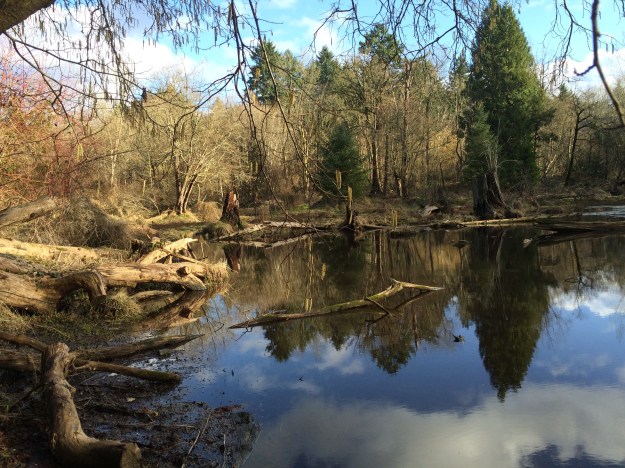
The east end of Reed Lake looking south.

The landscape is the land we live in.  It is the place and the territory that surrounds us: built, disturbed, neglected or purposeful.  A garden is a piece of that landscape that we have defined as special, that we have applied our own purpose to, a theme, above and beyond the natural forces at work across its face to grow plants of our choice.  Many urban places are feral, once domesticated, now gone to ‘weeds’.  A few pockets may be as nature made them, eroding at their edges, surrendering little bits of themselves to exotics tramped in on our boots, the hooves of our horses, the hair of our dogs, floated into place by streams or rivers or flown in by birds and on the wind.  Most landscapes exist somewhere on that continuum between undisturbed nature and the wastelands we have left in our wake of disturbance, vacant land waiting in that limbo, land on its way to purpose, value and development.  As Portland became urbanized over the last 150+ years the land has been literally transformed, become an expression of our culture, via a matrix of values and forces, that act as a particular and devastating template, a process that is still occurring and will continue to do so as long as value is measured in dollars, and demand, fashion and greed, keep cycling and reinventing this place we have made our home.  These in-between places are what French landscape architect, Gilles Clement, calls the Third Landscape.  Few areas are they that have escaped this process.  The Reed Canyon, that contains most of the headwaters of Crystal Springs Creek (another spring lies within the City Parks owned Crystal Springs Rhododendron Garden), the last of the free flowing such creeks on the east-side, may have been spared the heavy handed re-contouring of its terrain, but it has suffered much over the years anyway. Continue reading

Manzanita, Arctostaphylos, a Genus Whose Time has Come: Advocating for a Plant

IMG_4669

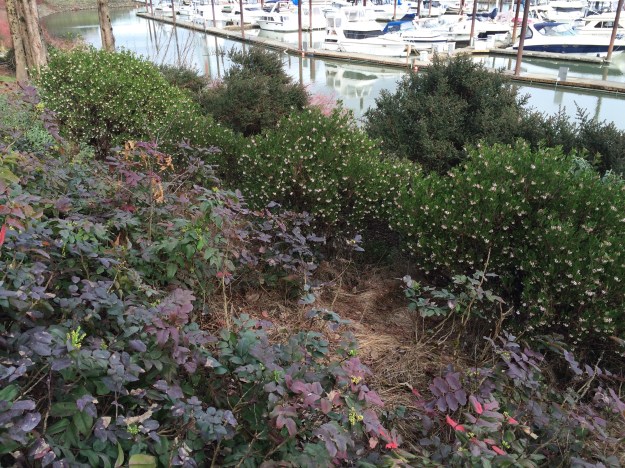
Many Arctostaphylos, like these A. densiflora ‘Howard McMinn’ make admirable landscape plants on xeric sites. This is above Riverplace Marina on the east facing bank of the Willamette in nutrient poor, compacted fill. It shares the site with Compact Oregon Grape and a variety of local dry site natives, Mediterraneans and Californians.

Thirty years ago, when I first moved here to the Portland area from the Central Oregon High Desert country, very few people were growing Manzanita.  Those plants that you did see were local natives that you had to search out, remanent populations of widely scattered stands, in western Oregon, in the Cascades, parts of the Gorge and Siskiyous or on old stabilized dunes above the beach, e.g., near Manzanita.  They were mostly ignored in the trade, barely recognized by anyone other than those in the Northwest native plant societies and hikers who would go out on forays botanizing. When I still lived in Bend, I would occasionally order dry-land native plants, like Cercocarpus, that could be seen in the Ochocos, from Forest Farm in southern Oregon.  My first two horticulture books, other than the many vegetable growing guides I bought from Rodale Press and Steve Solomon’s guide, were the Sunset Western Garden Guide and Arthur Kruckberg’s, “Gardening with Native Plants of the Pacific Northwest”…I went through them over and over again.  In the small space Kruckberg devoted to Manzanita he wrote, in the first paragraph, “Only Arctostaphylos uva-ursi…, A. nevadensis…and possibly A. patula are hardy in colder areas.”  Because I lived in one of these ‘colder areas’ this stayed with me, effecting my view of the genus.  I’ve already posted on A. patula, of it growing in Central Oregon, the eastern slopes of the Cascades and as a specimen outside of our breakfast window in my childhood home.  Other than A. columbiana, a denizen more of the western Cascade slopes and the high ground of the Coast Range, Kruckberg barely mentions the other species and forms…of which there are argued to be between 50 and 100, primarily in California and  southern Oregon.   Continue reading

TriMet’s Orange Line Landscapes: SW Lincoln & 4th to SE Milwaukie Ave

[I had been delaying the posting of this entry as I was waiting to meet the project manager with TriMet.  As I’ve heard nothing back from him, I’m going ahead and posting.  It would seem that my earlier posts concerned him, but I suspect now that time has passed and the sky has not fallen…he has moved on to more pressing matters.  It is a common tactic not to engage ‘critics’ so as not to give them any energy.  Ignoring critics can be effective, albeit, a very frustrating treatment to the one who is being ignored.]

Part 3 of the Series

This is an introductory note.  Yes, I realize I started the series in the middle, in a linear thinking world this would have been the first posting, but I live nearest the middle portion of the Line…and I have my own motives. Those of you who don’t know me, I do not mean this to be overly critical in spirit.  I’m a person who is always thinking what next? How can I do this better?  I have similar high expectations of the organizations around me.  Organizations all tend to be conservative in action.  There is a reason mature bureaucracies have a reputation for mediocrity.  It is not my intent to question the intent of TriMet or of its hired contractors.  I am a big supporter of transforming our City into a more livable place and the Orange Line is part of that.  There is nothing to be gained through polarizing a situation or setting someone up as ‘the bad guy’ and putting them unnecessarily on the defensive…having said that, sometimes a ‘push’ is in order.  We live in times of rapid change, many of them destructive, and it does no one any good to not work toward the changes that they see as positive.  That is my intent here.

I began this series with a discussion of scale and how it acts as a magnifier.  I spent some time talking about the problems caused by compacted, heavily disturbed, soils and I emphasized the issues created by a history of bad weed management…this first section of the Orange Line landscapes, from SE 11th to its beginning at SW Lincoln and 4th is heavily impacted by these factors.  Built on heavily graded and or imported fill, often on abandoned industrial sites, on or adjacent to sites that have been out of control weed generators for decades, this section may pose the biggest problem for landscape maintenance of all.

It is dangerous to assume that a new urban landscape is created on a ‘blank slate’.  Merely scraping a landscape off and beginning anew does not return it magically to its ‘pristine’ condition prior to the arrival of ‘modern’ white American culture and all of our accumulative impacts.  To be successful some effort must be expended to ameliorate at least the worst of these conditions.  Even if we make our ‘best’ effort to do this, landscapes such as these with their ‘heavy’ impact histories will present a powerful challenge to those charged with maintenance.  It is easy to underestimate the severity of this problem.  We have developed an ‘alien’ aesthetic that really doesn’t belong anywhere and as such is outside the bounds of the function of the normal cycling of energy and resources common to nature.  We impose this aesthetic and our designs on our landscapes and then expend a great deal of energy, in the form of labor and chemistry, to maintain them, or they quickly degenerate.  In some ways it would have made maintenance much simpler to have buried all of the surface beneath concrete sealing the problems beneath it.  But then the priorities of urban tree canopy, the capture and ‘treatment’ onsite  of stormwater would have been negated, the possibility of groundwater recharge further reduced and the ‘softening’ of a very hard edged urban ‘landscape’ stymied. Continue reading

Tri-Met’s Orange Line Landscapes: Bybee Stop to Oak Grove

Part 2 of the Orange Line series

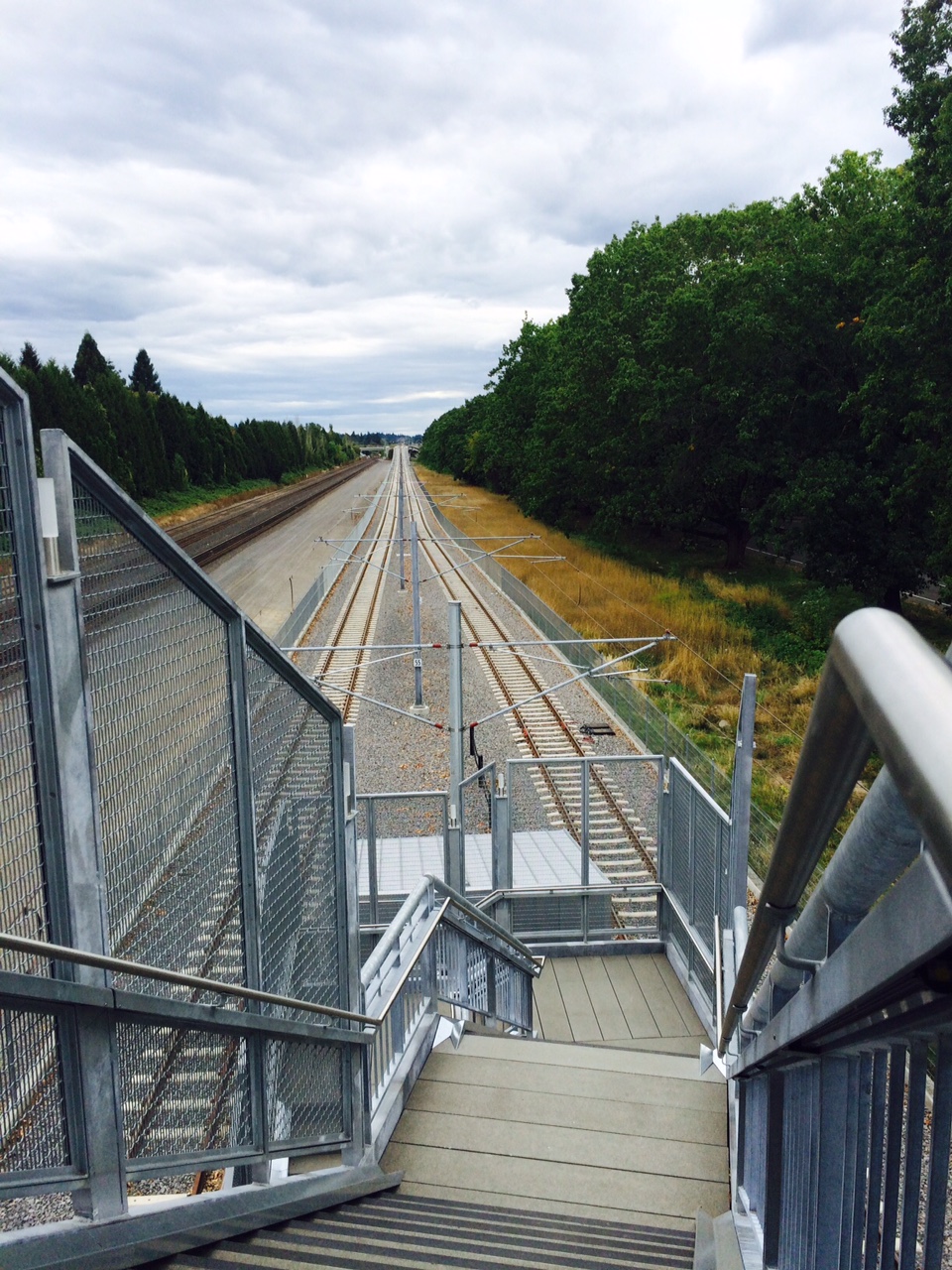
Looking south from the top of the stairs at the Bybee Stop. This is pretty much the same view as looking north with respect to the landscape.

Looking south from the top of the stairs at the Bybee Stop. This is pretty much the same view as looking north with respect to the landscape.  BNSF’s tracks lie to the left, the east.  The railroads have their own ‘landscape’ maintenance standards set primarily for safety reasons.  Within so many feet of their tracks they have a zero tolerance for plant growth and use sterilants.  There is also a zone within which the will ‘brush back’ trees and shrubs to keep site lines open.  Metro will have its own standard.  The two side by side show their combined effect.  Also, typically railroads do not fence off their tracks making clear sight lines a more pressing safety concern.  Trimet has fenced off the tracks from casual pedestrian ‘conflicts’.  Fencelines are problematic for maintenance unless ‘dead zones’ are expanded to include both sides.

Heading south of the Harold St. overpass the Orange Line leaves the most urbanized portion of its route, or at least its most densely populated stretch.  Traveling south to the Bybee, the Tacoma/Sellwood and then the Milwaukie stops, the line run alongside the BNSF tracks and there is very little ‘landscaping’ of the corridor.  The railroads contract out maintenance of their thousands of miles of tracks. (For a brief look into their approach check this link.) Continue reading

Tri-Met’s Orange Line Landscapes: Clinton & SE 12th to Harold St.

This shows the banded pattern common today in long mass plantings each swath a single species.

This shows the banded pattern common today in long mass plantings each swath a single species going for a kind of landscape scale ‘graphic’ pattern that is less concerned with ‘fit’.  This is near the Clinton/ SE 12th stop.

Size matters.  In horticulture it changes everything.  Things that are inconsequential, or maybe even enjoyable in the backyard garden, can quickly become daunting or onerous when the scale is ramped up.  Working at a commercial or institutional scale has to change your entire approach to the landscape.  In a small garden it is easier to accommodate mistakes, the conflicted combinations and those issues of horticultural ‘fit’ that we missed when we design or install.  Scale, however, rubs our faces in it everyday, makes us pay with aching backs as unintended consequences play out across the thousands of sq.ft. and acres.  It becomes a matter of physical survival and undermines your professionalism.  You become perforce part laborer, part diagnostician, designer, plantsman and critic….Out of necessity you sharpen your critical thinking skills and the last thing you ever wanted, your sales skills, as you work to sell your ideas to management who are absurdly ignorant of the problems you face everyday in the field.  And, then, eventually, you retire, but you don’t turn it off…you can’t.

Which brings me to the MAX Orange Line and its landscapes.  When I did horticultural design review for large capital Parks projects, it often felt like a dueling match.  I would pour over the design, whatever the stage it was in, match that with my particular knowledge of site conditions and my maintenance experience within Parks.  I would state my concerns on paper and in meetings with the Project Managers and Architects.  I was stubborn and consistently found myself up against a process that undervalued horticulture and my input.  Good horticultural practice was regularly placed in a losing position opposite not just that of the Landscape Architects but of a very political process that tried to give the public what it wanted as long as it fit within the Architect’s vision.  Horticulture always came out a poor third, even though good horticulture always saves money in the mid and long runs.  It was exasperating.  The public, by and large is ignorant of horticultural practice and no effort is made to educate them at any level. Continue reading

Revisiting Holgate Overpass: A Mistake Repeated

Holgate Overpass - the northeast approach. This was taken Aug. 28 of the landscape cut down in April showing regrowth in a hot drought year.

Holgate Overpass – the northeast approach. This was taken Aug. 28 of the landscape cut down in April showing regrowth in a hot drought year.

Holgate Overpass Update:

It finally rained this last weekend!  Somewhere around .3″.  Woohoo!  It will be the most rain that we’ve received since March.  It’s been dry!  In April the City cut down the ‘weedscape’ on the northeast approach of the Holgate Overpass.  It’s rained very little since and we’ve had record warm temperatures all summer.  No one has come back to spray, plant or do anything.  No one’s even picked up the trash.  If you compare the four ‘weedscapes’ on the two approaches they are very similar.  The NE, by volume has had the most regrowth.  This is for two different reasons: first, this site was cut earlier in the season when there was more moisture still in the soil to enable regrowth, and secondly, because the site is dominated by Blackberry and Tree of Heaven, both perennials, well established and of larger stature than the plants dominating the other approach landscapes. Continue reading

The Subterranean Dance: Plants, Nutrients, Water and Their Relationship in Soil Health

The western coast of North America is home to an amazing array of landscapes each with its particular climate and range of soils.  This is in the California coastal range looking southerly towards the distant Bay area across meadow, native Coast Live Oak, Doug Fir and the Coast Redwood of the Armstrong Grove in the lower creek bottom land.

The western coast of North America is home to an amazing array of landscapes each with its particular climate and range of soils. This is in the California coastal range looking southerly towards the distant Bay area across meadow, native Coast Live Oak, Doug Fir and the Coast Redwood of the Armstrong Grove in the lower creek bottom land.

Third in the Water Series

As I seem to keep repeating, water, makes life possible. Plants and animals, with too little, die. Soil, in a very real sense is alive as well, and requires water to animate it. Without water the teeming organisms that occupy and comprise it, die or lie dormant until they are rehydrated. Topsoil, that thin layer upon which all terrestrial plants rely, is a swarming, largely invisible, community. Its effect on all life are essential and intimate. Topsoil is where all of terrestrial life is grounded. It’s health and vitality reflects that of the life on the surface including our own. As humans we are essentially consumers and, if we are to survive, stewards of the life upon which we depend. Plants are the creators. That is perhaps a bit simplistic because the relationship between plant, animal and earth is considerably more complicated. Life has evolved together, each species, each element, and, because of this, is part of an integrated whole. Continue reading