Tools of the Trade: Pruning Shears, Loppers and Saws

(This is a slightly edited version of the same article published a few years ago in the HPSO Bulletin.)

The Pruning Series, 1

If you garden you will need to prune. Pruning is necessary not only for garden aesthetics but for the health and survival of plants in your garden. Gardens are our own inventions. They are infused with our intentions while the natural forces at play in any landscape work toward their own conclusion. We gather plants from disparate places around the world, put them together on soils in climates they did not evolve with, in intimate relationships we impose. We will have to be involved in an ‘editing’ process that is ongoing within the ebb and flow of plant growth and death that will include shuffling, removals, additions and pruning. Gardens are dynamic. Whether we make ‘good’ plant choices or not our continued involvement is a given. If we are good observers and modify our actions accordingly, we can move our gardens toward a balance that will require less of us. If we have aesthetic priorities that we are unwilling to relinquish, we will have to work to assure they continue. If our knowledge of how the plant will perform on our site is less than perfect and we fail to take all of it into consideration when we planted, we will have to intervene, maybe regularly.

Continue reading

Arctostaphylos patula: Greenleaf Manzanita – Seeing a Plant in Context

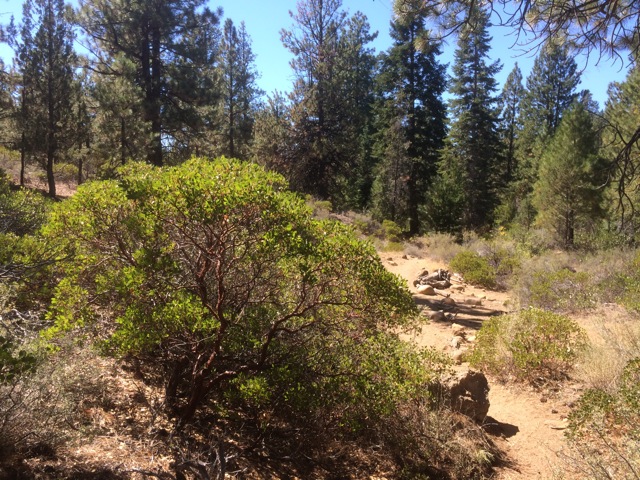
Arctostaphylos patula growing on site near Whychus Creek south of Sisters, OR.  Here it is 5' tall growing in a mixed condifer forest along with Doug Fir, Grand Fir, Noble Fir, Ponderosa Pine and Western Juniper.

Arctostaphylos patula growing on site near Whychus Creek south of Sisters, OR. Here it is 5′ tall growing in a mixed condifer forest along with Doug Fir, Grand Fir, Noble Fir, Ponderosa Pine and Western Juniper.

Outside our breakfast window, when I was a kid, was an Arctostaphylos patula. I never thought that much of it at the time, and how unusual it was, that sometime, probably by the late ‘40’s or early ‘50’s, somebody had dug one up and transplanted it to our yard in Redmond. They are denizens of the eastside Ponderosa Pine forest ecotone not the Sagebrush ecotone where I grew up. We averaged less then 10” of precipitation a year, too dry (For those who don’t know Redmond, OR, lies wholly within Oregon’s High Desert country that puts it in USDA zone 6b, -5 to 0 F). It grew in this little jog of the house facing northwest. I’m sure it got overspray from when we dragged hoses and sprinklers around to keep the lawn green, which is probably why it had grown with some vigor, having a form that you wouldn’t see in the Ponderosa – Juniper transition band sixteen to twenty miles away. In my memory it was always clean, with bright green foliage, part of which can be attributed to the low desert humidity and our sandy soil. I wish it was still there to take a picture, but the house has sold several times and had ‘improvements’ to the structure and the landscape including an irrigation system. I don’t know whether it rotted out or they removed it for one of their remodel projects. In its day it was 6’ high x 7’-8’ across with the characteristic sinewy branches and smooth peeling red bark.

Continue reading

Whychus Canyon Preserve

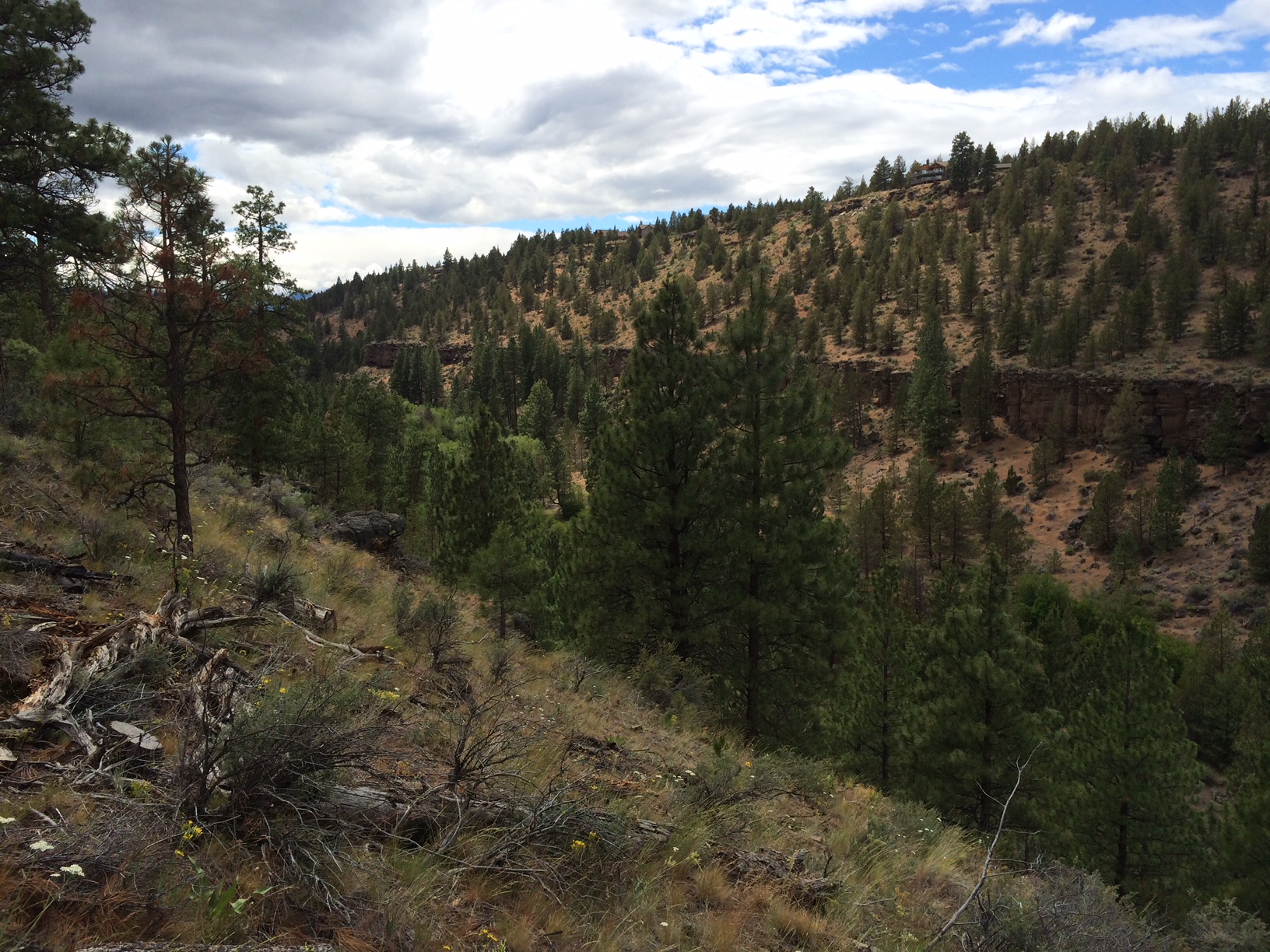
IMG_0062Whychus Creek starts up in the Three Creeks area south of Sisters, OR, below Broken Top and the Three Sisters, and runs north-easterly to where it joins the Deschutes River winding much of the way through a canyon carved through basalt.  It’s a beautiful band of green cutting its way through the Juniper – Sagebrush Scrub country where I grew up.  I’d never been to the Preserve before and was happy to see it mostly intact.  Though development has been creeping up along some of its edges the Preserve is being actively managed by the Deschutes Land Trust these days.  We hiked it on June 26 and many plants  were still in bloom.  Many people from the wet side of the Cascades have never developed an appreciation for the starkness of Oregon’s High Desert country.  Julie and I both grew up over here and where some people see barreness we see country defined by its sky, its geology and the spaces in between that set off the unique character of everything that lives here.  We took this hike with long time friends, Robert and Elayne, who stayed in Bend when we and others left.

Continue reading

Landscape and Culture: Redefining the Urban Landscape – Single Use Corridors – Railroads

R x R below Division St. and 9th

R x R below Division St. and 7th

Landscape, is a human concept. It is more than simply a place, or the land that we occupy. Land becomes landscape when it passes through the lens of our eyes and we ascribe to it not only our own values and emotions, but also the value and emotions of the culture we share as members of this society. Just as we are shaped by the laws and culture of our society so to is the landscape. Without, sometimes, considerable conscious effort we cannot see the landscape free of this ‘cultural looking-glass’. As individuals I don’t think it’s ever possible to look at the landscape neutrally, though over time, our experiences can change us, and so, also, how we value and view the landscape. This is important if we ever want to change our relationship with the landscape we live in, if our role as an actor in the landscape is to change, if we are to, individually and collectively, become responsible stewards of the places within which we live…because it is one thing to say we are good stewards and something else entirely to actually be one.

People continue to be drawn here to the landscape of the Pacific Northwest. We all have our favorite places that hold us, and, unfortunately, over time, can come to sadden us as we see them degraded and homogenized by the momentum of our culture, the economic engine we all depend on, that is still systematically converting our landscape into one that can be found almost anywhere with the exception sometimes of a geography too expensive to alter. Even climate, we are beginning to realize, is within our ability to change, though we are finding, such changes are likely beyond our control. Continue reading

Photosynthesis Types: C3, C4 and CAM a simple overview

If you’re curious I found a relatively simple, not too technical, overview on-line titled: 

Photosynthesis – An Overview

There are 3 basic types of photosynthesis:  C3, C4, and CAM.  Each has advantages and disadvantages for plants living in different habitats.

Check it out at: http://www.marietta.edu/~biol/biomes/photosynthesis.htm

The bulk of plant species, around 90%, utilize C3, while C4 plants comprise 3% (7,600) of all plant species, but account for 30% of terrestrial carbon fixation.  46% of the Grass Family are C4s, including Corn, Sugar Cane, Millet and Sorgum.  They make up 61% of all C4 plants.  Most C4s are monocots, obviously.  Among the dicots are many species from the Aster, Brassica, Amaranth and Euphorbia families.

C4 plants have a competitive advantage over C3 plants when grown under higher temperature conditions, 30+ C (C4 plants are concentrated in the tropics and sub-tropics where temps are higher), with lower available nitrogen and drought.  With moderate temperatures, available N and water, C3 has the advantage.  CAM have the greatest advantage under desert conditions.

Among other things scientists are trying to engineer Rice, a C3 plant, into a C4 plant, increasing yields and lowering their water requirements for growth.  Rice is the most commonly consumed food plant in the world.

Crassulacean Miracles

Some of my CAM plants: back, Agave colorata, A. americana Medio-Picta; middle, Hechtia 'Texas Red' w/ Sedum 'Anglina', Agave gentryi 'Jaws', Puya venusta, Aloe (?); front, Puya chiliense, Dyckia 'Big Red', Senecio mandraliscae and Agave parryi 'Cream Sickle'

Some of my CAM plants: back, Agave colorata, A. americana Medio-Picta; middle, Hechtia texensis’ Big Red’ w/ Sedum ‘Angelina’, Agave gentryi ‘Jaws’, Puya venusta, Aloe (?); front, Puya chiliensis, Dyckia ‘Red Devil’, Senecio mandraliscae and Agave parryi ‘Cream Spike’

Plants for me are little windows into the working of the world. Beautiful, exotic, grand or seemingly simplistic, perfectly attuned to their place. We are simple animals ourselves our attentions grabbed and later lost by what shimmers and glitters in our minds for a moment. We look, but only partially see. Each plant is an opportunity, maybe a lesson and later forgotten by most of us, unaware that there is anything there to learn beyond our initial attraction to the physical plant itself. The unrolling of a leaf of Liriodendron, like a flag, happening 10 thousand times on one tree, each year across the span of its years, for generations for millions of years. The perfectly memorized pattern of the single enormous leaf of an Amorphophallus as it stretches up out of its corm, fully formed, each leaflet revealed as a piece, entire, not expanding through a growing tip, adding tissue, but revealing itself wholly if we watch. Each plant a miracle to all but the blind.

I was reading an article on UBC’s botany photo of the day site, on Crassula ovata (Jade Plant). It is one of the most common of the Crassula species in South Africa growing on sandy loam soils, with around 12”-18” of rain as part of what some call the ‘Albany Thicket’. Continue reading

Dispatches from Bend, OR

I’m over here in Bend for the Labor Day weekend doing family stuff, visiting my dad and Julie’s parents…dealing.  I worked my way through the first draft of an article/posting on everyone’s favorite Manzanita, isn’t it, Arctostaphylos patula, with a sustainable landscape spin.  I met two old friends at the 6th Annual Little Woody, a celebration of beers aged in barrels, mostly bourbon or wine, 24 breweries with 40 decisions to make.  Needless to say they got easier as we worked our way around.  If you’re a beer snob and like to wow your friends with talk of original and final gravity, A.B.V. and what the right balance of I.B.U.s might be, this is for you.  It’s still a modest sized crowd that attends.  Don’t expect pints, just good beer, with a twist and extra ooomph!

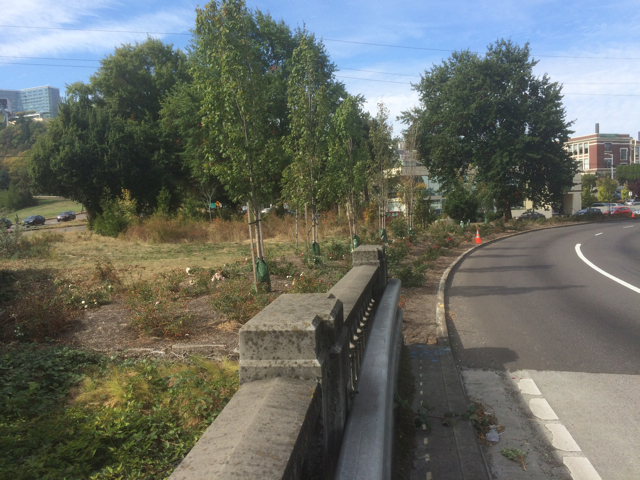
Today, though I’m between things and went for a walk with plants in mind, Arctostaphylos foremost, and set out to look a little closer at some of Bend’s more public ‘scapes, in their roadways not their Parks.  Bend is known for its ubiquitous and proliferating traffic circles so I checked this one out on SW 14th, on Bend’s westside.  They are all planted from a native palette.  A couple of bronze deer were curious what I was doing.  The light was glaring and my pictures less than I had hoped.

After that I was cutting through some commercial spaces on my way to check out Bend’s newest booze joint, Back Drop Distilling, it’s sharing space with Good Life Brewing, but the sign says they won’t be open until sometime later this fall, when I saw these Rhamnus frangula ‘Asplenifolia’ at a little US Bank branch office.   Continue reading

Katsuras as Street Trees: picking the right tree

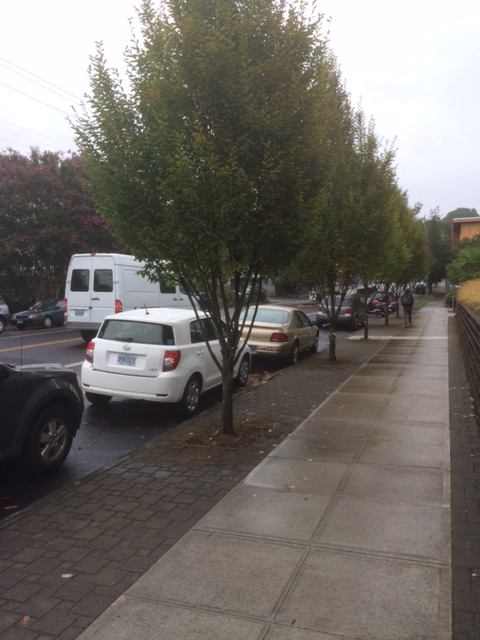
photo 1

Sometimes it pains me to take walks.  I was on my way home from the Imperial Bottle Shop and Tap Room, walking down SE 26th south of Powell Blvd when I came across these four Katsura trees planted in a 4′ wide parking strip, no curb parking with a painted bike lane right next to the curb.  Katsura trees 24″ from the bike lane.  How is that going to work?  Trees grow.  Branches extend and caliper up.  Branches hit bicyclists and pedestrians in the face and people crash and or break branches. (Yes, I know these can be limbed up over time but we all know how often that doesn’t happen and what are these trees going to look like if all of the branches are cut off of the street side up to 14′ for traffic clearance.  Trucks regularly use this street.)  And then there’s the whole it’s just the wrong plant for the growing conditions thing.  Katsuras grow in the mixed woodlands of Japan with moderate temps and summer rainfall.  So that looks like 3 strikes out of 4 pitches.  Landscape architects still love these…so do I, but planting them in positions with reflected heat with limited root runs through compacted mineral soils!!!! It’s 90 degrees today, their foliage is stressed even with their water bags filled around their bases.  I have seen many more bad examples of Katsura use over the last 25 years than i’ve seen appropriate.  If you’re going to plant them plant them in a woodland or along the edge where they will be protected from intense direct  sun and make sure they have a long cool root run.  This is so wrong.  Now we’ll all have to watch these limp along getting by stressing until they die or become so damaged someone removes them. Continue reading

Drought Tolerant Plantings: A Review of Riverplace and South Waterfront, Summer ‘12 (updated Aug. ’14)


Riverplace Esplanade Bank looking south along the Marina toward the Marquam Bridge

Riverplace Esplanade Bank looking south along the Marina toward the Marquam Bridge.  My last big xeriscape experiment.

The following is an evaluation I initially did while still working for Portland Parks and Recreation.  I’ve edited it a bit and added a few things to make it more current.  I think it’s important for people to know what others are doing, what they’ve tried and what were the successes and failures.  While kind of long it is still a brief look at the conditions on a few sites that were under my care and my observations concerning their performance.  As Downtown area Parks these landscapes are very accessible for those curious to see how these plants have done on the ground.  Now, most of you if your gardening is limited to your own backyards will never have to deal with landscapes so large, nor will your growing conditions, specifically your soil, be the same, I thought that it would be interesting to share this anyway, in addition to letting you know where you can come see how these plants can look in a landscape.  All were planted small as they tend to better adapt to their sites when small, but some are beginning to mature and show what they can do.  Anyway, I view our Parks as a public asset.  There are many valuable and important plantings around us, that the public is largely unaware of.  Part of my role here is to change this situation through promotions like this and by continuing to work with horticulturist to create some kind of database of public and private plantings that is accessible for viewing by the general public. Continue reading