Author Archives: gardenriots

Unknown's avatar

About gardenriots

I'm a horticulturist with 35 years experience primarily in the maintenance and management of public landscapes and gardens, including, renovation, construction, planting design, doing horticultural reviews of capital projects and creating and implementing maintenance plans that recognize the dynamic nature of these places. I have a strong interest in sustainable/ xeric landscapes and view the landscape as an opportunity to create places of beauty in an all too often utilitarian urban world while at the same time using them as a teaching tool for the public and peers. I recently retired from Portland Parks and Recreation where I was responsible for many of our downtown landscapes for 16 years. I have a degree in ornamental horticulture and a life long interest in science, beginning when I was ten or eleven with astronomy. I became fascinated by physics and the paradoxes and conundrums theory left us with in the '60's. I moved on from this to an avid interest in nature, biology and the living world around me in Central Oregon. I did not find a mentor so instead spent many hours by myself exploring and wondering and became largely self-taught, a pattern that has continued through my adulthood. Some of my postings are a direct result of my curiosity and are a result of my learning style, submersing myself in a topic that interests me, generally related to a plant I have grown and then building a fuller understanding of what is going on. Topics as diverse as general evolution to quantum biology and learning the biogeography of regions from which my plants come are continuously fascinating to me. These interests can become consuming 'rabbit holes' for me taking me places my wife does not understand. The world to me is a beautiful, fascinating place filled with puzzles to be understood and thereby more fully appreciated.

Puya mirabilis: Flowering, Place and Choice, The Wonder and Magic of Gardening

IMG_9010

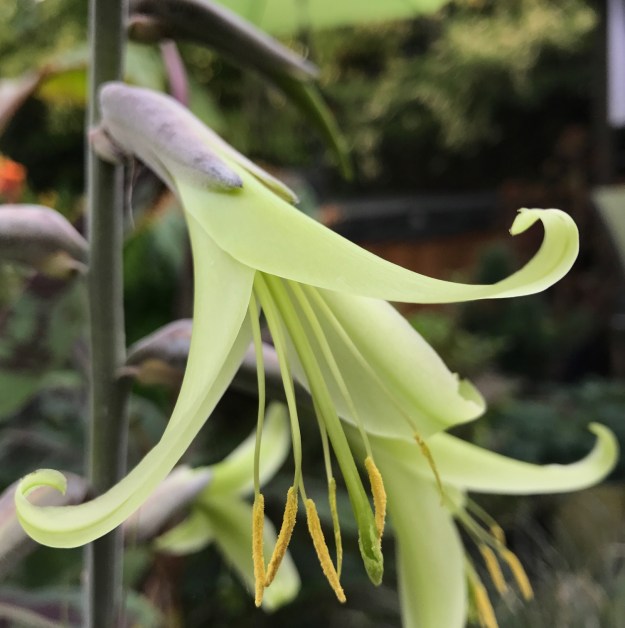
Sunday night our son and his girl friend came over for dinner on the deck.  The week long heat wave had passed and it was another very comfortable evening outside.  They had been at the beach attending a wedding the day before, Julie’s birthday.  When they first arrived, because I can be a bit obsessive, I noticed that the still tightly ‘rolled’ petals in the extending flowers on my Puya mirabilis were ever so slightly beginning to curl back and open.  It was one of those times I wished I had a camera to set up to do a time lapse series, but I don’t.  Regardless, within 2 hours the five lowest flowers were completely opened with stamen and styles fully extended beyond the corolla. Continue reading

The Opposite of Freezing: Plants Have Upper Limits Too

It’s Sunday, July 30 [2017], and 87º outside, our forecasted high.  We’re at the front end of a forecast that is calling for two days over our record highest temperature ever recorded in Portland.  I’m looking at it now, Monday, the 31st calls for 92º, August 1 for 99º, 108º, a record, on the 2nd, 110º, another record, on the 3rd, before ‘cooling’ to 105º on the 4th and 95º the next day.  Our average high for this time of year is 82º.  The current record is 107º set on Aug. 8, ’81 and matched on Aug. 10, ’81.  That may not seem that high to people in the SW, but it is here and here is what matters.  Temperature is a local phenomenon.  It’s okay if we whine about it.  It’s hotter than we’re used to.  Hotter than what the local native flora and fauna are ‘used’ to.  For native species it’s not just about preferences, though we may use that word when we talk about their requirements and limits.   Continue reading

Bromeliaceae and Dangerous Plants: Adaptation, Climate Change and Gardening in Portland

IMG_5555

I don’t know what this Bromeliad is, but it is statuesque, the inflorescence reaching well above my head. I took this shot next to Burl’s ‘chateau’ at Rare Plant Research just south of Oregon City. He moves a lot of tropical exotics in and out of his greenhouses every year. This is what a lot of people think of when they picture a Bromeliad.

I awaken and come down stairs at about 7:00 am…it’s a warm 66ºF outside.  I was up late last night, until after 12:00 am, keeping the air flowing through downstairs in an attempt to cool the house.  This is on the warm side for us here in the summer.  On rare occasions our lows can drop to as high as the low 70’s…such temps tend to occur more frequently in more recent years when ‘heat lows’ settle in around us and we suffer through ‘heat alerts’, whenthe air stagnates and turns ‘brown’ and we can become caught in one of those cycles of days where our highs remain in the upper 90’s and low 100’s.  Our all time record high of 107º, in August of 1981, was during such a cycle that I had the privilege of experiencing as I was here in Portland visiting a friend and attending my brother’s wedding.  On the 6th it hit 99º.   The high rose the next day to 102º, 105º on the 8th, 104º the next, 107º on the 10th, the humidity at 15%, then cooling to 97º on the 11th.  I remember taking turns trying to cool ourselves, without any air conditioning, submerging in a tub of tepid bath water, Continue reading

On Amelanchier / Serviceberries: Their Susceptibility to Rust and Their Use in our Gardens

Sometimes we are drawn to plants by memories and sentiment, plants we have early associations with.  They can regularly appear in our palette, our quiver of plants, that we might choose from.  We all have our preferences, our biases.  Sometimes the mismatch might only be aesthetic other times it can be a problem related to our site conditions.  When we include these plants they may struggle, yet persist in the garden, maybe demonstrating to others their ‘ill-fit’.  When a plant is a poor fit, its inclusion can become a glaring error to others that we are blinded to.  Diseases can present such a problem, diseases that can be problematic in our area, or that our site is simply unfortunate enough to suffer from.  ‘Rust’ diseases,  Gymnosporangium spp., can be an issue here.  In the case of Serviceberries, it can be disfiguring and debilitating.  Several of these species attack Rose Family members, that include the Serviceberries, which seem particularly susceptible, though it doesn’t kill them.  Diseased, stunted and suffering, unwilling to just die and put us both out of our misery, these plants continue.  It is akin to being drawn to the wrong lover or life partner…it’s not going to work out and we simply can’t seem to help ourselves. Continue reading

What to do about Bamboo?

[Please note that I wrote this in 2004 as an article in the HPSO Bulletin.  A recent FB posting has prompted me to revive/revise and repost it here.]

My first significant relationship with a bamboo,15 years ago, (this was the summer of ’89 when we moved into our current home) was a fatal one.  Phyllostachys aurea, Golden Bamboo.  I had heard all of the usual stories, yards lost, asphalt heaved and cracked, good neighbors gone bad.  Our new house confronted me with several problems, that I knew would get worse if I put them off.  It was another example of a homeowner picking the wrong plant for a screen, or failing to take the precautions to contain it.  With my limited knowledge and biases I had no doubt about what I needed to do.  I got my shovel and chased every rhizome down.  I was thorough and a good hunter, none survived. Continue reading

What is a Species?

Specious (?) Speculations on Species 

IMG_8181.jpg

Iris x pacifica ‘Tanus’.  This is a hybrid Iris of species know collectively as series ‘californicae’, a group of Iris endemic to the Pacific coast of the US, primarily California, some very localized, with several occurring north through Oregon, and one, I. tenax, all of the way to the Puget Sound area of Washington.  These species obviously can be crossed.  Their form shows the distinctive tri-partite structure of a classic Monocot, in Genus Iris taking this particular form with 3 ‘falls’, 3 stamen and stigma structures angling out from the ovary at center, across the brightly colored ‘signal’ on each fall and the 3 more upright ‘standards’.

I do not recall from high school biology how an individual species was defined to us in our text or class, nor do I in my college Zoology 200 series.  All that I have is a general understanding that it is a select population with a shared, narrow, range of physical characteristics, in the case of plants, best determined by their floral or reproductive parts, that is able to reproduce stable offspring with the same range of characteristics.  Webster’s defines species as:

“a category of biological classification ranking immediately below the genus or subgenus, comprising related organisms or populations potentially capable of interbreeding, and being designated by a binomial that consists of the name of a genus followed by a Latin or latinized uncapitalized noun or adjective agreeing grammatically with the genus name” Continue reading

Palms, Bananas, All Monocots…Oh My! Their Similarities and the Differences that Distinguish Them From Dicots…and why this should matter to you!

DSCN5323

I use a lot of Monocots in my garden, among them in this picture are the Colocasia esculenta ‘Black Magic’ with its huge dark velvety heart shaped leaves, Arundo donax ‘Variegata’, the Giant Reed, whose clasping leaves show us that this is a grass not a bamboo and the white speckled, green, heart shaped leaves of my Zantedeschia x elliotiana ‘Flame’ just behind the reaching stem of Arundo.

Many gardeners are self taught and haven’t formally learned Botany, the science that helps us understand plants in a more formal, academic way, though they may be excellent ‘gardeners’ in terms of their growing of plants.  Botany provides a pathway toward the understanding that many of us crave, that for others is an unwanted burden..they are happy with the doing.  For them the task of learning botanical latin, binomial nomenclature and the classification system by which we organize and study the various species, understand their structure, development and common history…is of less interest.  No doubt a good many fall somewhere in the middle.  I have always been among the more curious ones with regards to this. Continue reading

This Life: A Memoir, Gambol and Botananomical Tale

Sharpless 249 and the Jellyfish Nebula Image Credit & Copyright: Eric Coles

Sharpless 249 and the Jellyfish Nebula, Image Credit & Copyright: Eric Coles

I hope that you will forgive me this departure into verse, prose, whatever this is…another thread in my life.  I don’t think it is too far amiss, because, after all, horticulture is the ‘art’ and science of growing plants.  Originally I began this as an idea for a children’s story, yes I did, the life of a particular Dandelion, but, probably due to my more recent reading on topics like photosynthesis, cellular metabolism and a biophysics response to the question of, ‘What is life?’…it has morphed…considerably.  When you read this, keep in mind that my intention was to write from the perspective of the Dandelion, a concept pretty incomprehensible to a modern American. 

The Taraxacum Cycle

Stories all begin with a single word, a seed, around which they grow, nurtured over time by the things we all share in common, family, history and experience.  They contain ‘truth’, but are not themselves true, because they must be told in such a way that they lure the reader in and are ‘believable’.  They are organic and grow within us and to the extent that they reflect our own ‘story’, that they meet our expectations, we stay with them and them with us, because there is no story if it is forgotten.  So, the author must manipulate what he knows, he must ‘lie’, to bring you in and keep you, weave truth and lie into a whole.  We take the stories you already know and introduce our own characters, set them in exotic though familiar settings, and, if a writer is good, introduce enough, but not too much, that is ‘new’, different from your cultural experience, your expectation, that you are affected by its unfolding, that you become a part of the story and look at your world in a different way, even if only a little bit.  The word here is Taraxacum. Continue reading

Manzanita, Rock Roses and Friends: The Strength to Stand

Choosing the right plant is not an easy process.  We pick a design theme, make sure our plant choices are a good match for our site conditions, are compatible with their ‘bedmates’ and won’t become overly burdensome, in terms of the maintenance we are able and willing to perform.  There are a lot of variables here.  Our expectations of how a plant performs in the landscape, as individuals and as a composition, are important as we assess their performance over time and decide how we will respond to them.  Many of us are attempting to create gardens that require less of us in terms of maintenance, that fit the conditions on the ground with minimal intervention on our part.  We may chose to create a xeric garden to minimize or even eliminate supplemental irrigation.  If we do, the plant choices we make, their spacing, the size of plants we purchase, even the timing of the planting and the soil prep we do, are all important in our success or failure.  While we attempt to keep our specific site conditions and our goals in mind, we need to be prepared for the extremes of conditions, like weather, that can occur occasionally, even if only once every several years.   Continue reading

The Strength to Stand: Surviving the Load of Ice and Snow in Portland

img_7484

The morning after the big snow along the front of my house. To the left, splayed out and weighted down, is my Butia capitata. This one, from Argentina and not used to snow, had me worried, but it sprung back. The Oleander to the right, next to the sign, was bent down to the ground from its 8’+. Further back is one of my Chinese Windmill Palms, Trachycarpus fortuneii, bent under a snow load it is used to from high in the mountains of southern China.

Many of us who garden in the Pacific Northwest, and especially those of us in Portland this year, will be visiting our garden centers and favorite nurseries this spring and summer with a little more anxiety and need as we look for plants to replace those that have succumbed to this winter’s cold, ice and snow loads, all of which were more severe than what we have come to expect here.  But before we pull on our boots and don our rain gear to head off for shopping there are several questions that we need to consider before we make our purchases.  Not all of us draw up plant lists, but most of us at least carry in our heads a wish list of plants we have seen in other gardens, in magazine spreads and while on vacations, but if we want to avoid some major mistakes and move our gardens toward the kind of landscapes that we really want, we are going to have to put on our reality goggles and critically assess our choices…that is, if we want to avoid unnecessary losses in the future. Continue reading