Category Archives: Xeric

The Lower Deschutes River: the Incursion of Invasive Plants and our Failure to Responsibly Maintain Native Plant Communities

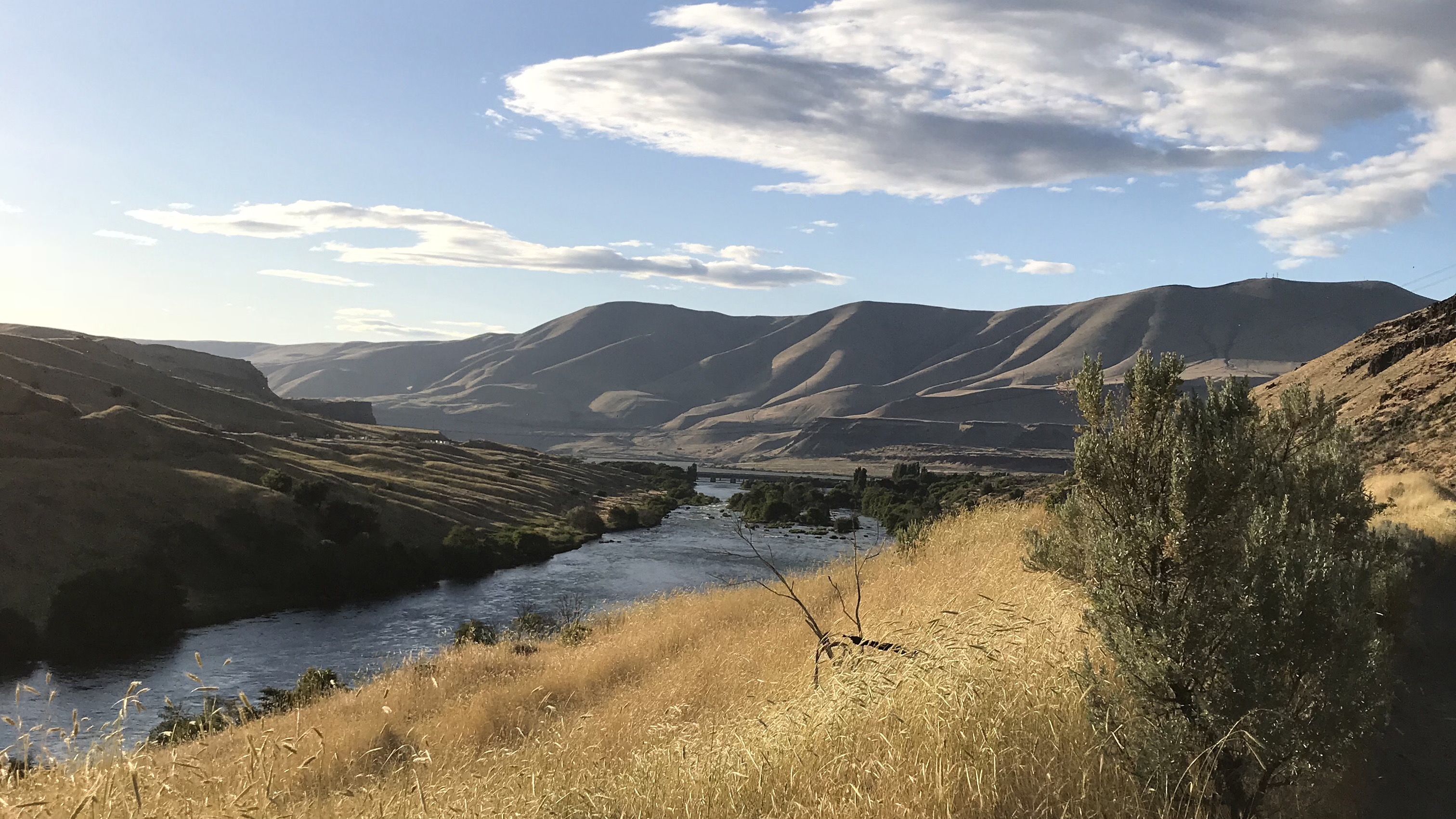
This picture should give anyone more than enough reason to visit here, the Deschutes sliding out its mouth into the Columbia with the Washington side of the Gorge in the distance, the low angled early evening sun illuminating everything sharply.


[As I go over this post yet again, July 21, the 80,000 acre Substation Fire is still burning across canyon and wheat country here.  Included in the blaze are the 20 miles of the Lower Deschutes canyon down to the campground at the confluence with the Columbia.  Much of this burned down to within 2′ or 3′ of the riverbank including the historic Harris Ranch buildings.  So, when you look at all of these pictures, with the exceptions of where the fire hopped and skipped, everything is charred.  The Oregon Wildlife Federation, formed in the 1980’s to purchase and protect this portion of the canyon, has stepped up with $100,000 to help the area recover.  It will take considerably more especially if there is any intention of making headway regarding the spreading invasives problem.]

[Now, another 2 weeks later more massive fires continue to burn across the dried up West that has just experienced another record breaking month of heat, while the president goes on ‘bleating’ and blaming it on our ‘bad’ environmental laws and all of the water we’re diverting into the ocean!  ‘F’ing! moron!]

The last time we came here was eight years ago in December.  My memory of then is much like the experience on this evening…only it was clear and cold.  The light was similar except that then the low angled sun was due to winter, with that season’s urgency, not a late Spring evening like this outing.  This time it is warm, camp is comfortable and nearby and the greens are still gathered around the river and the still moist draws and seeps.  On that day we’d gone to Hood River for my birthday, to get out of town and there was a break in the weather so we drove here to these trails at the mouth of the Deschutes, hiked along the river, returning on the upper springs trail.  Winter or summer, green only sticks around a little longer than we do, before it retreats…life is shier here, tough, but shy.  The starkness of this landscape should be read as a warning to visitors, this is no easy Eden.  Life is earned here or at least requires a strength, patience and frugality that many don’t have.  This is much the same for people as it is for wildlife and plants.   Them that don’t, can’t.  That’s why it may be surprising to some that such a place has a problem with exotic invaders.  What could possibly look on places such as this as ‘favored’?  Well, Central Asia, especially its Steppe, with its continental, cold and dry climate containing many species that see such a place as this as home, or even better, without the competitors they faced back there.  The temperature can swing widely here on any given day while the seasonal extremes can vary as much as 125ºF from high to low.  Relatively few plants can thrive in this.  The dry summers with their very limited and sporadic thunder showers, combined with the ‘wet’ winters, total only 10″-12″ or so of precipitation, plus or minus, is another major limiting factor.  Of course, near the river, the moisture problem is moderated  and a broader range of invasives can find a ‘foothold’.  We, as a people, have ‘brought’ these weeds here with us in our travels, often as a result of our commerce.  Those that have made it here are spreading.  Too many prosper. Continue reading
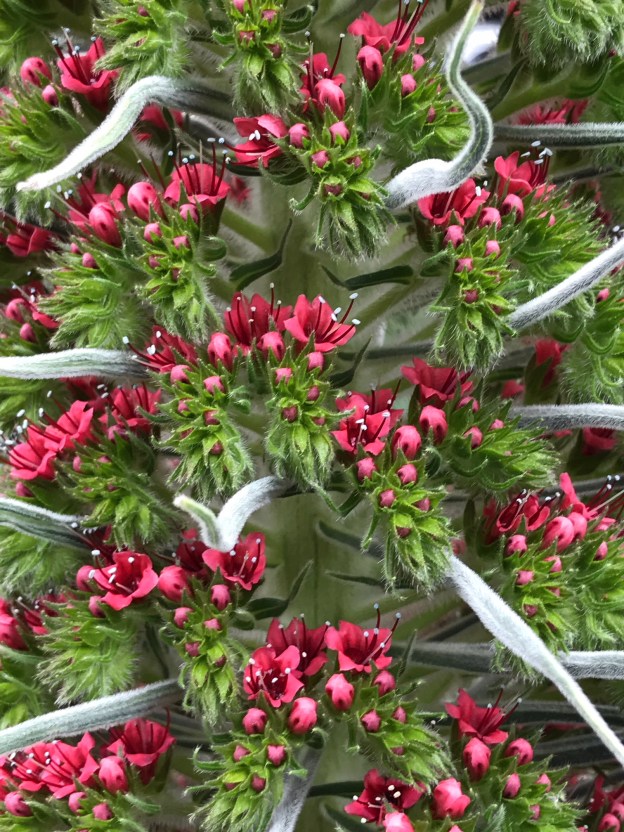
Echium wildpretii in Bloom

IMG_9915

This Canary Island native has a tougher winter climate here to endure than back home.  As an alpine growing on Tenerife, this plant is said to tolerate down to 20ºF with its characteristic dry winters…not so here.  After a relatively mild winter here in inner SE Portland the later half of February chilled down with a little snow as shown here on Feb. 22.  The official weather station at PDX recorded nine days at or below freezing in February ranging down to 23F on the 21st.  This was a fairly ‘normal’ February temperature wise for us, though with just less than 2″ of precipitation, about half of normal, which could have aided its survival.  At my location in inner SE we can record 5-6º warmer than PDX though we often move right in step,  January was milder PDX recording below freezing temperatures on only two dates, the first and second…and we were right around freezing both of those days with just under 5″ of rain for the month.  During December we were ‘blocked’ from lower temperatures that hit most of Portland.  PDX recorded 14 lows below freezing, we suffered only six getting as low as 25º on one of them.

Continue reading

Argyle Winery: A Look at a Landscape in Dundee as an Example for Those on the Trail to Xeric Design and Sustainability

IMG_9186

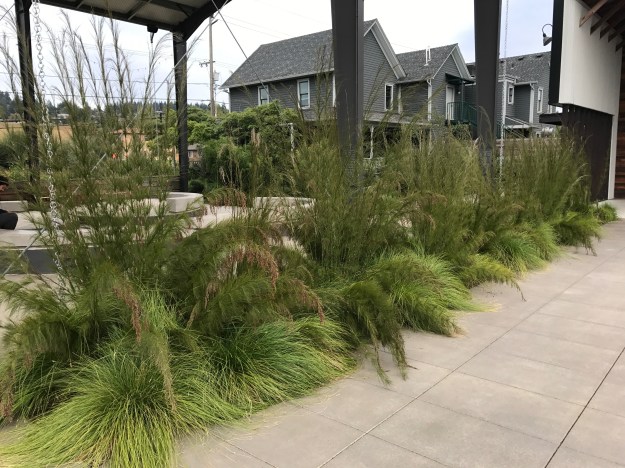
This strip planting dominated by a Carex and a taller, 7′ or better, spine of the feathery Rhodocoma capensis from South Africa, rated at zn 8b. Mine, in my home garden, survived two nights down to 15ºF this last January with very little damage.

I don’t usually do this, write about a particular landscape with which I have no history, so this is a bit of  a departure for me.  I’ve know Sean Hogan for quite a few years, consider him a friend and a highly influential mentor of sorts.  His encyclopedic knowledge of plants, his boundless enthusiasm, has been infectious and inspirational over much of my career as a horticulturist while I was working for Portland Parks and Recreation.  I’ve benefited from the existence of his nursery and his commitment to horticulture picking his brain for plant and design suggestions as I attempted to broaden my own repertoire. Continue reading

Manzanita, Rock Roses and Friends: The Strength to Stand

Choosing the right plant is not an easy process.  We pick a design theme, make sure our plant choices are a good match for our site conditions, are compatible with their ‘bedmates’ and won’t become overly burdensome, in terms of the maintenance we are able and willing to perform.  There are a lot of variables here.  Our expectations of how a plant performs in the landscape, as individuals and as a composition, are important as we assess their performance over time and decide how we will respond to them.  Many of us are attempting to create gardens that require less of us in terms of maintenance, that fit the conditions on the ground with minimal intervention on our part.  We may chose to create a xeric garden to minimize or even eliminate supplemental irrigation.  If we do, the plant choices we make, their spacing, the size of plants we purchase, even the timing of the planting and the soil prep we do, are all important in our success or failure.  While we attempt to keep our specific site conditions and our goals in mind, we need to be prepared for the extremes of conditions, like weather, that can occur occasionally, even if only once every several years.   Continue reading

Growing Agave in My Maritime NW Garden

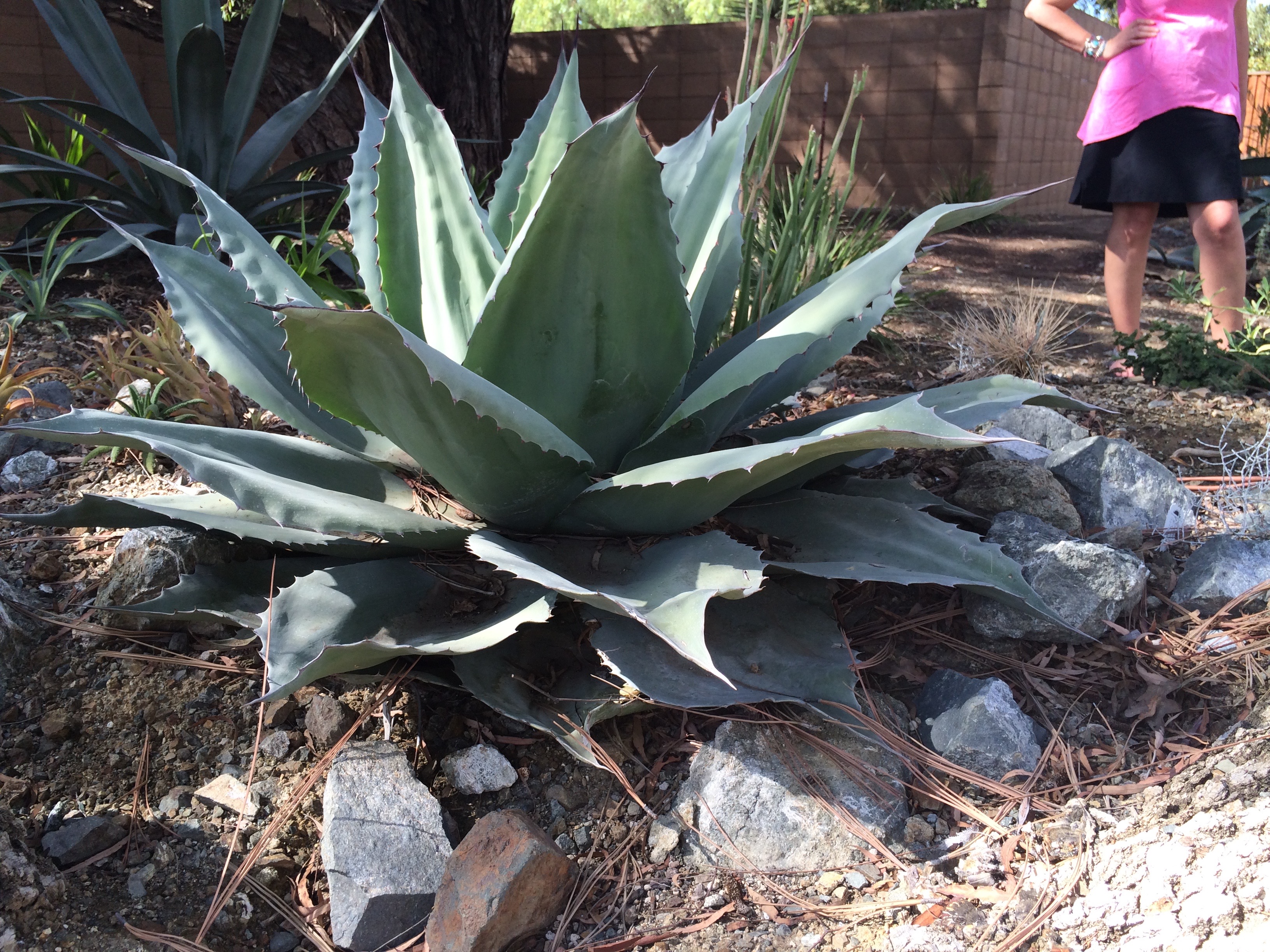
My picture, but not my plant. Alas! I just potted my start up to a 1gal purchased from Sean at Cistus. Agave ovatifolia 'Vanzie'. Several of these big beautiful cultivars are growing in the Bancroft Garden. It is distinguished from the species by its undulating longitudinal waves across the wide guttered leaves.

My picture, but not my plant. Alas! I just potted my start up to a 1gal purchased from Sean at Cistus. Agave ovatifolia ‘Vanzie’. Several of these big beautiful cultivars are growing in the Ruth Bancroft Garden, in Walnut Creek, CA.  We visited on a nice 80F+ day last October.  It is distinguished from the species by its undulating longitudinal waves across the wide guttered leaves.  Each leaf can be over 10″ across.

When we garden in the public view, and most of us do, at least where we front along the street, or even when we invite others into its more private and inner sanctum, and we grow plants successfully, people are going to ask you: ‘What’s that?’  ‘I didn’t know you could grow those here!’ and, ‘What did you do? they always die for me!’  In short, if you’re successful, people will regard you with respect and assign to you the attributes and position of ‘expert’…when all you did was try to follow the gardening maxim of ‘Right Plant, Right Place!’  In short, you tried not to kill it.  Genuine expertise requires broader experience, study even, that the simple buying and planting of one particular plant cannot earn you.  If you’re like me such easy success and adulation, can be embarrassing and often serves as a prompt, to look through books, search the internet and ask others, that you know who have way more practical growing experience than you yourself do, and gradually, the assignation of ‘expert’ feels a bit less flimsy, maybe even ‘earned’.  I often tell gardening friends that I consider myself to be more of a dilettante, flitting from one plant or group of plants to the next.  Inquisitiveness has always been a part of me and growing one Penstemon, one Banana or one Agave, never adequately ‘grounds’ me.  Grow a few more and I feel a little more comfortable with it.  Look into some of its ‘cousins’ and the particulars of where something grows, its climate and soils particularly, and I feel ‘better’, much like I did when I was preparing for mid-terms at school.  And then I move on, my interest sated for the time being, somewhat comfortable in what I know and curious about the next group.  Over time they all start forming a bigger picture out of what once seemed like a massive, unknowable puzzle and I enjoy solving puzzles.  Having said this, I still don’t consider myself to be an expert, just an avid and focused gardener. Continue reading

Iris x pacifica: Hybrids & Jewels of the West Coast

PCH Native Warrior w: Stachys Primrose Heron DSCN2479

Iris x pacifica ‘Native Warrior’ next to Stachys byzantina ‘Primrose Heron’  These Iris are very garden worthy and can combine beautifully with plants  with similar cultural requirements

(I wrote this several years ago for the HPSO Bulletin, when it was actually printed on paper, and thought re-issuing it today, edited and expanded, might be helpful to some as we are about to enter their flowering season.  The iris pictured on my Blog’s masthead is Iris x pacifica ‘Simply Wild’ poking out from the base of the Chilean shrub Fabiana imbricata ‘Violacea’)

Gardening is no more or less subject to the vagaries of fad and fashion than the other activities we dabble in.  Marketers prey on us luring us with plants possessing new and alluring characteristics, promises of larger flowers, more disease resistant, floriferous, more exotic or environmentally responsible, less maintenance intensive… the list goes on.  Gardening is a very personal endeavor and as such we will always be subject to such Siren calls.  There will be the righteous amongst us convinced of their own focused vision who seem to be immune (but what, we might ask, are they missing?) and there will be those who simply surrender completely to the beauty and bounty around them making themselves easy prey.  In the long run, who is to say who is right?   Our knowledge is imperfect and we are weak…. The act of gardening strengthens us, provides us with the opportunity to learn and in so doing puts us into relationship with the living world around us.  We become better gardeners capable of making better, though still imperfect, decisions.  Whether we garden to augment our own diets with what we grow or are trying our hand at healing a small piece of a damaged earth, or building a place of respite for ourselves and friends or trying to model ‘right’ behavior for our children and neighbors, we are out in our gardens and landscapes learning something of how incredibly complex this earth is…and that is all good. Continue reading

Manzanita, Arctostaphylos, a Genus Whose Time has Come: Advocating for a Plant

IMG_4669

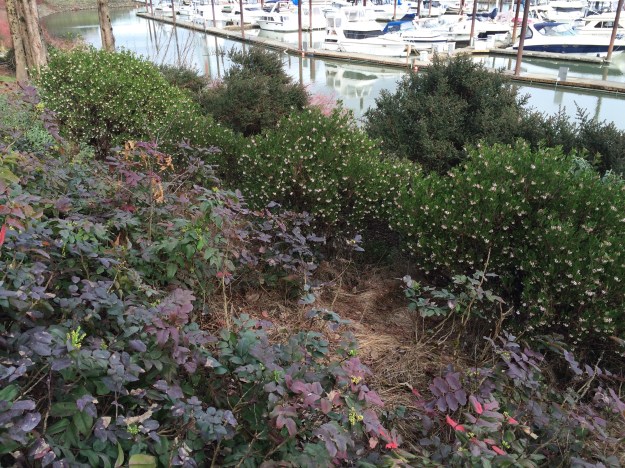
Many Arctostaphylos, like these A. densiflora ‘Howard McMinn’ make admirable landscape plants on xeric sites. This is above Riverplace Marina on the east facing bank of the Willamette in nutrient poor, compacted fill. It shares the site with Compact Oregon Grape and a variety of local dry site natives, Mediterraneans and Californians.

Thirty years ago, when I first moved here to the Portland area from the Central Oregon High Desert country, very few people were growing Manzanita.  Those plants that you did see were local natives that you had to search out, remanent populations of widely scattered stands, in western Oregon, in the Cascades, parts of the Gorge and Siskiyous or on old stabilized dunes above the beach, e.g., near Manzanita.  They were mostly ignored in the trade, barely recognized by anyone other than those in the Northwest native plant societies and hikers who would go out on forays botanizing. When I still lived in Bend, I would occasionally order dry-land native plants, like Cercocarpus, that could be seen in the Ochocos, from Forest Farm in southern Oregon.  My first two horticulture books, other than the many vegetable growing guides I bought from Rodale Press and Steve Solomon’s guide, were the Sunset Western Garden Guide and Arthur Kruckberg’s, “Gardening with Native Plants of the Pacific Northwest”…I went through them over and over again.  In the small space Kruckberg devoted to Manzanita he wrote, in the first paragraph, “Only Arctostaphylos uva-ursi…, A. nevadensis…and possibly A. patula are hardy in colder areas.”  Because I lived in one of these ‘colder areas’ this stayed with me, effecting my view of the genus.  I’ve already posted on A. patula, of it growing in Central Oregon, the eastern slopes of the Cascades and as a specimen outside of our breakfast window in my childhood home.  Other than A. columbiana, a denizen more of the western Cascade slopes and the high ground of the Coast Range, Kruckberg barely mentions the other species and forms…of which there are argued to be between 50 and 100, primarily in California and  southern Oregon.   Continue reading

Chilling, Freezing & Surviving: Understanding Hardiness & Preparing Your Plants for Winter

IMG_4248

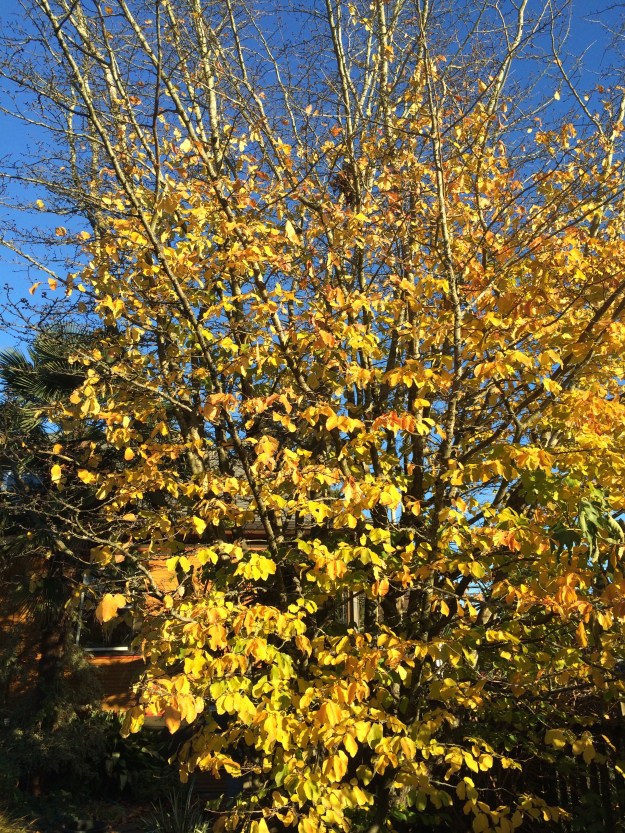
Parrotia persica, Persian Ironwood, has long been among my favorite trees, for its leaf shape, substance, fall color, the overall plant form and for its exfoliating puzzled bark. Hardy to zn4 this plant is tough as nails here requiring no protective effort at all.

[A note to the reader. This is not a scholarly treatment of all of the peer reviewed material on this topic.  There are no footnotes or listed sources.  This is a product of my more than 35 years of horticultural field experience and gardening along with what I’ve gleaned from reading several technical peer reviewed articles on the subject.  Such material is difficult to read and can be off putting and intimidating to even the educated layperson.  This posting is my attempt at interpreting the research and reviews that I read in a way I think is understandable without overwhelming the reader with bi0-chemistry and the technical esoterica scientists must consider in their pursuit of understanding.  Any faults are mine.]

I’ve been thinking about plants and their response to cold having watched the deciduous trees drop their leaves, dug tender plants out of the garden and moved pots around to where they would be adequately protected from freezing temperatures.  We all know what happens to water when it freezes, going from a liquid state to a solid one, its molecules forming crystalline structures, expanded and rigid, responsible for burst water pipes and snowflakes.  Water possesses some amazing qualities, as a solid, kind of counter-intuitively, it becomes less dense floating rather than sinking even taking on some insulative qualities and stopping the convective flow of heat that is normal in liquid water.  At the instant of freezing water releases a small but measurable amount of heat. What happens inside plants when temperatures drop below freezing? How does the plant keep from bursting its own cell walls like the water in pipes within an unheated crawl space or wall cavity of a building?  You’ve seen what happens to plants like Coleus and the sodden black heaps they become upon thawing out. Continue reading

Tri-Met’s Orange Line Landscapes: Clinton & SE 12th to Harold St.

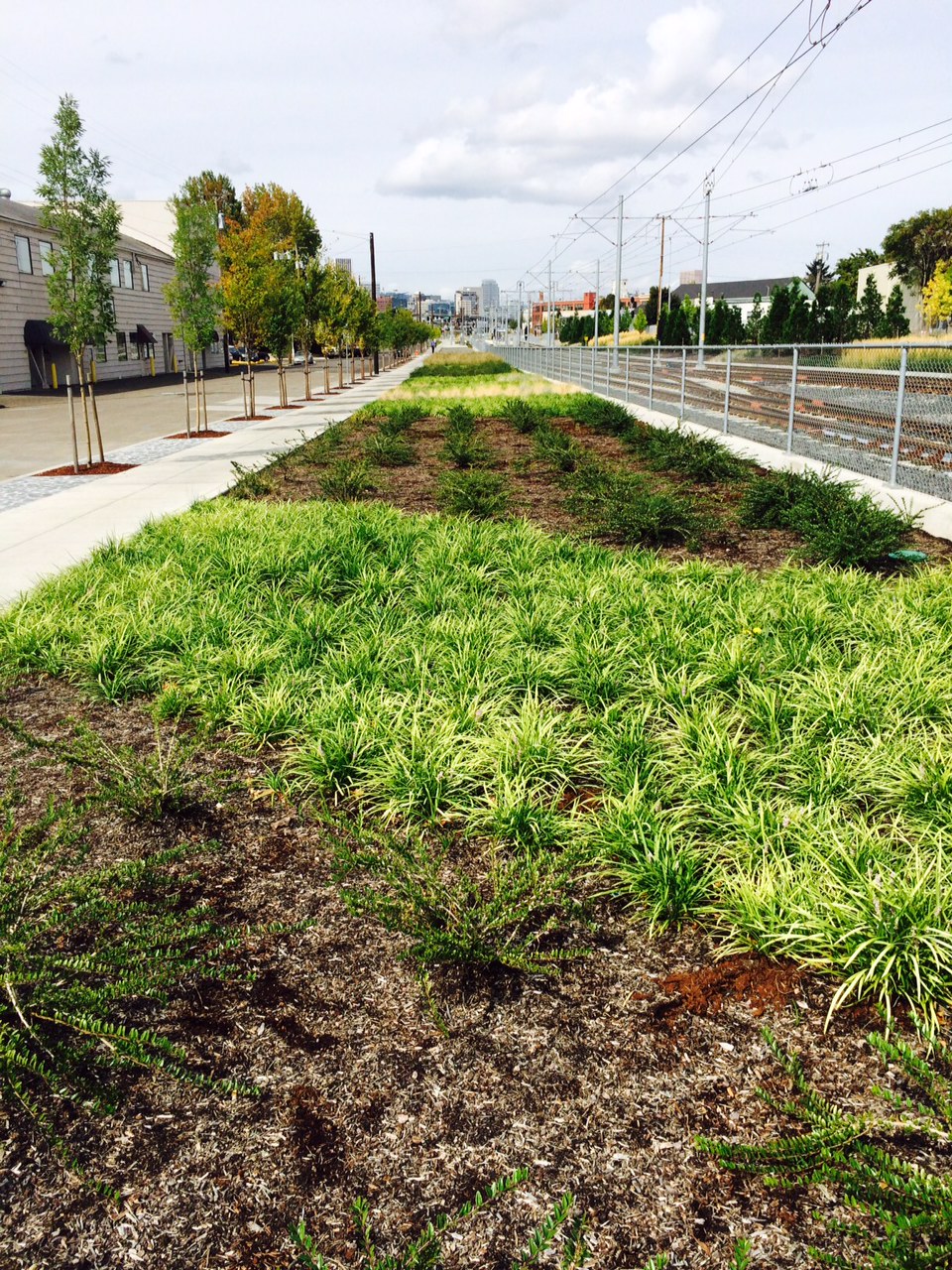
This shows the banded pattern common today in long mass plantings each swath a single species.

This shows the banded pattern common today in long mass plantings each swath a single species going for a kind of landscape scale ‘graphic’ pattern that is less concerned with ‘fit’.  This is near the Clinton/ SE 12th stop.

Size matters.  In horticulture it changes everything.  Things that are inconsequential, or maybe even enjoyable in the backyard garden, can quickly become daunting or onerous when the scale is ramped up.  Working at a commercial or institutional scale has to change your entire approach to the landscape.  In a small garden it is easier to accommodate mistakes, the conflicted combinations and those issues of horticultural ‘fit’ that we missed when we design or install.  Scale, however, rubs our faces in it everyday, makes us pay with aching backs as unintended consequences play out across the thousands of sq.ft. and acres.  It becomes a matter of physical survival and undermines your professionalism.  You become perforce part laborer, part diagnostician, designer, plantsman and critic….Out of necessity you sharpen your critical thinking skills and the last thing you ever wanted, your sales skills, as you work to sell your ideas to management who are absurdly ignorant of the problems you face everyday in the field.  And, then, eventually, you retire, but you don’t turn it off…you can’t.

Which brings me to the MAX Orange Line and its landscapes.  When I did horticultural design review for large capital Parks projects, it often felt like a dueling match.  I would pour over the design, whatever the stage it was in, match that with my particular knowledge of site conditions and my maintenance experience within Parks.  I would state my concerns on paper and in meetings with the Project Managers and Architects.  I was stubborn and consistently found myself up against a process that undervalued horticulture and my input.  Good horticultural practice was regularly placed in a losing position opposite not just that of the Landscape Architects but of a very political process that tried to give the public what it wanted as long as it fit within the Architect’s vision.  Horticulture always came out a poor third, even though good horticulture always saves money in the mid and long runs.  It was exasperating.  The public, by and large is ignorant of horticultural practice and no effort is made to educate them at any level. Continue reading

Revisiting Holgate Overpass: A Mistake Repeated

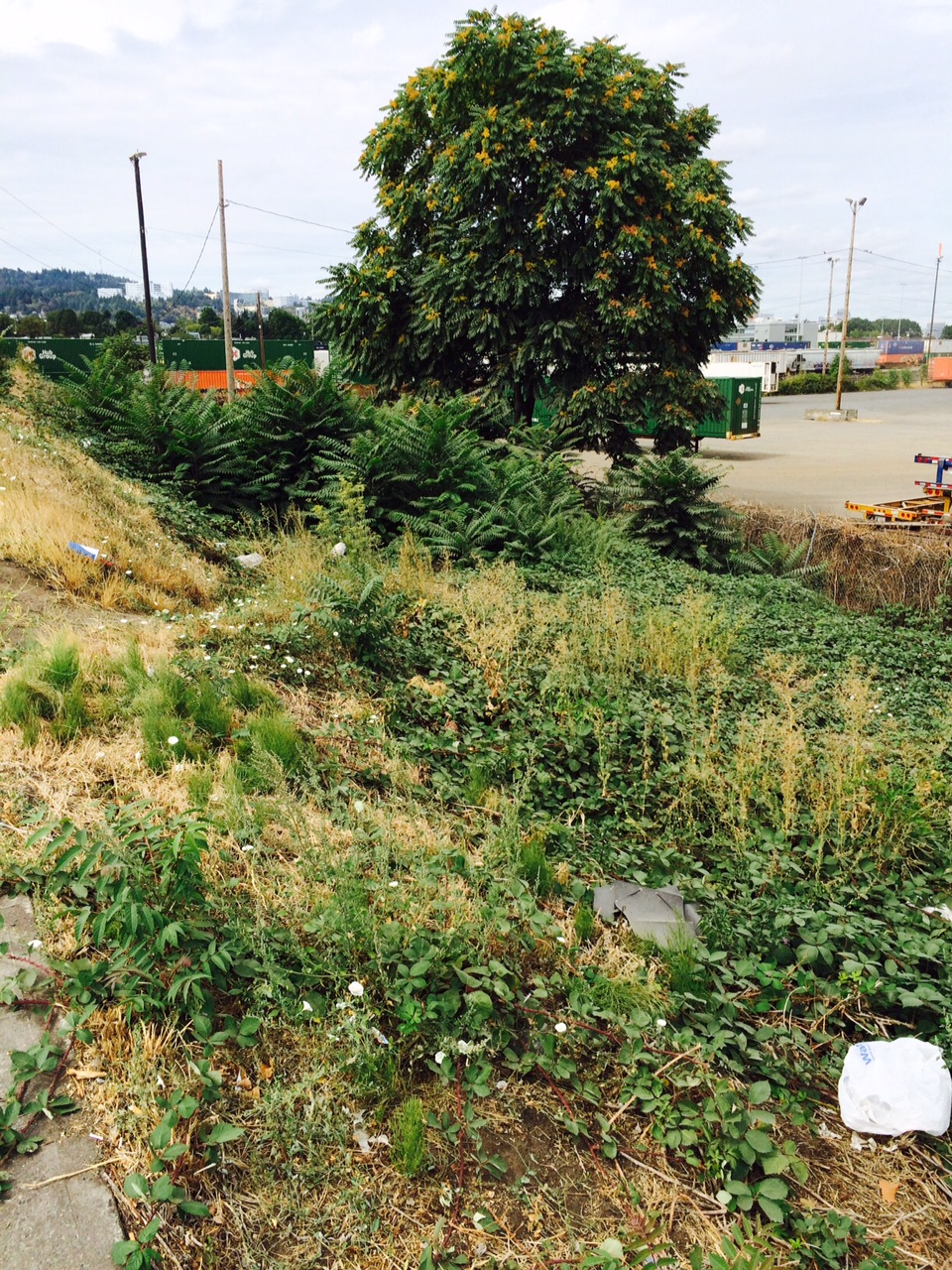
Holgate Overpass - the northeast approach. This was taken Aug. 28 of the landscape cut down in April showing regrowth in a hot drought year.

Holgate Overpass – the northeast approach. This was taken Aug. 28 of the landscape cut down in April showing regrowth in a hot drought year.

Holgate Overpass Update:

It finally rained this last weekend!  Somewhere around .3″.  Woohoo!  It will be the most rain that we’ve received since March.  It’s been dry!  In April the City cut down the ‘weedscape’ on the northeast approach of the Holgate Overpass.  It’s rained very little since and we’ve had record warm temperatures all summer.  No one has come back to spray, plant or do anything.  No one’s even picked up the trash.  If you compare the four ‘weedscapes’ on the two approaches they are very similar.  The NE, by volume has had the most regrowth.  This is for two different reasons: first, this site was cut earlier in the season when there was more moisture still in the soil to enable regrowth, and secondly, because the site is dominated by Blackberry and Tree of Heaven, both perennials, well established and of larger stature than the plants dominating the other approach landscapes. Continue reading